

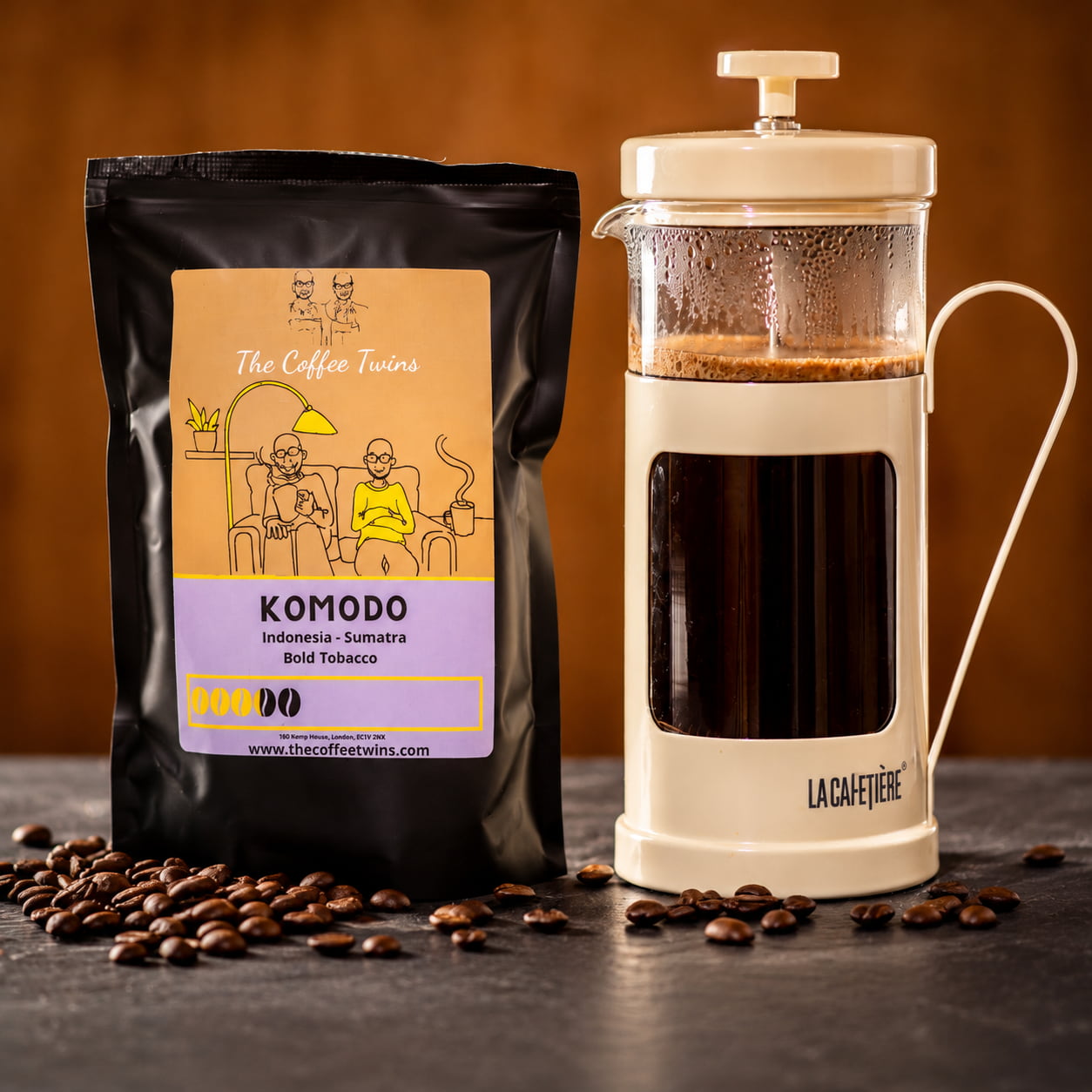
Quick answer: Indonesian coffee is famous for a heavy body, low acidity and earthy, spicy flavours such as cedar, tobacco and dark chocolate. That style comes largely from wet-hulling (giling basah), a local process that strips the parchment off while the beans are still wet. Most of the coffee grows on Sumatra, which holds about 60% of the country’s coffee land, according to the USDA’s May 2026 Coffee Annual. Even so, only around one bag in nine is arabica.
By The Coffee Twins (Jeremiah and Raja Wolstenholme) | Last reviewed 12 November 2026
Shop Komodo, our Sumatran single origin
Indonesia is one of the world’s biggest coffee producers, yet its arabicas taste like nothing else on the shelf. If African coffees have ever tasted too bright or sharp to you, a Sumatran cup is often the answer. This guide covers the main islands, the process behind the flavour and how to brew Indonesian coffee at home. Our Sumatran Komodo features too. We came up through five-star hotel food and beverage, so we judge coffee by how it tastes in the cup, both black and with milk.
What does Indonesian coffee taste like?
Indonesian coffee usually tastes full-bodied, low in acidity and earthy, with notes of cedar, spice, tobacco and dark chocolate. In other words, it sits at the opposite end of the scale from a bright, fruity Ethiopian. For example, an FAO project report on North Sumatran Mandheling coffee describes coffees with “a spicy flavour, complex, earthy body and low acidity”.
That said, not every bag tastes the same. Sumatra leans heaviest and most savoury, while Toraja coffee from Sulawesi is often sweeter and cleaner. If tasting notes are new to you, our guide to coffee tasting notes explains how to pick them out.
Where is Indonesian coffee grown?
A handful of islands supply most of the beans you will see in the UK. According to the USDA, arabica comes mainly from Aceh and North Sumatra, with smaller volumes from the highlands of Java, Sulawesi and Papua. Smallholders farming one or two hectares work about 98% of the country’s coffee land.
Sumatra
This island is the heart of Indonesian coffee. The south of the island grows mostly robusta, whereas the northern highlands around Gayo in Aceh and Lake Toba grow arabica. Lake Toba is the world’s largest volcanic crater lake, covering 1,100 square kilometres, and UNESCO named the Toba Caldera a Global Geopark in 2020. Meanwhile, Gayo arabica has been a registered Indonesian geographical indication since 2010, according to the Indonesian intellectual property office. These highland coffees are what most shops sell as Sumatra coffee beans.
Java
Few places are so tied to coffee that their name became slang for a cup. The Dutch first brought arabica to Indonesia in 1696. After floods killed those plants, a second shipment followed in 1699 and took root around Jakarta and West Java, according to the Indonesian Coffee Exporters Association (GAEKI). Today, Javanese arabica comes from highland areas such as the Ijen plateau in East Java, and Java Ijen-Raung arabica gained its own geographical indication in 2013.
Sulawesi
On Sulawesi, the Toraja highlands produce some of Indonesia’s most celebrated arabica. Perfect Daily Grind describes Toraja coffee as sweet and spiced, with a cleaner cup than many Sumatrans. It also notes that the rust-resistant S795 variety is common there. Kopi Arabika Toraja became a geographical indication in 2013.
Bali
Bali’s Kintamani highlands grow arabica alongside citrus trees. Farmers there organise through subak abians, traditional Balinese farmers’ groups, and many now process ripe red cherries by the washed method. In fact, Kopi Arabika Kintamani Bali was the first product of any kind protected under Indonesia’s geographical indication system, in December 2008, as an FAO case study records.
Flores and Papua
Further east, Flores is known for its Bajawa arabica, a registered geographical indication since 2012. Papua, by contrast, is a small producer, and the USDA lists its highlands among Indonesia’s minor arabica areas.
What is wet-hulling (giling basah), and why does it make Indonesian coffee earthy?
Wet-hulling, or giling basah in Indonesian, is the main reason Sumatran coffee tastes the way it does. In most coffee countries, beans dry inside their papery parchment until they reach about 12% moisture, and only then is the parchment milled off. Around Lake Toba, however, farmers pulp the cherries and sun-dry the parchment for just a day or two. Collectors then hull the beans while they still hold about 40 to 45% moisture, before drying the bare beans down to around 12%, as the FAO report sets out.
Perfect Daily Grind explains that the method helps stop coffee fermenting in Indonesia’s wet, humid climate. The process shapes the flavour too. When FAO researchers trialled other methods on North Sumatran coffee, tasters found many samples “too clean in the cup, with body not as complex” as true Mandheling. In short, wet-hulling builds the heavy body and earthy depth that people expect. Our guide to washed vs natural coffee covers the other main processes for comparison.
Is Indonesian coffee arabica or robusta?
Most Indonesian coffee is robusta. The USDA’s 2026 report puts the 2025/26 crop at 12.37 million 60kg bags, of which 1.37 million were arabica. That is roughly 11%, or about one bag in nine. The robusta belt sits mainly in southern Sumatra, including Lampung, South Sumatra and Bengkulu.
History explains the split. Arabica was Indonesia’s only commercial coffee for around 175 years, until coffee leaf rust arrived in 1876. Afterwards, arabica survived mainly above 1,000 metres, where the disease was less severe. Robusta arrived in 1900, resisted rust and yielded more, so it spread quickly, according to GAEKI. For more on the two species, read our guide to the difference between arabica and robusta.
Highland arabica is still under pressure. According to the USDA, floods and landslides in November 2025 hit arabica areas in Aceh and North Sumatra, so it revised that season’s arabica crop down.
What are Sumatra coffee beans like? Meet Komodo
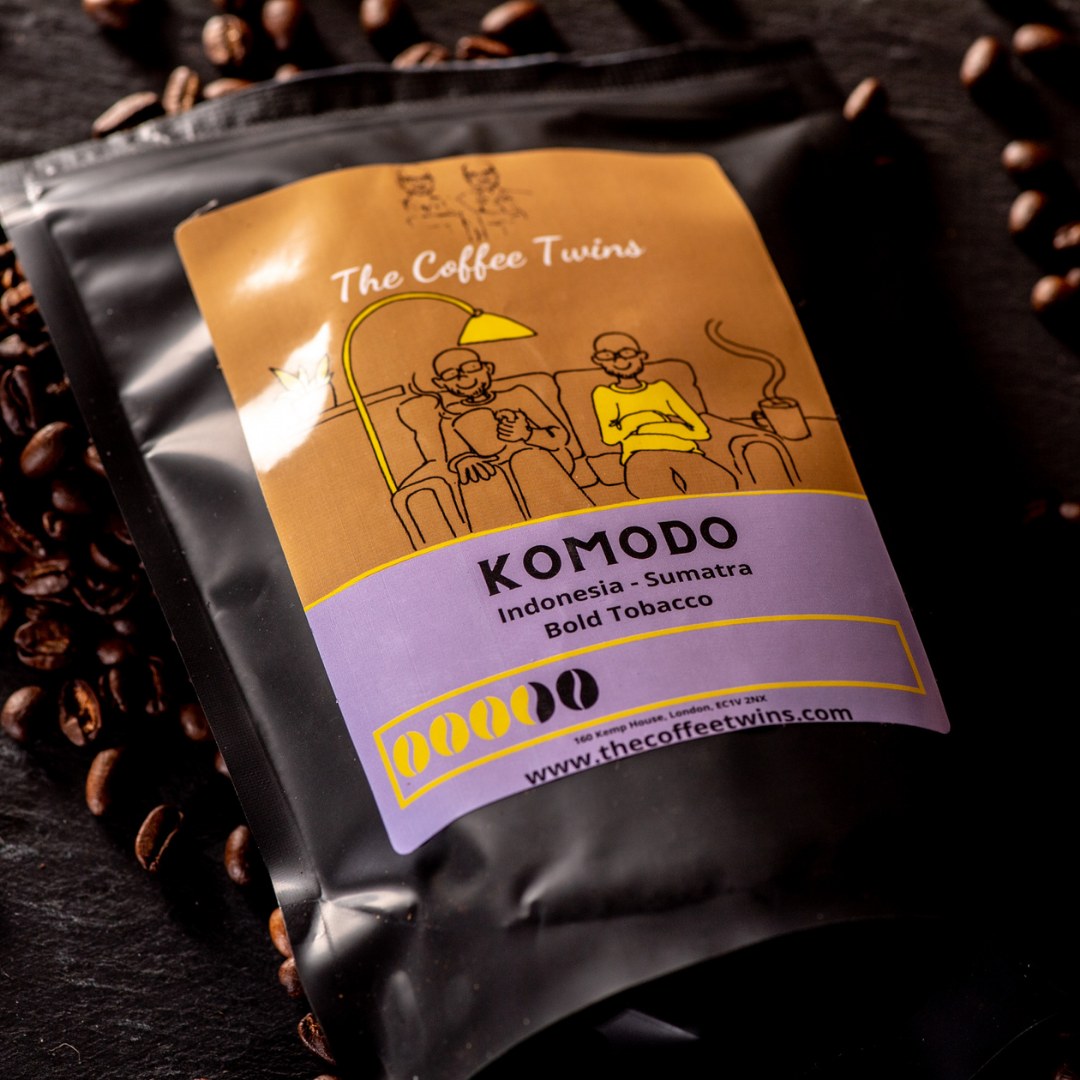
Our Komodo is a single origin from Sumatra, grown near Lake Toba and processed by giling basah. The varieties are Catimor and Typica. On its product page we rate it 5/5 for body, 2/5 for acidity, 2/5 for sweetness and 3.5/5 for roast. The tasting notes are spicy, bold and tobacco, with a full body, a spicy aroma and a long aftertaste.
That makes Komodo a classic example of Indonesian coffee. It suits anyone who likes a rich, low-acid cup. Our partner roastery in England roasts it to order, and orders are usually dispatched within 24 hours. You can buy whole beans or choose a grind for cafetière, filter, espresso or V60.
How do you brew Indonesian coffee at home?
Indonesian coffee shines in brewers that keep its body, such as a cafetière or an espresso machine. We checked the brewed recipes below against the Specialty Coffee Association Golden Cup guideline of 55g of coffee per litre of water, give or take 10%. Espresso, on the other hand, follows the usual 1:2 ratio.
| Method | Coffee | Water | Grind | Time |
|---|---|---|---|---|
| Cafetière | 30g | 500g at about 94°C | Coarse | 4 minutes, then press |
| Filter (V60) | 15g | 250g at about 93°C | Medium-fine | 3 to 4 minutes in total |
| Espresso | 18g | 36 to 40g in the cup | Fine | 25 to 30 seconds |
Cafetière method
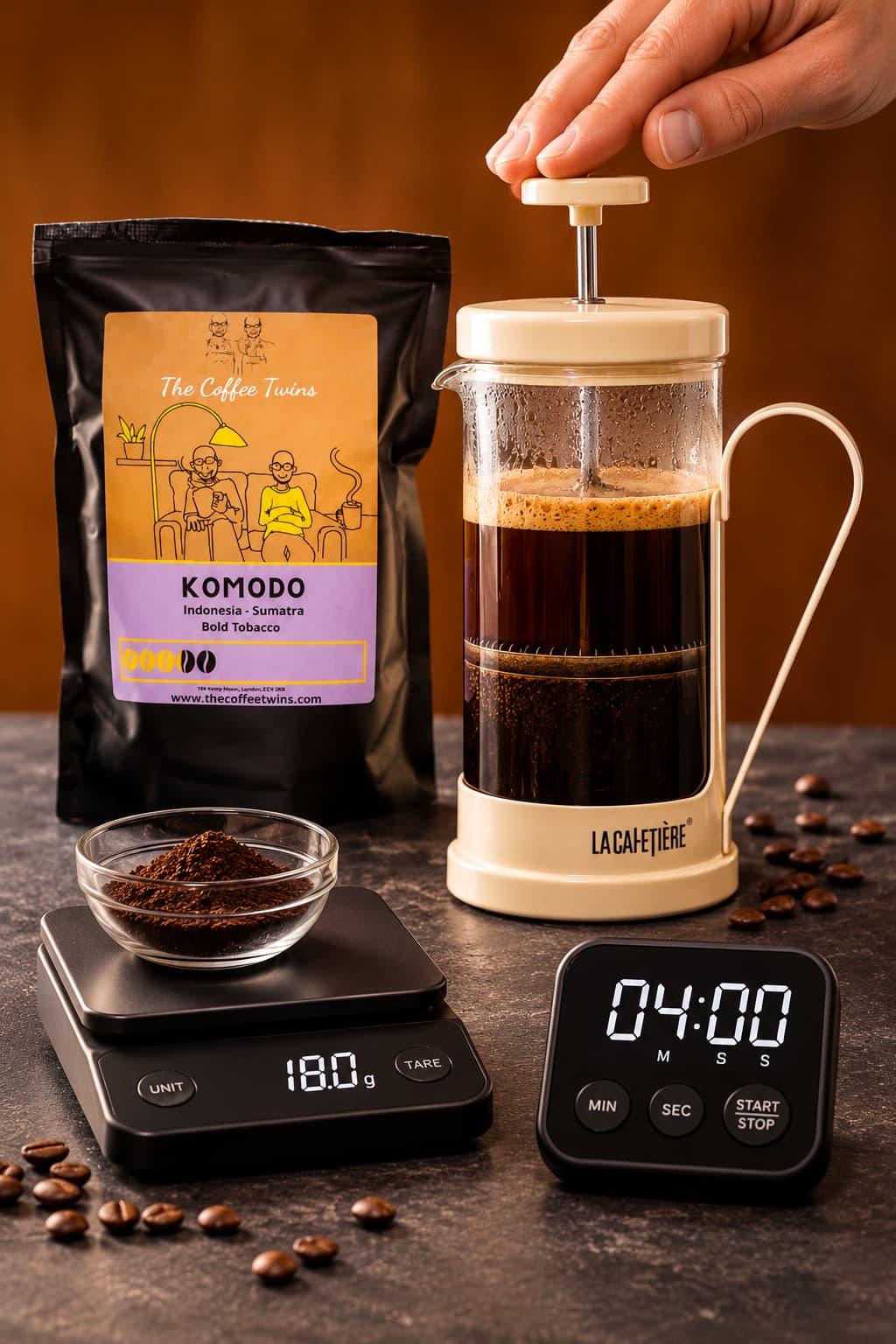
- Boil the kettle and let it rest for about 30 seconds, so the water drops to around 94°C.
- Add 30g of coarsely ground coffee to the cafetière, then pour in 500g of water.
- Stir gently after one minute to break the crust.
- Put the lid on and wait until the 4 minutes are up.
- Press the plunger slowly and pour straight away, so the coffee does not keep brewing.
A cafetière suits Sumatran coffee well, because the metal mesh lets the oils through and keeps that heavy body. That’s why Komodo is the top pick in our guide to the best coffee for cafetière. To scale the recipe up or down, use our coffee to water ratio guide.
Indonesian coffee with milk
Low acidity and a full body help Indonesian coffee hold its own in milk, so it makes a rich base for a flat white or latte. At the hotels we work with, we test coffees to match them with the milk they use, because milk changes how a coffee tastes. Today we supply hotels including Trafalgar St James, and we visit clients to train their staff on site. If you run a hotel, café or office, our wholesale page explains how we work.
Kopi luwak: is this Indonesian coffee worth it?
Kopi luwak, or civet coffee, is made from coffee cherries that palm civets have eaten and excreted. However, the welfare cost is serious. A study in the journal Animal Welfare by World Animal Protection researchers examined 48 wild-caught civets at 16 tourist coffee plantations in Bali and found inadequate conditions. World Animal Protection also reports that the animals are kept in cramped, barren cages with wire floors.
For that reason, we do not sell it and suggest you skip it. A well-grown Sumatran arabica gives you Indonesia’s signature flavour without the cruelty.
Which of our coffees use Indonesian coffee?
Indonesian beans appear in four of our products. Scores come from our own product pages (out of 5).
- Komodo: our Sumatran single origin from near Lake Toba, with 5/5 body, 2/5 acidity and notes of spice and tobacco.
- Ant Blend: Ethiopia, Indonesia and India, with 5/5 body and dark chocolate notes. As a milk coffee it gives a nougaty sweetness, so try it in a flat white.
- Little Robot Blend: Brazil, Costa Rica and Indonesia, with berries, vanilla and milk chocolate. It is smoother and sweeter, at 4/5 sweetness and a 3/5 roast.
- Single Origin Bundle: Komodo with Ethiopian Jojo and Brazilian Parrot. It is the easiest way to taste how much origin changes a coffee.
For more on single origins, our single origin coffee guide goes deeper.
Frequently asked questions
What does Indonesian coffee taste like?
Most Indonesian coffee is full-bodied and low in acidity, with earthy, spicy notes such as cedar, tobacco and dark chocolate. Sumatra tastes the heaviest, while Toraja coffee from Sulawesi is often sweeter and cleaner.
Why does Sumatran coffee taste earthy?
Mostly because of wet-hulling, or giling basah. The parchment comes off while the beans still hold around 40 to 45% moisture, and that builds a heavy body, low acidity and an earthy depth.
Is Indonesian coffee arabica or robusta?
Mostly robusta. In the USDA’s May 2026 report, arabica made up 1.37 million of the 12.37 million bags in the 2025/26 crop, or roughly one bag in nine. The arabica grows mainly in the highlands of Aceh and North Sumatra.
Is Indonesian coffee strong?
It tastes bold because of its heavy body and low acidity. However, the strength of your cup depends mostly on how much coffee you use. So for a stronger cafetière, add a few more grams rather than steeping for longer.
What is the best way to brew Sumatra coffee beans?
A cafetière keeps the heavy body. Use 30g of coarse coffee to 500g of water at about 94°C, steep for 4 minutes, then press. They also make a rich espresso base for milk drinks.
Is kopi luwak ethical?
Usually not. Researchers from World Animal Protection found inadequate conditions for 48 caged civets at 16 tourist coffee plantations in Bali. Since caged and wild beans are hard to tell apart, we suggest you skip it.
Do The Coffee Twins roast Komodo themselves?
No. Our partner roastery in England roasts to order for us, and we choose and taste the range. Orders are usually dispatched within 24 hours.
Ready to try Indonesian coffee?
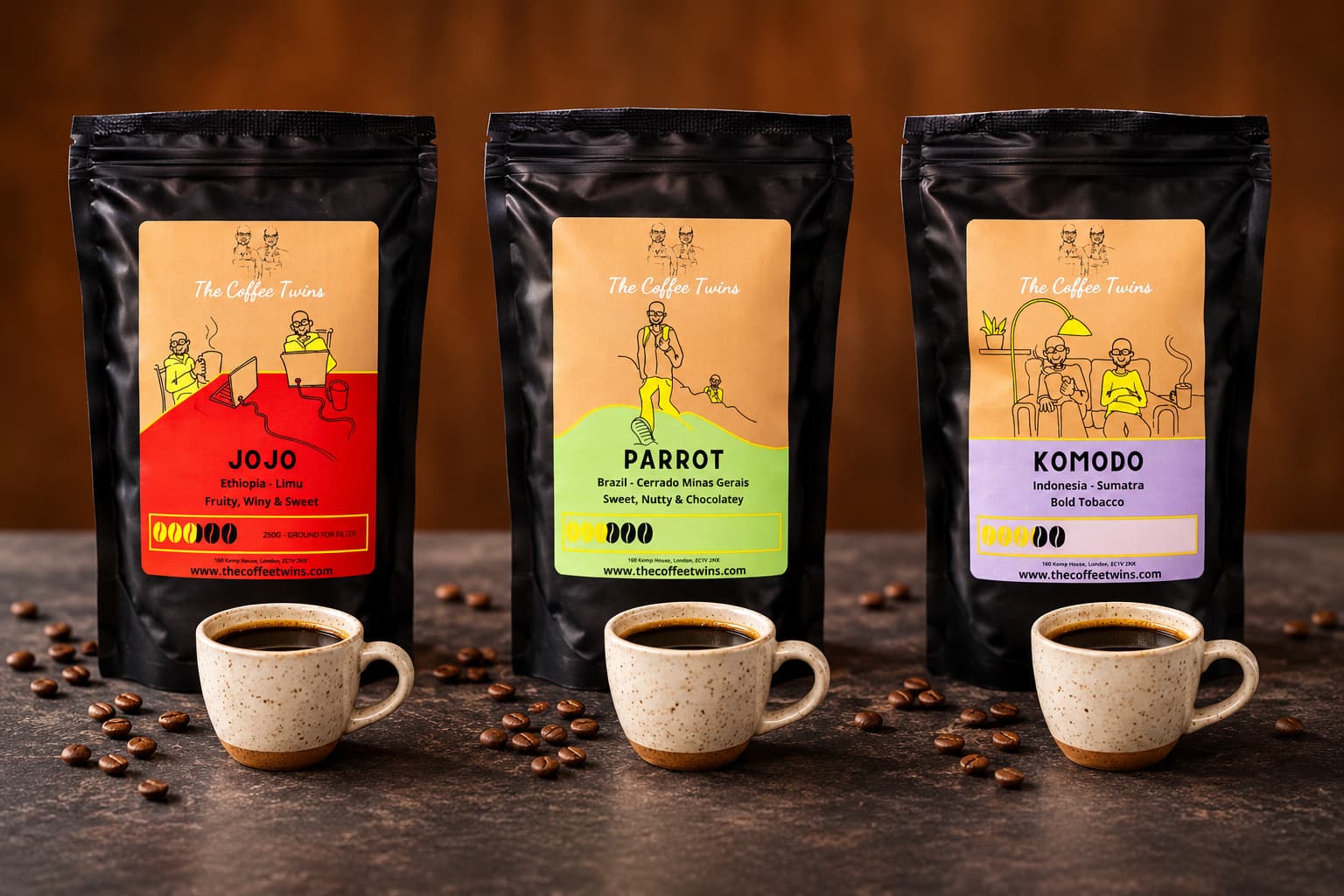
Start with Komodo in a cafetière to taste the classic Sumatran style, then try it with milk. If you would like to compare origins, the Single Origin Bundle puts Komodo next to Jojo and Parrot. We have 8 coffees in the shop, and a subscription keeps fresh beans arriving, which you can pause or cancel any time.
Shop Komodo Try the Single Origin Bundle Start a subscription
0 Comments