

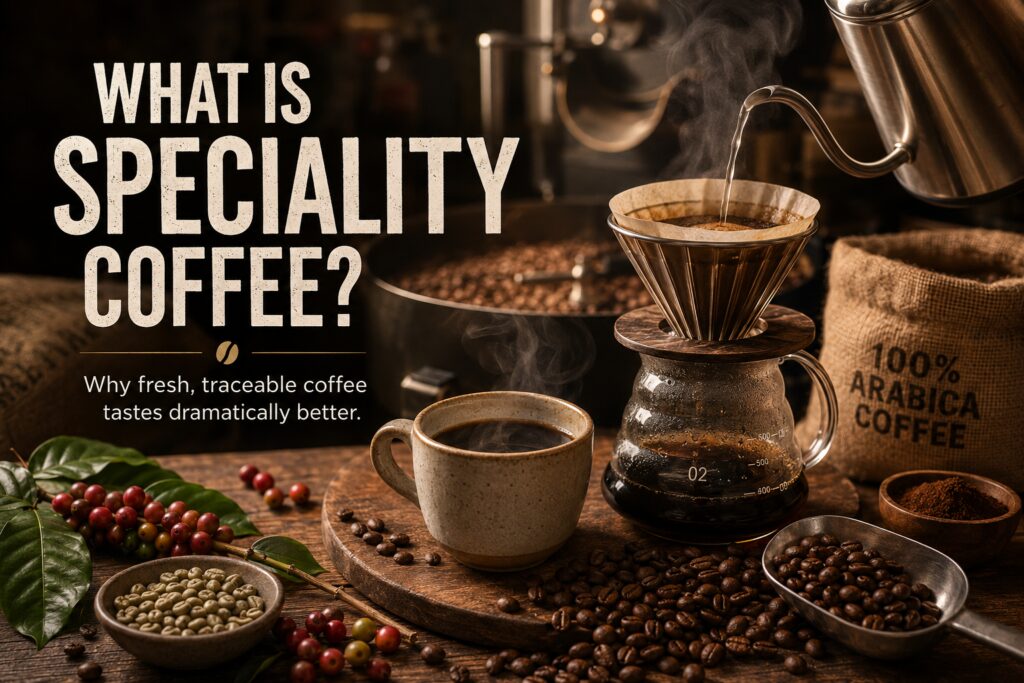
Speciality coffee is coffee that scores at least 80 out of 100 under Speciality Coffee Association (SCA) standards. Certified Q Graders award that score. Moreover, true speciality coffee is traceable to a specific farm or region. Farmers pick it by hand at peak ripeness, and roasters develop it to highlight its natural flavours. In fact, only the top few percent of the world’s coffee makes the grade.
That’s the textbook answer. However, we’re not textbooks. We’re twin brothers who roast speciality coffee here in the UK and supply it to five-star London hotels. So let us explain what that definition really means for your mug.
Specialty or Speciality — Which Is Correct?
Both. “Specialty” is the American spelling, while “speciality” is the British one. The industry’s governing body is the Speciality Coffee Association, which formed when the American and European associations merged. As a result, you’ll see both spellings, even on official materials. We’re a British roastery, so around here it’s speciality, with the “i”, thank you very much. Either way, both words refer to exactly the same grading standard.
A Very Short History: The Three Waves of Coffee
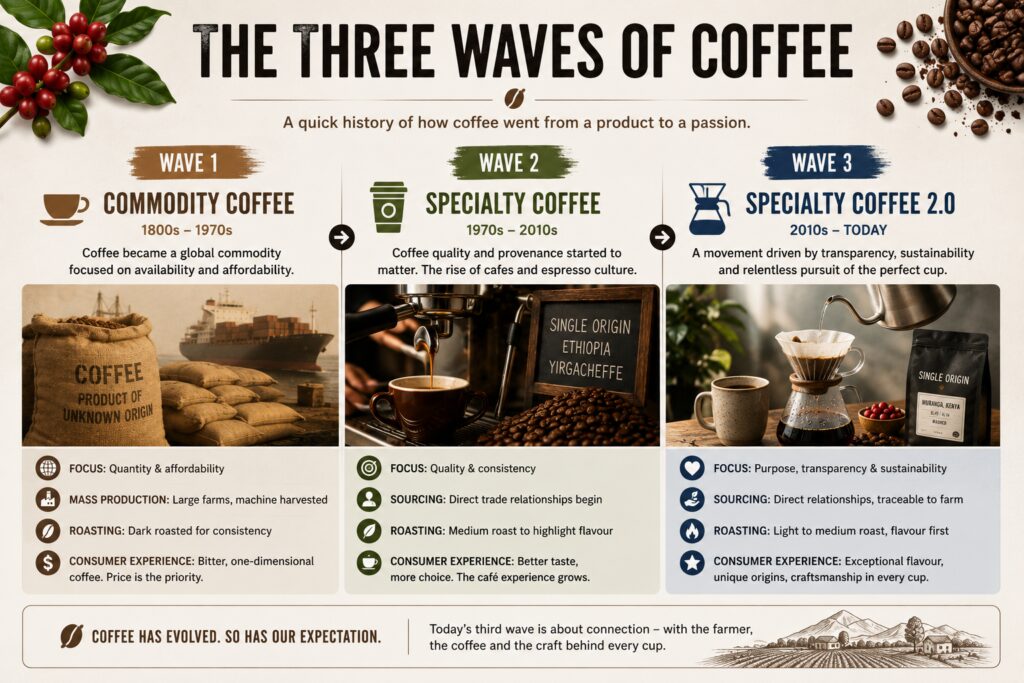
People in the coffee industry talk about three “waves”. It’s a useful shorthand for how we got here.
The first wave made coffee a household commodity. Think instant granules and vacuum-packed tins, where convenience beat quality every time. Next came the second wave, which turned coffee into an experience. During the espresso-bar boom of the 1990s and 2000s, everyone learned to say “latte”. However, the coffee itself was usually a dark-roasted blend hiding under milk and syrup. Finally, the third wave treats coffee like wine. This is where speciality coffee lives: a craft product whose origin, variety, processing and roasting all shape the cup.
The good news? You don’t need to be a hipster in a Shoreditch café to drink third-wave coffee. You just need fresh, well-sourced beans and a cafetière. In fact, that accessibility is rather the point of everything we do.
What’s the Difference Between Regular Coffee and Speciality Coffee?

The short version: regular (commodity) coffee trades on price, whereas speciality coffee trades on quality. Here’s how that plays out at every stage:
| Regular / commodity coffee | Speciality coffee | |
|---|---|---|
| Grading | Ungraded, or below 80 SCA points | 80+ points, graded by certified Q Graders |
| Origin | Blended from many unknown sources | Traceable to a single farm, estate or co-operative |
| Harvesting | Often machine-stripped, ripe and unripe together | Hand-picked at peak ripeness |
| Defects | Permitted in quantity | Virtually zero tolerance |
| Roasting | Industrial, often dark to hide inconsistency | Small-batch, profiled to each bean’s character |
| Freshness | Months (or years) from roast to shelf | Days from roast to dispatch |
| Price to farmer | Commodity market rate, often below cost | Quality premiums paid above market rate |
That last row matters more than most people realise. When you buy speciality, more money flows back to the farm. As a result, farmers can fund the careful picking, processing and sustainability work that makes coffee taste better in the first place. It’s a virtuous circle, and it’s the reason we’ll never roast anything else.
Arabica vs Robusta: Does the Bean Type Matter?
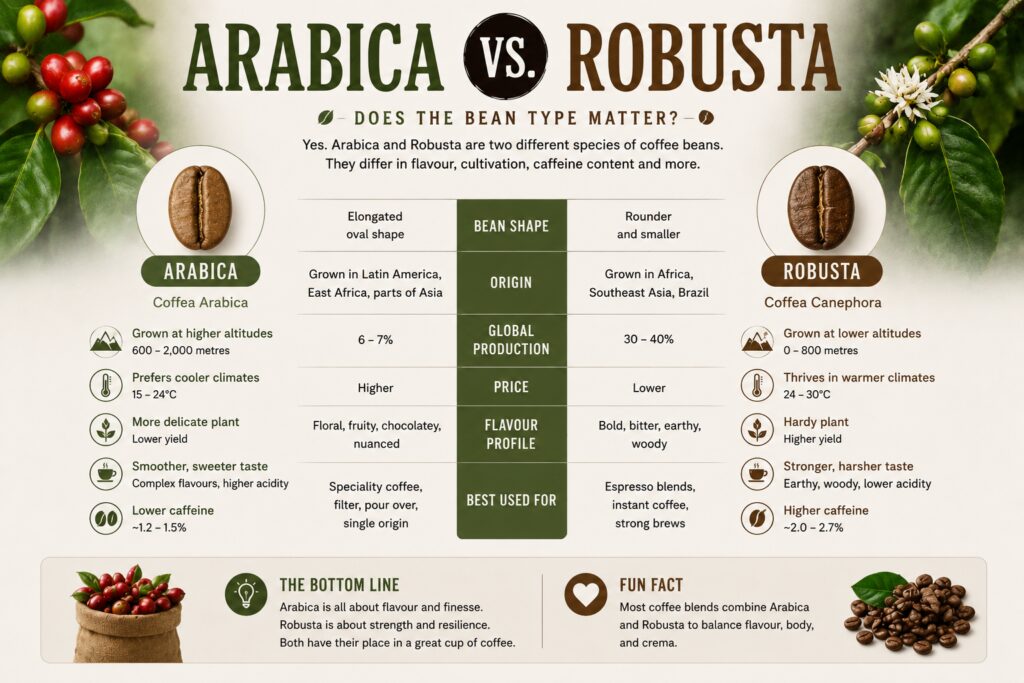
Quite a lot, yes. There are two commercially important coffee species. Arabica grows at higher altitudes and is harder to farm. In return, it produces the complex, sweet flavours that define speciality coffee. Robusta, on the other hand, is hardier, cheaper to grow and higher in caffeine. Unfortunately, it also tastes harsher and more bitter. Because of this, it dominates instant coffee and cheap supermarket blends.
Virtually all speciality coffee is arabica, and everything we roast is 100% arabica. That said, “100% arabica” on a supermarket bag doesn’t guarantee quality by itself. Plenty of low-grade arabica exists too. Therefore, a coffee also needs grading, traceability and freshness before it counts as speciality.
How Is Speciality Coffee Graded?
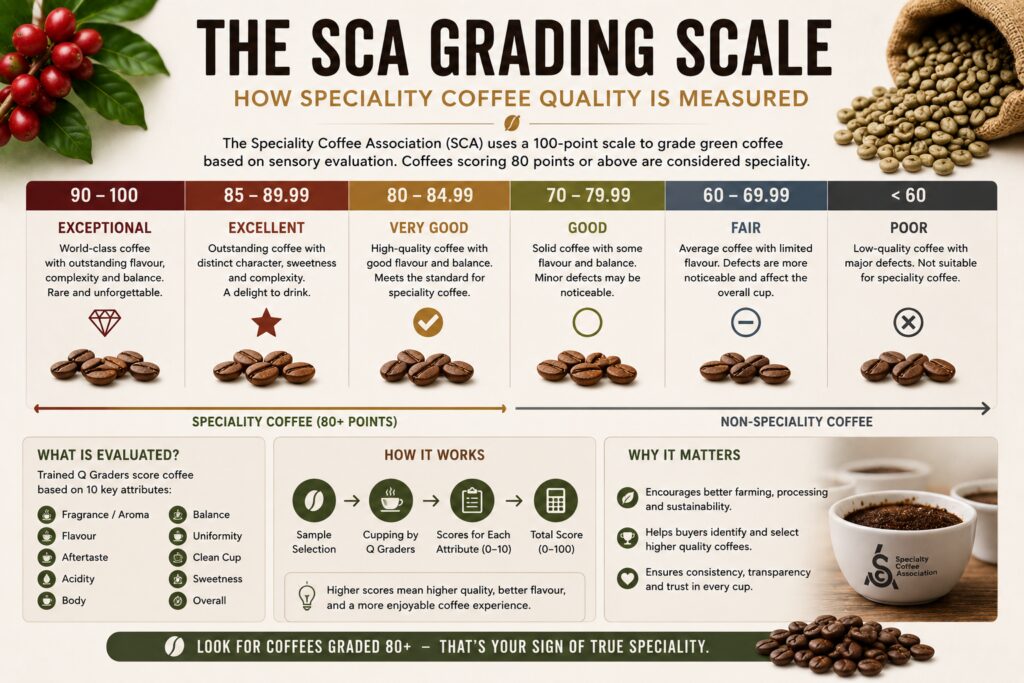
Certified Q Graders “cup” the coffee using a standardised tasting protocol. They score it across ten categories, including aroma, flavour, acidity, body, balance, sweetness and uniformity. A score of 80–84.99 counts as “very good”, 85–89.99 as “excellent”, and 90+ as “outstanding” — with prices to match.
Before any coffee joins our range, we cup samples the same way. Admittedly, it’s the least glamorous part of the job. There’s a lot of slurping and spitting at 7am. However, it’s how we know a coffee deserves its place before we fill a single bag.
From Farm to Your Cup: Why the Journey Matters
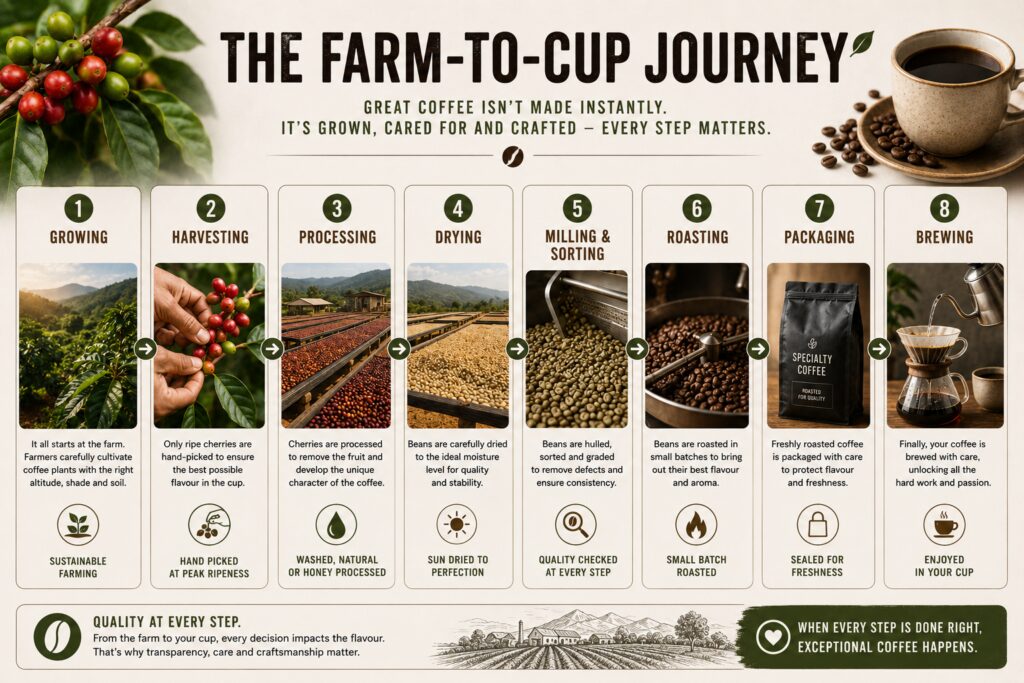
Every speciality coffee we roast has a story we can actually tell you: which farm, which altitude, which processing method. That traceability isn’t marketing fluff. Rather, it’s the mechanism that makes quality possible.
At the farm, growers select varieties and altitudes for flavour rather than just yield. Then they pick the cherries by hand at perfect ripeness. At processing, workers sort, ferment and dry those cherries with real precision. That stage decides whether you taste bright citrus or muddy cardboard. At the roastery — that’s us — each coffee gets its own roast profile. For example, a delicate washed Ethiopian needs a very different time-and-temperature curve to a chocolatey Brazilian natural. Get it wrong and you flatten everything special about the bean. Get it right, however, and the cup tastes like the place it came from.
This is the opposite of industrial roasting, where everything comes out dark and uniform so that nothing stands out — good or bad.
What Do Different Origins Taste Like?

One of the joys of speciality coffee is that geography is flavour. These are broad strokes, because farms and processing vary. Still, they make a handy starting map:
- Ethiopia — the birthplace of coffee. Expect fruity, floral, winey cups; think berries and jasmine rather than “coffee flavour”. For example, our Jojo is a single-origin Ethiopian with exactly this fruity, sweet character.
- Brazil — chocolate, nuts and toffee. Smooth, low in acidity and very crowd-pleasing. Consequently, it forms the backbone of many great blends, including our bestselling Bobo.
- Guatemala & Central America — balanced and sweet, with gentle citrus brightness from volcanic soils.
- Indonesia — big, earthy, full-bodied cups with spice and dark chocolate. Our Komodo, grown near Lake Toba, is a wonderfully bold example.
- Colombia & East Africa — juicy and vibrant, often with red-fruit sweetness and lively acidity.
Did that make you want to taste the differences side by side? That’s precisely what our Tasting Pack is for. It bundles three contrasting coffees, so your own palate can do the deciding.
Why Does Speciality Coffee Cost More?
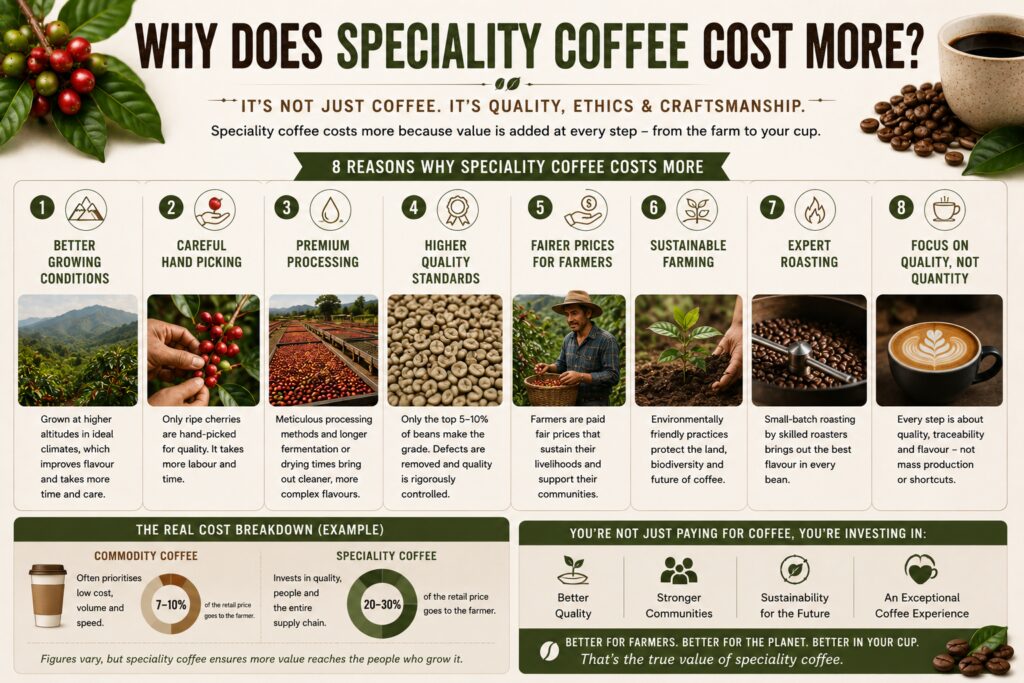
Because every step above costs more. Hand-picking costs more than machine-stripping, and quality premiums cost more than commodity rates. Likewise, small-batch roasting costs more than running an industrial furnace around the clock.
Even so, a bag of speciality coffee typically works out at 30–50p per cup at home. That’s more than instant, certainly. However, it’s a fraction of a coffee-shop flat white, for a noticeably better cup.
On top of that, you’re not just paying for taste. You’re also funding fair incomes for farmers, plus farming practices that keep coffee-growing regions viable.
Does Speciality Coffee Taste That Different?
Honestly, yes — and you don’t need a trained palate to notice. Most people first remark that good speciality coffee tastes naturally sweeter and smoother, with no harsh bitterness. As a result, many of our customers drop the sugar without even thinking about it. From there, you start noticing the fun part: genuine notes of chocolate, berries, citrus or nuts. Importantly, those flavours come from the bean itself, not from added flavourings.
Can Decaf Be Speciality Coffee?
Absolutely — and this surprises people. Decaffeination removes the caffeine, not the quality grade. Start with an 80+ point bean and decaffeinate it gently; methods like sugarcane or Swiss Water avoid harsh chemicals. Then roast it with the same care. The result is a decaf that tastes like proper coffee rather than a punishment. In fact, we’re proud enough of ours to give it a name as daft as Hufflelump. So if instant granules put you off decaf, you owe your evenings another try.
How to Start Drinking Speciality Coffee at Home

You don’t need a £2,000 espresso machine. In order of simplicity:
- Cafetière (French press) — you probably own one. Use freshly ground beans, a coarse grind and four minutes’ brew time.
- Pour-over (V60 or similar) — about £15 of kit. Moreover, it’s the best way to taste the subtleties in lighter roasts.
- Espresso — the deep end. Wonderful, but entirely optional.
Whatever the method, two things matter most: freshly roasted beans, and grinding just before you brew. Coffee is a fresh product. Therefore, treat it like good bread, not tinned soup. We roast every order fresh for exactly this reason — see our full range.
How Should You Store Speciality Coffee?
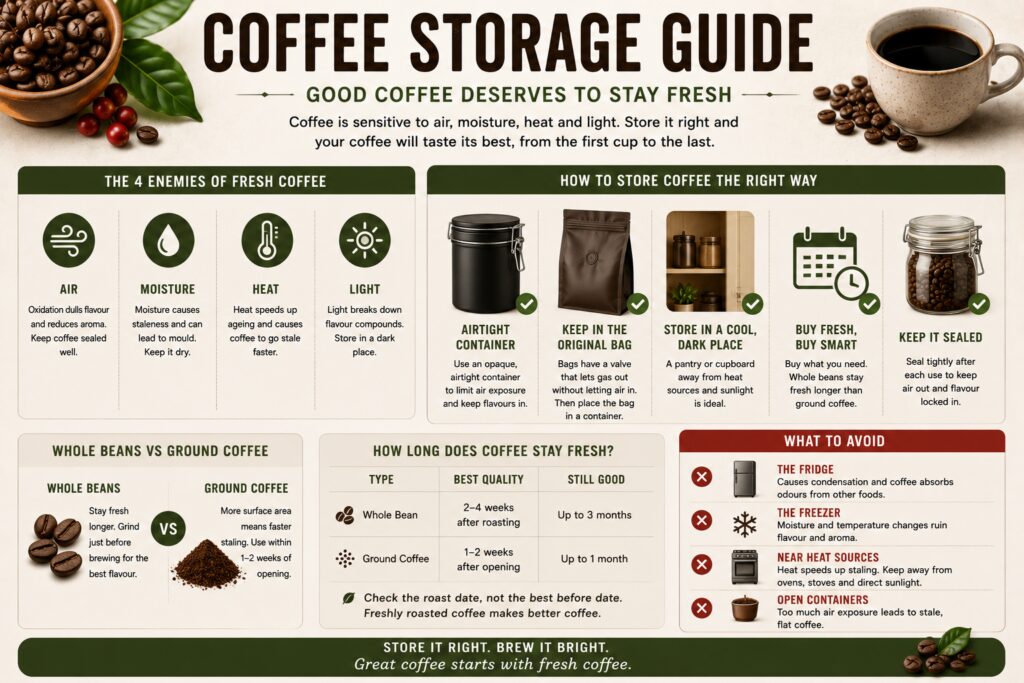
Coffee has three enemies: air, light and heat. Keep beans in their sealed bag or an airtight container, inside a cool dark cupboard. The one-way valve on the bag is there for a reason. Avoid the fridge, though. Coffee absorbs food smells in there, and condensation forms every time you take it out. Also, buy whole beans where you can and grind as you go. Ground coffee loses its aromatics within minutes, whereas whole beans hold theirs for weeks. As a rule of thumb, speciality coffee is at its best from a few days to about a month after roasting. That’s another reason fresh-roasted beats supermarket shelf coffee, which is often months old before it reaches your basket.
Frequently Asked Questions
What is a speciality coffee?
A speciality coffee scores 80 or more out of 100 under Speciality Coffee Association grading. It’s traceable and free of defects. Farmers pick it by hand at peak ripeness, and roasters develop it to highlight natural flavour. In fact, only the top few percent of world coffee qualifies.
Is it “specialty” or “speciality” coffee?
Both are correct. “Specialty” is the American spelling, while “speciality” is the British one. Both refer to the same SCA grading standard. As a UK roastery, we use “speciality”.
What is the difference between regular coffee and speciality coffee?
Commodity coffee comes from many untraceable sources. Producers machine-harvest it and roast it industrially for consistency at the lowest price. By contrast, speciality coffee grades 80+ with certified Q Graders and traces back to a specific farm. Farmers pick it by hand, and roasters develop it in small batches for flavour.
Is speciality coffee stronger than regular coffee?
Not necessarily. Caffeine content is similar bean for bean. In fact, robusta-heavy cheap coffee often contains more caffeine. Speciality coffee tastes more intense, yet it’s typically smoother and less bitter than dark-roasted commodity coffee.
Is all speciality coffee arabica?
Almost all of it, yes. Arabica produces the complex, sweet flavours that score highly in grading. Robusta, meanwhile, mostly ends up in instant and commodity coffee. However, “100% arabica” alone doesn’t make a coffee speciality. It still needs to grade 80+ and stay fresh and traceable.
Can decaf coffee be speciality?
Yes. If the underlying bean grades 80+, gentle decaffeination and careful roasting keep it genuinely speciality. The result is real flavour — a world away from instant decaf granules.
Is speciality coffee worth the price?
For most coffee drinkers, yes. It works out around 30–50p per cup at home, which is far less than a café coffee. Moreover, it tastes noticeably better and pays farmers fairly. To judge for yourself, try a tasting pack against your usual brand.
Twin brothers run The Coffee Twins, a UK speciality coffee brand. We roast fresh and supply some of London’s five-star hotels. Naturally, we’d love to be your morning coffee too. Browse the range.
I have had the pleasure of reading your piece on specialty coffee. I guess the first thing that came to my mind was ‘you get what you pay for’. It’s no surprise that specialty coffees command a higher price tag but you have done a nice job of explaining why that is. Naturally, one would expect a higher standard at every stage of the production process and the growers themselves have a vested interest in producing beans of the highest quality. I’m a lover of French Vanilla and some of the lattes so I appreciated your post and i thank you for sharing this interesting and educational content with us today.
Grant R
Hi there,
Let me tell you, your article “What Is Specialty Coffee” is like a flavorful journey through the world of coffee! Your detailed exploration of the process from farm to cup is as rich and nuanced as a well-brewed espresso.
I’m curious, though, about the roasting process. How does a roaster decide the perfect roasting profile for a particular bean? It sounds like a delicate balance between science and art, much like a chef seasoning a gourmet dish to perfection. Does this mean that the same bean can taste remarkably different when roasted by different experts?
Thank you for sharing such a deep dive into the world of specialty coffee. It’s certainly given me a new perspective on my morning cup
Warm regards,
Makhsud