


Quick answer: Coffee tasting notes are the flavour, aroma, and texture descriptors used to describe what you’ll actually taste in a specific coffee. Most speciality roasters draw them from the Specialty Coffee Association’s Coffee Taster’s Flavour Wheel (developed with World Coffee Research), which organises coffee flavours into families like fruity, floral, nutty, chocolatey, spicy, and sweet. Our three single origin coffees deliver distinctly different tasting notes: Jojo (fruity, winy, sweet), Parrot (sweet, nutty, chocolatey), and Komodo (spicy, bold, tobacco).
Ready to explore different tasting notes? Shop the Tasting Pack or try the Single Origin Bundle.
Why trust this guide?

Written by: Jeremiah & Raja, Co-founders, The Coffee Twins
Credentials: UK speciality coffee brand with beans roasted in England. Stocked in five-star London hotels including Trafalgar St James, where we also train hotel staff on machine handling, coffee education, and latte art. Previously ran our own coffee shop in Farringdon after training in five-star hotel food and beverage.
Last reviewed: October 2026
Coffee is not just a black liquid with a kick. Every coffee carries flavour shaped by its origin, varietal, processing, and roast, and tasting notes give drinkers a shared vocabulary for what is in the cup. This guide covers what coffee tasting notes mean, how the SCA Flavour Wheel organises coffee flavours, how to taste coffee properly at home, and what the tasting notes on our bags tell you to expect.
Table of contents
- What are coffee tasting notes?
- Why do coffee tasting notes matter?
- How does the SCA Flavour Wheel organise coffee flavours?
- Which tasting notes appear most commonly?
- How does origin shape coffee tasting notes?
- Do processing and roast change tasting notes?
- How do you taste coffee properly at home?
- Reading The Coffee Twins tasting notes
- FAQ
What are coffee tasting notes?
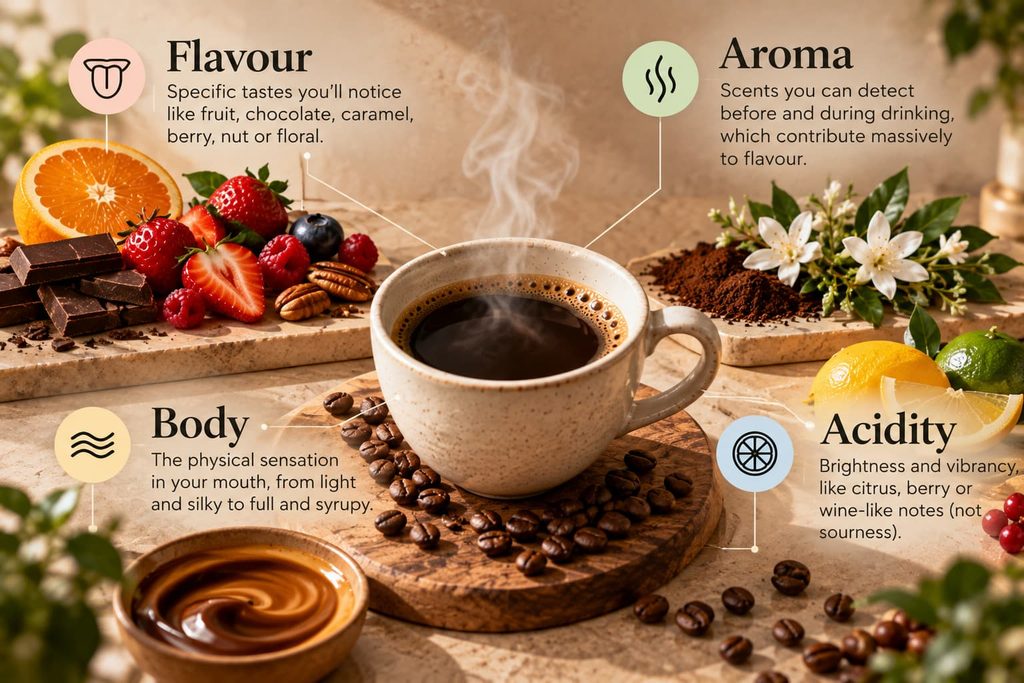
Coffee tasting notes are specific flavour, aroma, and texture descriptors used to describe what you’ll experience when drinking a particular coffee. The Specialty Coffee Association publishes the cupping protocols and vocabulary that let baristas, roasters, and drinkers describe flavour consistently, rather than relying on vague terms like “strong” or “smooth”.
Flavour descriptors
Flavour descriptors identify the specific tastes you’ll notice: citrus, chocolate, caramel, berry, nut, floral. Because flavour is the combined sensation of taste and aroma, these descriptors cover both what the tongue detects and what the nose adds.
Aroma descriptors
Aroma descriptors identify what you can smell before and during drinking. In fact, aroma contributes more to perceived flavour than taste alone, which is why professional cuppers smell a coffee at several stages of an evaluation.
Texture and body descriptors
Body descriptors identify the physical feel of coffee in your mouth: light, medium, full, syrupy, silky. Body is independent of flavour, so a coffee can be bright and light-bodied, or chocolatey and full-bodied, and each combination drinks differently.
Acidity descriptors
Acidity in coffee describes brightness and vibrancy, not sourness or stomach discomfort. Instead, good acidity tastes like the lift you get from citrus, berries, or wine, and it is a big part of what separates speciality coffee from commodity brews.
Why do coffee tasting notes matter?
Coffee tasting notes matter because they help you choose coffees you’ll enjoy and understand why you enjoy them. Once you know a handful of terms, you can match a coffee to your preferences instead of guessing.
Buying coffee you’ll actually enjoy
Tasting notes let you buy coffee based on what it tastes like rather than what the packaging looks like. For example, if you love bright, fruity coffee, you can buy bags marked “citrus, berry, floral” with confidence instead of finding out after brewing.
Developing your own palate
In addition, reading tasting notes while you drink trains you to pick out flavours yourself. This is how drinkers move from “I like this” to “I like this because of the stone fruit and chocolate”.
Communicating preferences clearly
A shared vocabulary lets you ask baristas and roasters for exactly what you want. “I like bright, citrus-forward coffee with a clean finish” gets you a better recommendation than “I like coffee that isn’t too strong”.
Understanding what you’re paying for
Tasting notes also make the work behind speciality coffee visible. Notes like “fruity, winy, sweet” come from careful sourcing, processing, and roasting that commodity coffee doesn’t get.
How does the SCA Flavour Wheel organise coffee flavours?
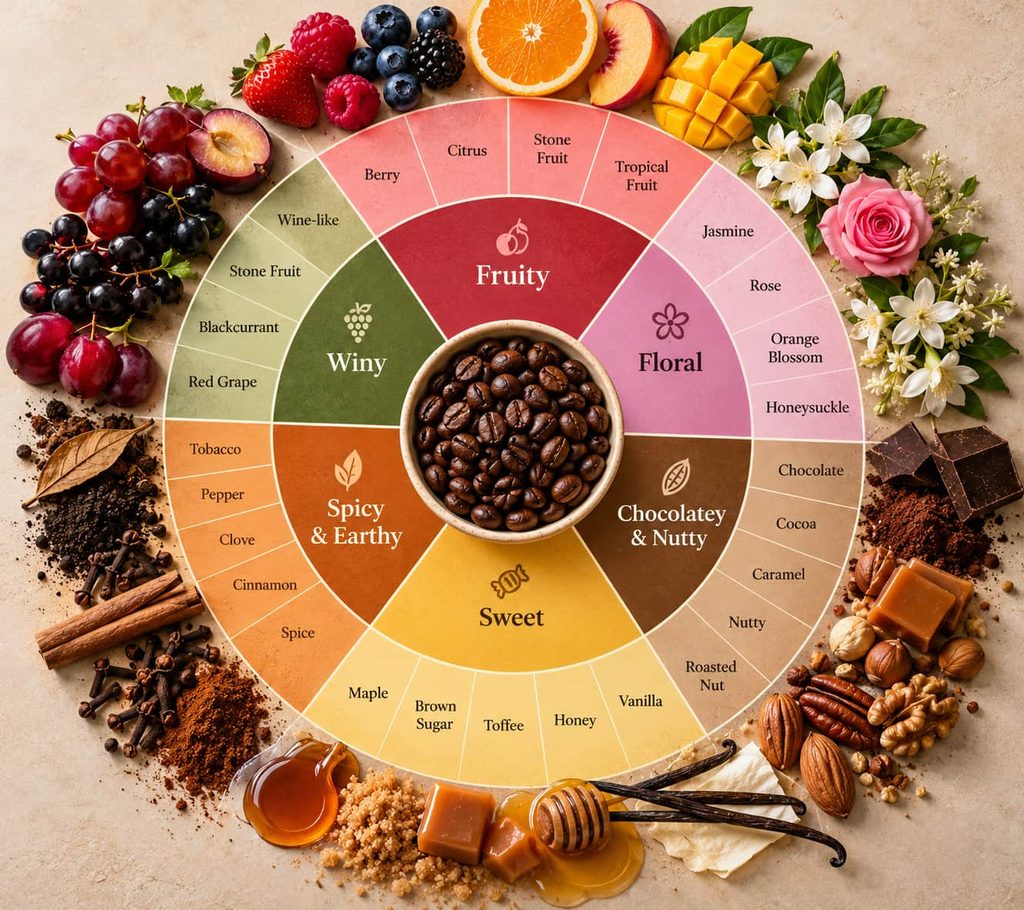
The SCA Flavour Wheel organises coffee flavours into three concentric rings, moving from broad categories to specific descriptors. Developed by the Specialty Coffee Association with World Coffee Research, it is the industry-standard tool for describing coffee flavour consistently.
Inner ring: broad flavour families
The inner ring groups flavours into nine families: fruity, sour/fermented, green/vegetative, other, roasted, spices, nutty/cocoa, sweet, and floral. These are the broadest categories, so this is where new tasters usually start.
Middle ring: specific flavour groups
The middle ring breaks each family into more specific groups. Fruity, for example, splits into berry, dried fruit, citrus fruit, and other fruit, while nutty/cocoa splits into nutty and cocoa.
Outer ring: specific descriptors
The outer ring lists individual descriptors such as lemon, grapefruit, orange, and lime within citrus fruit, or chocolate and dark chocolate within cocoa. Notably, this is the level professional cuppers work at, and where the notes on speciality coffee bags usually land.
Why this structure works
The layered structure lets you describe coffee at whatever level of detail suits you. For example, a beginner might say “fruity”, a developing taster “berry”, and an experienced cupper “blueberry with a hint of blackcurrant”, and all three are describing the same coffee accurately.
Which tasting notes appear most commonly?
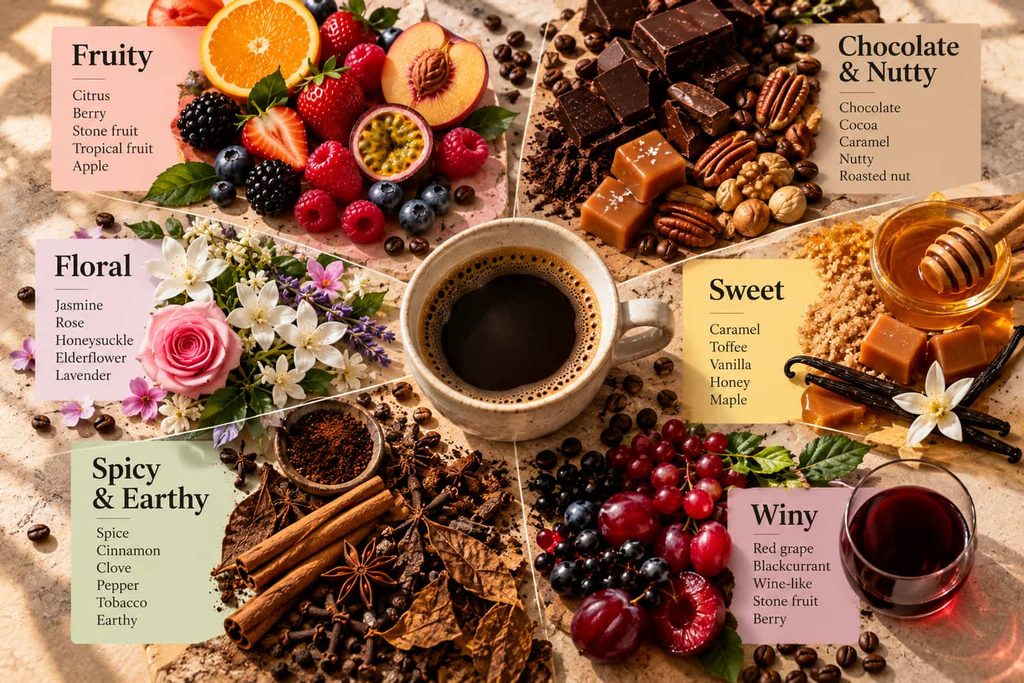
Six groups of tasting notes cover most of what you’ll see on speciality coffee bags, whatever the origin. Learn these and you can read almost any label.
Fruity notes
Fruity notes include citrus (lemon, orange, grapefruit), berry (blueberry, strawberry, blackcurrant), stone fruit (peach, apricot, cherry), and tropical (pineapple, mango). In particular, bright East African coffees tend to show the most pronounced fruit character.
Chocolate and nutty notes
Chocolate notes range from dark chocolate (bitter, intense) to milk chocolate (sweet, creamy) to cocoa (dry, powdery). Similarly, nutty notes include almond, hazelnut, pecan, and walnut. Generally, these notes are common in Central and South American coffees.
Caramel and sweet notes
Sweet notes include caramel, brown sugar, honey, toffee, and molasses. Also, they often sit alongside chocolate and nut notes in medium-roasted Central and South American coffees, which makes for easy-drinking cups.
Floral and tea-like notes
Floral notes include jasmine, bergamot, chamomile, and rose, and tea-like notes include black tea and green tea. You’ll find them most often in Ethiopian coffees, particularly from the Yirgacheffe and Sidama regions.
Spicy and earthy notes
Spicy notes include cinnamon, cardamom, clove, and pepper. In contrast, earthy notes include tobacco, cedar, forest floor, and leather. Overall, these notes are typical of Indonesian coffees from Sumatra, Java, and Sulawesi.
Winy and fermented notes
Winy notes include red wine, port, and sherry, and they show up most in naturally processed coffees, where the bean dries inside the fruit and takes on some of its sweetness.
How does origin shape coffee tasting notes?
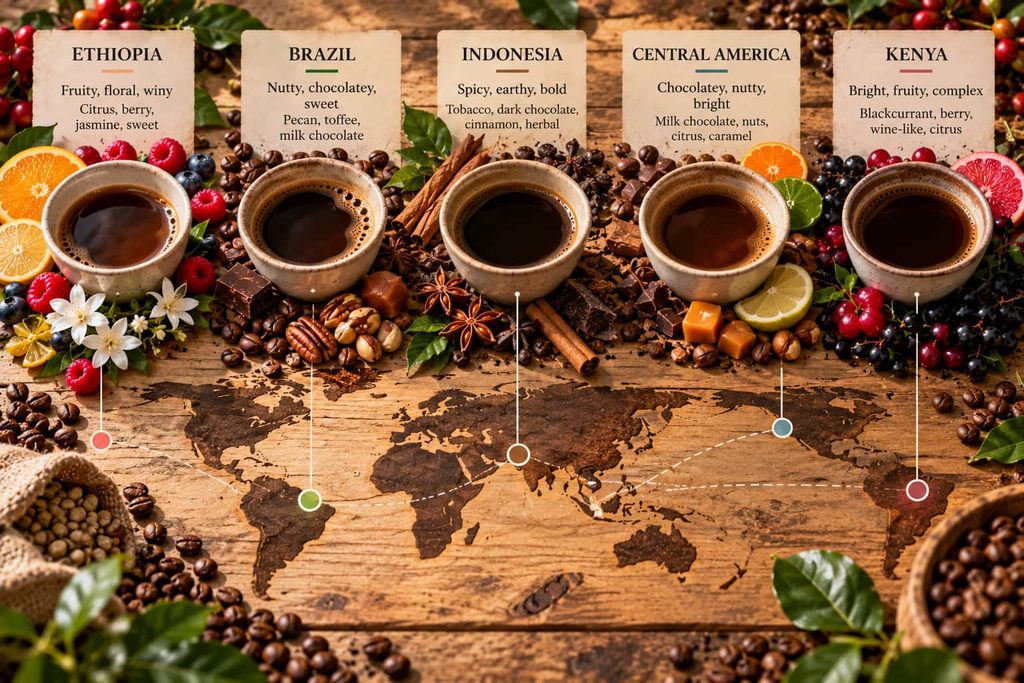
Origin shapes tasting notes because soil, altitude, climate, and varietal all influence which flavour compounds develop in the bean. As a result, coffees from the same region often share recognisable characteristics, even though individual farms vary.
Ethiopian tasting notes
Ethiopian coffees typically deliver fruity, floral, winy, and tea-like notes with bright acidity. Because Ethiopia grows heirloom varietals at high altitude, its coffees are some of the most distinctive in the world. Our Jojo (Ethiopian Limu) is fruity, winy, and sweet, and shows that character clearly.
Brazilian tasting notes
Brazilian coffees typically deliver sweet, nutty, chocolatey notes with low acidity and full body, which is why they form the backbone of many espresso blends. Our Parrot (Brazilian Cerrado) is sweet, nutty, and chocolatey in exactly this style.
Indonesian tasting notes
Indonesian coffees typically deliver bold, earthy, spicy, and sometimes tobacco-like notes with full body and low acidity. Above all, the Giling Basah wet-hulling process is behind much of that character. Our Komodo (Sumatran) is spicy and bold with a hint of tobacco.
Central American tasting notes
Central American coffees from Guatemala, Costa Rica, and Honduras typically deliver balanced, chocolatey, nutty, and sometimes citrus notes. They are often the easiest way into speciality coffee because they balance brightness and body without extremes.
Kenyan tasting notes
Kenyan coffees deliver intensely bright, blackcurrant-forward, and sometimes tomato-like notes with pronounced acidity. In addition, they are known for a complex, wine-like character that is quite different from Ethiopian brightness.
Do processing and roast change tasting notes?
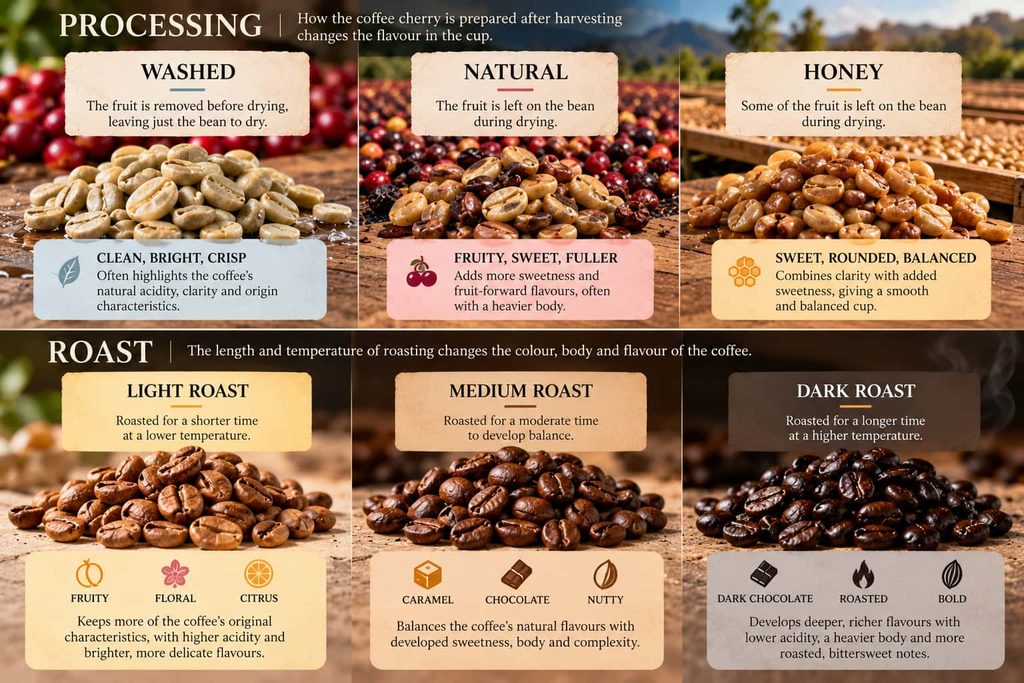
Yes. Processing method and roast level both change tasting notes significantly, even in beans from the same farm. In fact, after origin they are the two biggest influences on what ends up in the cup.
Washed processing notes
Washed processing removes the cherry fruit before drying, producing clean, bright cups that show the bean’s own character. For example, washed Ethiopians taste more floral and tea-like than natural Ethiopians.
Natural processing notes
Natural processing dries the whole cherry with the fruit intact, so sugars and fruit compounds move into the bean. As a result, natural coffees are sweeter, fruitier, and often wine-like, with more body than washed coffees.
Honey processing notes
Honey processing sits between washed and natural, leaving some of the fruit mucilage on the bean during drying. Therefore, it gives more sweetness than washed and more clarity than natural, and is popular for Central American single origins.
Light roast notes
Light roasts preserve origin character, with the brightest acidity, the most pronounced fruit, and the most delicate floral and tea-like notes. For this reason, they suit filter methods like pour over and AeroPress.
Medium roast notes
Medium roasts balance origin character with developed sweetness, giving chocolate, caramel, and nut notes alongside some fruit or floral complexity. Consequently, they work with most brewing methods.
Dark roast notes
Dark roasts put roast character ahead of origin, giving intense dark chocolate, smoke, toasted nut, and sometimes burnt sugar notes. So they suit espresso and milk-based drinks, where subtle origin notes would be lost anyway.
How do you taste coffee properly at home?
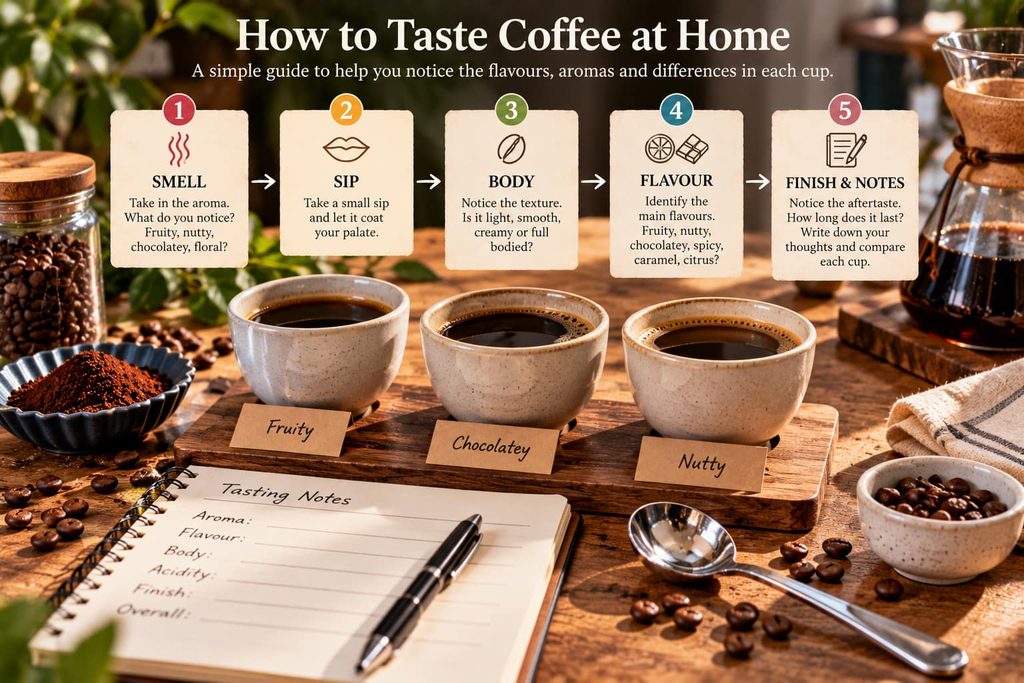
Tasting coffee at home is a simplified version of professional cupping: you pay attention to aroma, flavour, body, and finish, in that order, every time. Tasting is a skill like learning an instrument, so it takes practice and patience, and you don’t need professional equipment to start.
Smell the dry grounds first
First, smell the ground coffee before adding water. The dry aroma (often chocolate, nut, floral, or fruit) is a preview of the brewed cup.
Smell again after adding water
Next, smell the coffee again once it’s brewed. Hot water releases more aromatics, so notice what has changed between the dry and wet smell.
Taste in small sips, slowly
Then take small sips and let the coffee coat your whole mouth before swallowing. In fact, slurping, as cuppers do, sprays the coffee across your palate and carries aroma up to your nose, which is where most of the flavour is detected.
Note the body and finish
Pay attention to how the coffee feels (light, medium, full, syrupy) and what you taste after swallowing. Also, the finish often shows things the first sip missed, and flavours change again as the cup cools.
Write it down
Note what you taste in your own words, then compare it with the printed tasting notes. Additionally, a tasting journal or notes app builds your taste memory, and after a few months you’ll see how far your palate has come.
Compare side by side
Taste two or three coffees in the same session to make the differences obvious. Our Tasting Pack is designed for exactly this, with Audley, Bobo, and Jojo giving you three distinctly different profiles.
Try a triangle test
Brew two coffees and pour three cups, two of one coffee and one of the other. Ask someone to shuffle them, then find the odd one out. It is the quickest exercise we know for sharpening your ability to spot subtle differences.
Taste with other people
Finally, coffee tasting is better in company. Cupping sessions at local cafés and roasteries let you try a range of beans in one sitting, and comparing notes with a tasting group or online community shows you flavours you would have missed on your own.
Reading The Coffee Twins tasting notes
Our tasting notes come from cupping each coffee rather than from generic descriptors, and they are the same notes we use when we train hotel staff at Trafalgar St James to taste the differences themselves. Here is what each one means.
Jojo: fruity, winy, sweet
Jojo is our Ethiopian Limu single origin. Fruity means pronounced berry and stone fruit, winy means a complex fermented sweetness like red wine, and sweet means natural sugar character with nothing added. Overall, Jojo suits filter brewing, where its delicate complexity comes through.
Parrot: sweet, nutty, chocolatey
Parrot is our Brazilian Cerrado single origin. Sweet means caramel and brown sugar, nutty means almond and hazelnut, and chocolatey means milk chocolate rather than dark. As a result, Parrot works well as espresso or in milk drinks.
Komodo: spicy, bold, tobacco
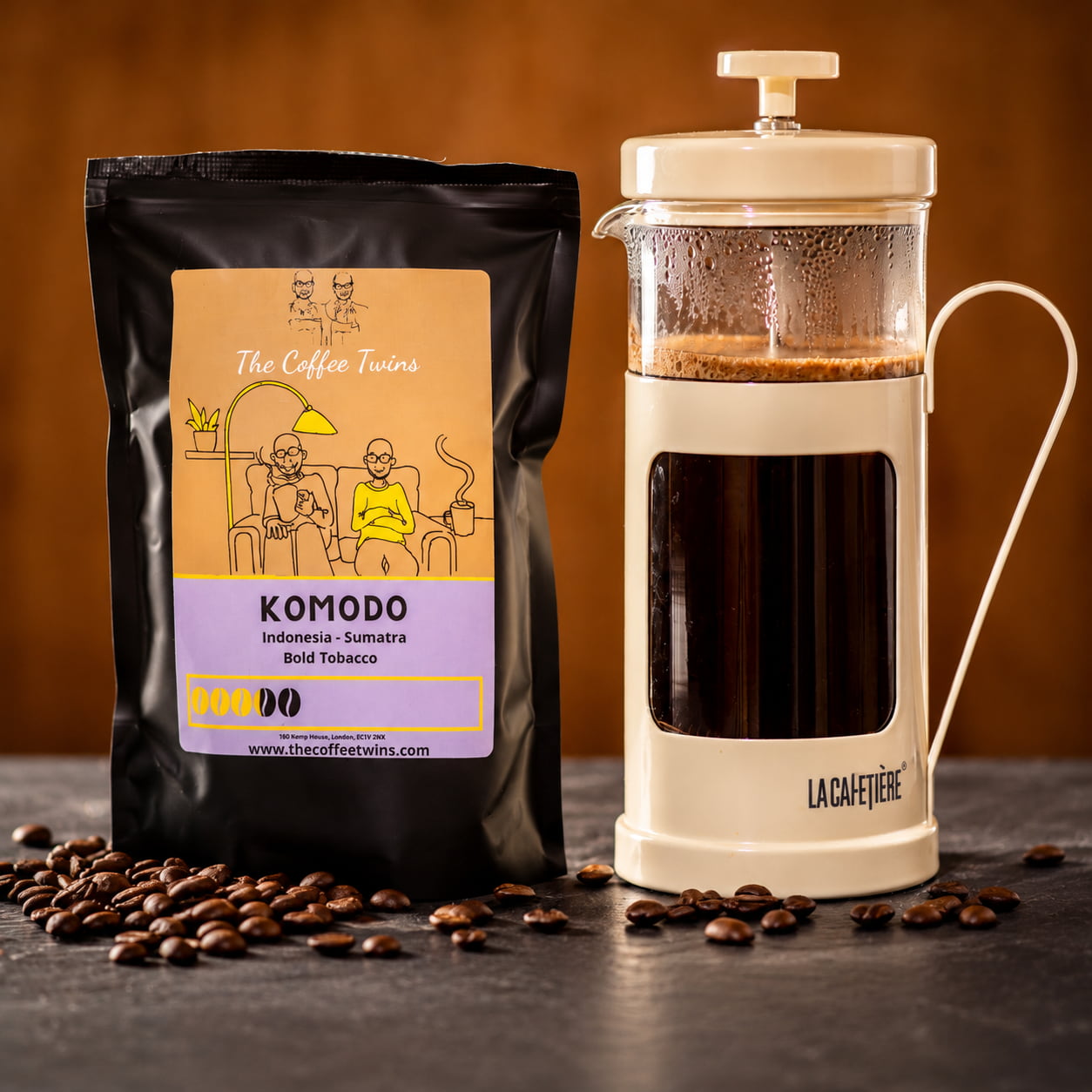
Komodo is our Sumatran single origin. Spicy means pepper and cinnamon, bold means full body and intense flavour, and tobacco is the distinctive earthy note that comes from Giling Basah processing. Likewise, Komodo is at its best in a cafetière or Moka pot.
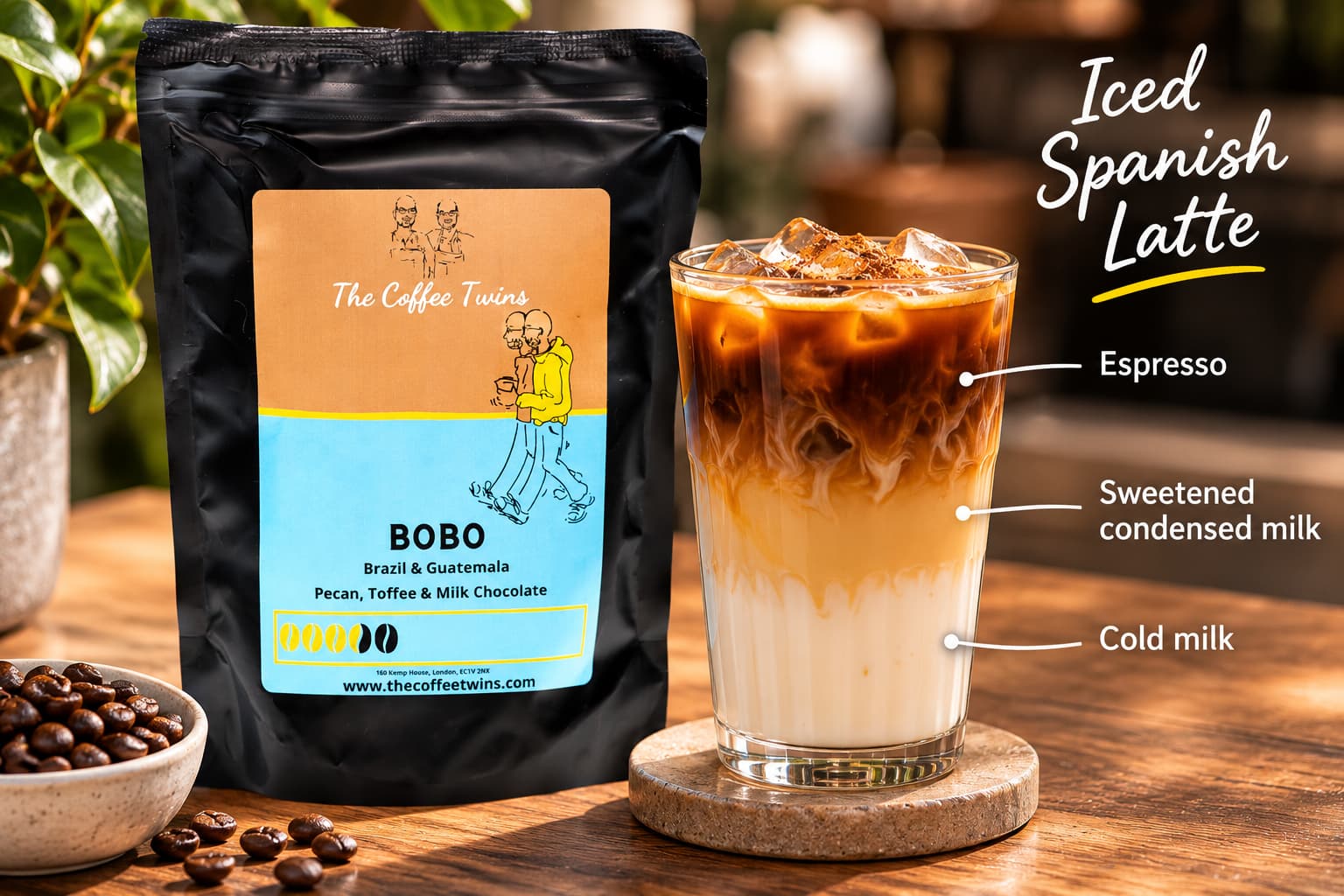
Bobo: pecan, toffee, milk chocolate
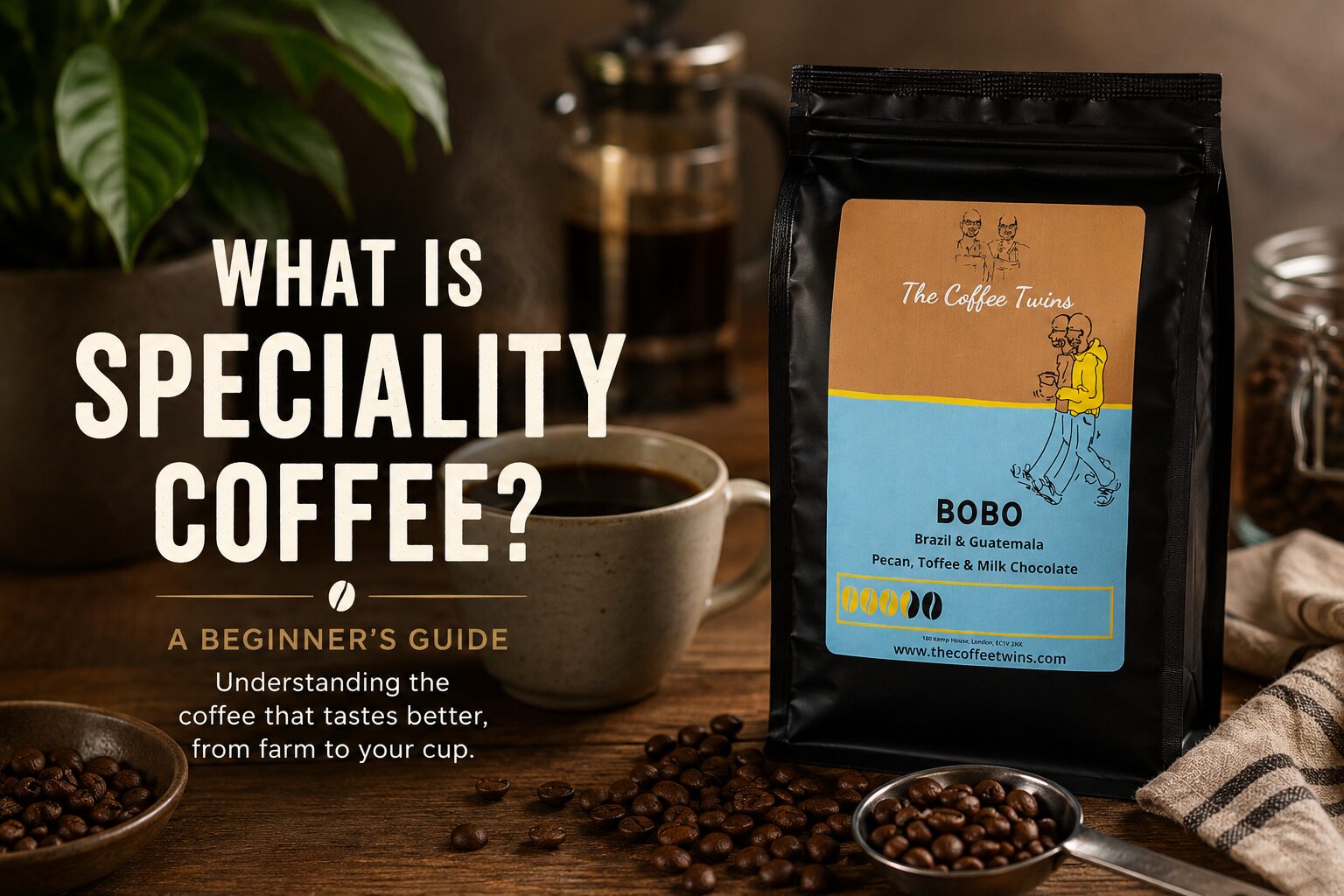
Bobo is our Brazil and Guatemala blend. Pecan is a soft nut character, toffee is buttery sweetness, and milk chocolate means creamy rather than bitter. Meanwhile, Bobo is our everyday workhorse and suits almost every brewing method.
Audley: caramel, dark chocolate
Audley is our Brazil, El Salvador, and India dark blend. Caramel is the developed sweetness of a darker roast, and dark chocolate means intense, bitter-leaning cocoa. Lastly, Audley is our strongest coffee and suits espresso and milk-based drinks.
Want to compare tasting notes side by side? Our Tasting Pack covers three distinctly different profiles (Audley, Bobo, Jojo) in one order so you can taste the full range. Use NEW10 for 10% off your first order.
Frequently Asked Questions
What do coffee tasting notes mean?
Coffee tasting notes are specific flavour, aroma, and texture descriptors that describe what you’ll experience in a particular coffee. Most are drawn from the SCA Flavour Wheel, which lets roasters, baristas, and drinkers describe flavour consistently.
How accurate are coffee tasting notes?
Tasting notes from speciality roasters are usually reliable because they come from cupping the coffee. In contrast, notes on supermarket coffee are more often marketing descriptors than the result of an evaluation.
Can I actually taste the notes in my coffee?
Yes, with practice. Developing your palate takes weeks or months of attentive tasting, but most people can pick out broad categories (fruity, chocolatey, nutty) within a few weeks of paying attention to what they’re drinking.
What’s the difference between tasting notes and flavour notes?
The terms are used interchangeably in speciality coffee. In other words, both describe the flavour, aroma, and texture of a particular coffee.
Why do my tasting notes differ from the roaster’s?
Palates differ. Taste perception varies with genetics, the foods you grew up with, and training, and your brew method and water change the cup too. So treat a roaster’s notes as a starting point, not a statement of what you must taste.
What’s the SCA Flavour Wheel?
The SCA Flavour Wheel is the industry-standard tool for describing coffee flavour. It organises descriptors into three concentric rings, from broad families (fruity, nutty/cocoa, floral) to specific descriptors (lemon, hazelnut, dark chocolate).
How do I develop my coffee palate?
Taste coffee attentively, compare different coffees side by side, read the tasting notes while you drink, and keep a tasting journal. A triangle test (three cups, two the same, find the odd one out) speeds things up.
What tasting notes should beginners try first?
Start with chocolatey, nutty, and sweet notes from Central American or Brazilian coffees, because those flavours are familiar and easy to spot. Our Parrot (Brazilian Cerrado) is sweet, nutty, and chocolatey, and a good first speciality coffee.
Which coffees have the most unusual tasting notes?
Ethiopian and Kenyan coffees usually surprise new drinkers most, with notes like winy, blueberry, blackcurrant, and jasmine. Our Jojo (Ethiopian Limu) is a good example.
Where do tasting notes on coffee packaging come from?
Speciality roasters develop tasting notes through cupping sessions, where trained tasters evaluate the coffee and agree on its dominant flavours.
Summary
Coffee tasting notes are the flavour, aroma, and texture descriptors that tell you what you’ll actually taste in a particular coffee.
Good tasting notes share four qualities:
- Based on cupping rather than marketing invention
- Specific enough to be useful (“blueberry, dark chocolate”) rather than vague (“strong, smooth”)
- Honest about what the coffee delivers rather than aspirational
- Matched to the origin, varietal, processing, and roast that produce those flavours
Our three single origin coffees deliver distinctly different tasting notes:
- Jojo (Ethiopian Limu): fruity, winy, sweet
- Parrot (Brazilian Cerrado): sweet, nutty, chocolatey
- Komodo (Sumatran): spicy, bold, tobacco
Every bean we supply is roasted in England to order and stocked in five-star London hotels including Trafalgar St James. Use NEW10 for 10% off your first order. Free UK shipping over £30.
Shop the Single Origin Bundle →
Enjoying this article?
If you find our coffee guides useful, you can add The Coffee Twins as a preferred source in Google so our latest articles are easier to find in your search results.
Add The Coffee Twins as a preferred source on Google →
Thanks for supporting our little coffee corner of the internet.
0 Comments