

Want to try a proper light roast? Our Jojo (Ethiopian Limu) is light-roasted to 2.5/5 with fruity, winy, sweet notes. £9.50 / 250g, free UK shipping over £30.
Why trust this guide?

We’re Jeremiah and Raja — The Coffee Twins, a UK speciality coffee brand with beans roasted in England. Specifically, our beans are stocked in five-star London hotels, and we trained in five-star hotel food and beverage before running our own coffee shop in Farringdon. Furthermore, two of our eight coffees are light roasts (Jojo Ethiopian Limu, and Parrot Brazilian Cerrado), so we know how light roasts behave, what they taste like, and which brewers bring out their best. Above all, this guide is the honest version of what we’d teach a customer who’d never tried one before.
Table of contents
- What is a light roast coffee? (The technical definition)
- How light roast coffee actually tastes
- Light roast coffee processing: natural, washed & honey methods
- Light roast vs medium roast vs dark roast
- The third wave coffee movement and why light roasting matters
- Does light roast coffee have more caffeine?
- How to spot a light roast coffee in the bag and the cup
- How to store light roast coffee for maximum freshness
- The best brewing methods for light roast coffee
- Brewers to avoid with light roast coffee
- Light roast coffee buying guide: what to look for
- Our light roast coffee: Jojo and Parrot
- Should you try a light roast coffee?
- FAQ
What Is a Light Roast Coffee? The Technical Definition

A light roast is coffee that’s been roasted for the shortest time at the lowest temperatures of any roast level. Specifically, coffee beans are roasted in batches in commercial roasters, and the roast level is determined by when the roaster stops the process.
Here’s what happens during roasting:
- First crack: Around 196–205°C, the beans audibly crack as moisture vaporises and expands. Furthermore, this is when light roasts are typically pulled.
- Light roast finish: Just after first crack — beans are light brown, dry on the surface (no oil), with no visible darkening.
- Medium roast finish: A minute or two after first crack — beans are medium brown, dry.
- Dark roast finish: At or just before “second crack” (around 224°C) — beans are dark brown to nearly black, often visibly oily on the surface.
In short, the longer you roast, the darker the bean. Specifically, light roasts spend the least time at high temperatures. As a result, they preserve more of the bean’s original character.
Why the roasting temperature matters
Above all, roast temperature affects the chemistry of the bean fundamentally. Specifically, three key transformations happen during roasting:
- Maillard reaction: Furthermore, sugars and amino acids react to create hundreds of new flavour compounds. Above all, this creates the sweetness and body in coffee.
- Caramelisation: Specifically, sugars break down at higher temperatures, adding caramel and toffee notes. As a result, medium and dark roasts have more of these flavours.
- Chlorogenic acid degradation: Above all, these naturally-occurring acids break down as roasting continues. Furthermore, this is why light roasts taste brighter and more acidic than dark roasts.
Furthermore, light roasts stop this process early — preserving more of the bean’s original chemistry. As a result, you taste the coffee bean itself, not just the roasting process.
How Light Roast Coffee Actually Tastes
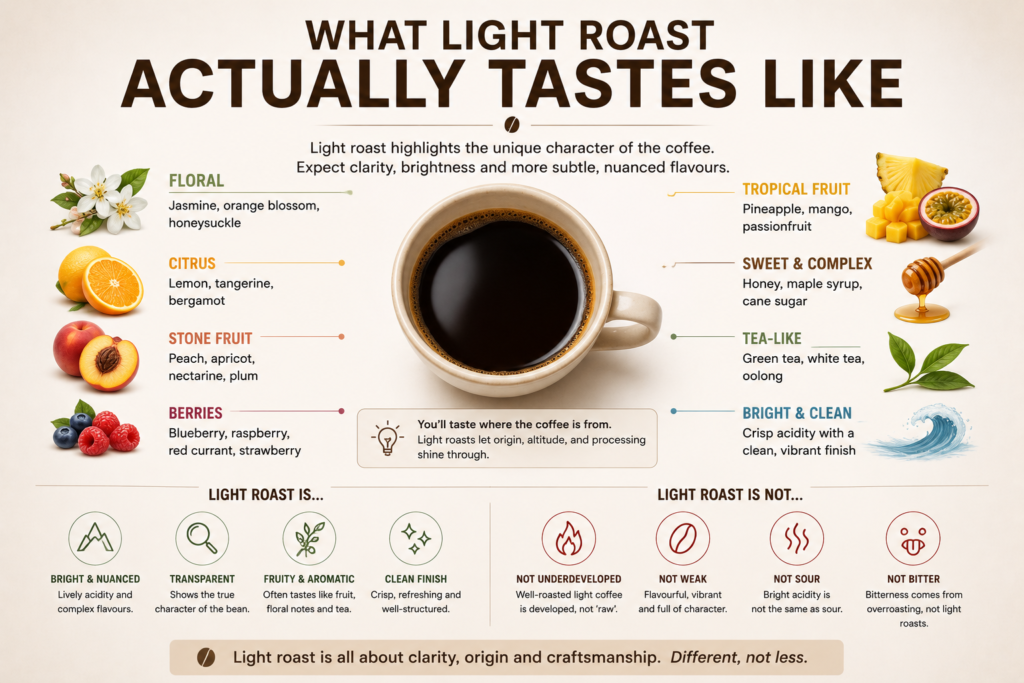
This is where the magic happens. Specifically, light roast coffee tastes fundamentally different from medium or dark roasts — and once you’ve tried one properly brewed, you’ll understand why.
The defining flavour characteristics of light roast coffee
- Bright acidity: Lively, citrusy, sometimes winy. Furthermore, this is a feature, not a fault.
- Fruity or floral notes: Berries, stone fruit, jasmine, bergamot, citrus zest.
- Distinct origin character: Specifically, you can taste where the coffee was grown.
- Light body: Tea-like rather than syrupy.
- Clean finish: The coffee leaves your palate quickly, ready for the next sip.
What light roast coffee does NOT taste like
- Not bitter — bitterness is mostly from dark roasting
- Not “strong” in the supermarket sense — strength here is complexity, not intensity
- Not chocolatey or roasty — those notes come from longer roasting
- Not heavy or full-bodied — light roasts are lighter on the tongue
Above all, the surprise for most UK drinkers trying a light roast for the first time is just how fruity coffee can naturally be. Specifically, our Jojo Ethiopian Limu has notes of stone fruit and red wine that genuinely don’t taste like “regular coffee” — and that’s the point.
Common tasting notes to expect in a light roast
Furthermore, professional coffee tasters use “flavour wheels” to describe coffee. Above all, light roasts commonly show notes across three flavour families:
- Fruit family: Blueberry, strawberry, cherry, apple, pear, lemon, lime, bergamot, apricot, peach, plum
- Floral family: Specifically, jasmine, honeysuckle, rose, orange blossom, chamomile
- Sweet family: Above all, honey, brown sugar, molasses, cane sugar
By the way, a well-crafted light roast might feature 3-5 distinct notes at once. Furthermore, this complexity is what separates speciality coffee from commodity coffee.
Light Roast Coffee Processing: Natural, Washed & Honey Methods
Specifically, how a coffee cherry is processed before roasting dramatically affects how a light roast tastes. Furthermore, this is why the same Ethiopian bean can taste completely different depending on processing method. Above all, understanding this genuinely helps you choose the right light roast coffee for your palate.
Washed processing (the clean, bright option)
Above all, washed processing removes the fruit before drying the beans. Specifically, this produces the cleanest, brightest flavour profile — perfect for showcasing origin character.
- Flavour profile: Bright, clean, defined acidity, distinct origin notes
- Best for: People who want the most refined tasting experience
- Common origins: Ethiopia (Yirgacheffe), Kenya, Colombia, Central America
Furthermore, our Jojo uses washed processing — hence the crisp, defined fruit notes. As a result, you get the cleanest possible expression of the Ethiopian Limu terroir.
Natural (dry) processing
Specifically, natural processing dries the beans with the fruit still attached. As a result, sugars from the fruit permeate the bean, creating sweeter, fruitier, more intense flavours.
- Flavour profile: Sweet, jammy, wine-like, sometimes wild and funky
- Best for: Adventurous drinkers who love fruit-forward coffee
- Common origins: Ethiopia (Sidamo), Brazil, Yemen
Furthermore, natural Ethiopian coffees are famous for berry and blueberry notes. Above all, they can taste almost like fruit juice compared to washed coffees.
Honey (pulped natural) processing
Above all, honey processing sits between washed and natural — some fruit mucilage stays on during drying. Specifically, this creates a balanced sweetness-plus-clarity profile.
- Flavour profile: Balanced sweetness, moderate acidity, honey-like undertones
- Best for: People who want fruit character without the intensity of naturals
- Common origins: Costa Rica, Brazil, El Salvador
Furthermore, our Parrot uses pulped natural processing — hence its rounded sweetness. As a result, it’s a gentler introduction to Brazilian speciality coffee.
Why processing matters for light roasts specifically
Specifically, light roasting preserves processing character. Furthermore, on a dark roast, all three methods start tasting similar (roast character dominates). As a result, if you want to actually TASTE processing differences, light roast coffee is genuinely the only way.
By the way, this is why speciality coffee shops obsess over processing methods. Above all, it’s a whole dimension of flavour that only exists in light-to-medium roasts.
Light Roast vs Medium Roast vs Dark Roast
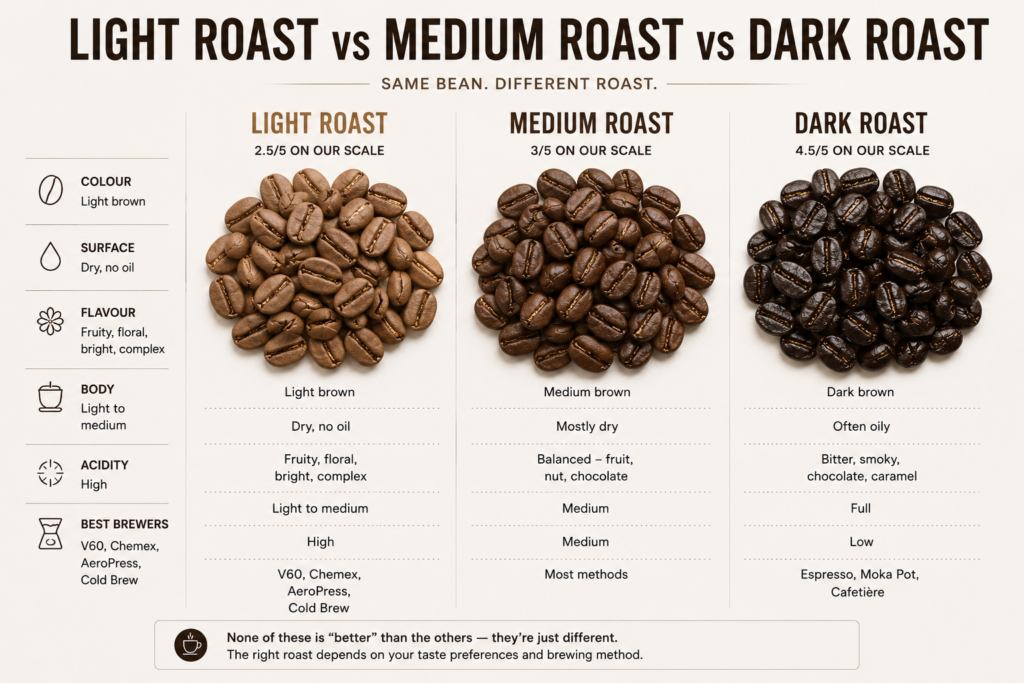
Specifically, here’s how the three roast levels compare on the things that matter:
• Colour: Light brown
• Surface: Dry (no oil)
• Flavour: Fruity, floral, bright, complex
• Body: Light to medium
• Acidity: High
• Best brewers: V60, Chemex, AeroPress, cold brew
Medium roast (3/5 to 3.5/5)
• Colour: Medium brown
• Surface: Mostly dry
• Flavour: Balanced — fruit, nut, chocolate
• Body: Medium
• Acidity: Medium
• Best brewers: Most methods
Dark roast (4/5 to 4.5/5)
• Colour: Dark brown to nearly black
• Surface: Often oily
• Flavour: Bitter, smoky, chocolate, caramel
• Body: Full
• Acidity: Low
• Best brewers: Espresso, moka pot, cafetière
By the way, none of these is “better” than the others — they’re just different. Specifically, the right roast depends on what you want from the cup and how you brew it. Furthermore, dark roast suits espresso and milk drinks; light roast suits filter coffee and shows off origin character.
When to choose each roast level
Above all, honest guidance on which roast fits your situation:
- Choose light roast if: You brew filter coffee, want to taste origin character, enjoy fruit-forward flavours, drink coffee black
- Choose medium roast if: Furthermore, you want versatility, drink both black coffee and milk drinks, prefer balanced flavour
- Choose dark roast if: Above all, you make espresso at home, drink lots of milk drinks, prefer bold intense flavour, have a moka pot
Furthermore, see our detailed coffee roast profiles guide for the full comparison.
The Third Wave Coffee Movement and Why Light Roasting Matters
Specifically, to understand why light roasting has become so important in modern coffee, you need to know about the “third wave” coffee movement. Furthermore, this is genuinely the philosophy behind modern speciality coffee.
The three waves of coffee culture
Above all, coffee experts describe modern coffee history in three “waves”:
- First wave (1800s-1960s): Coffee as commodity. Furthermore, characterised by mass-produced brands like Folgers and Maxwell House. Above all, dark roasted to mask low bean quality.
- Second wave (1960s-2000s): Specifically, coffee as experience. Furthermore, Starbucks led the way — introducing UK drinkers to espresso, lattes, and “café culture.” Above all, still mostly dark roasted.
- Third wave (2000s-present): As a result, coffee as craft. Specifically, coffee treated like wine — origin matters, farmer relationships matter, processing matters, roasting matters.
Why light roasting defines third wave coffee
Specifically, third wave coffee is about tasting where coffee comes from. Furthermore, dark roasting masks origin character with roast character. As a result, light roasting became the third wave standard — because it preserves everything that makes each coffee unique.
Above all, when you drink a well-crafted light roast, you’re tasting:
- The specific region where the coffee was grown
- Furthermore, the altitude and climate conditions
- Above all, the processing method chosen by the farmer
- The specific varietal (like a wine grape variety)
- As a result, the entire story of that coffee in a single cup
The UK speciality coffee scene
Furthermore, the UK has become one of Europe’s strongest speciality coffee scenes. Specifically, cities like London, Bristol, Manchester, and Edinburgh have thriving third wave coffee cultures. Above all, our own coffee shop background (Farringdon, London) was part of this movement. As a result, we bring third wave principles to our light roasts today.
By the way, see our best independent UK coffee brands guide for more on the modern UK speciality scene.
Does Light Roast Coffee Have More Caffeine?
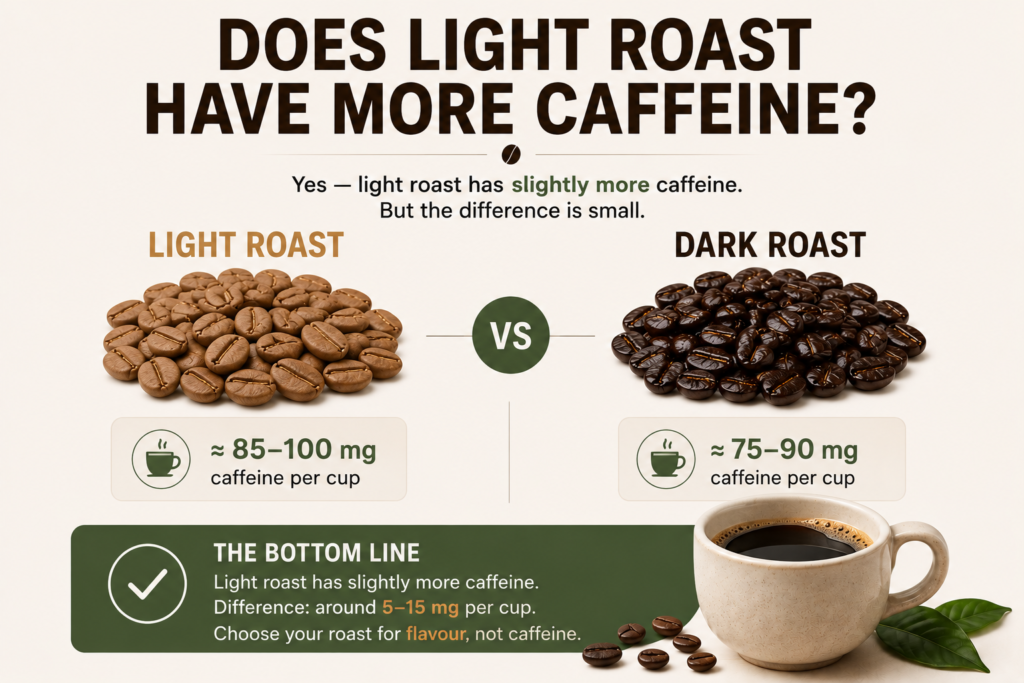
Yes — slightly more, by weight. Specifically, the roasting process breaks down some caffeine molecules. As a result, dark roasts contain slightly less caffeine than light roasts of the same bean.
The caffeine content by roast level
However, the difference is smaller than most people think:
Light roast (filter brewed): ~95–110mg
Medium roast (filter brewed): ~85–100mg
Dark roast (filter brewed): ~75–90mg
Espresso shots (30ml):
Light roast espresso: ~70–85mg
Medium roast espresso: ~65–80mg
Dark roast espresso: ~60–75mg
Above all, the difference is roughly 5–15mg per cup — small but real. Furthermore, the common assumption that “stronger-tasting coffee = more caffeine” is wrong. Specifically, dark roasts taste stronger because of flavour intensity, not caffeine content.
How brewing method affects caffeine
Specifically, brewing method affects caffeine as much as roast level:
- Cold brew: Highest caffeine per serving (12-18 hour extraction)
- Furthermore, filter/pour-over: High caffeine due to volume consumed
- Above all, espresso: Concentrated but small serving
- French press: Similar to filter brewing
- Instant: Lowest caffeine per typical serving
UK caffeine intake guidance
Above all, the NHS recommends UK adults consume under 400mg of caffeine daily. Specifically, that’s roughly 4 cups of light roast filter coffee, or 5-6 shots of espresso. Furthermore, pregnant women should stay under 200mg daily.
For more detail, see our comprehensive UK guide to caffeine in coffee.
How to Spot a Light Roast Coffee in the Bag and the Cup
In the bag
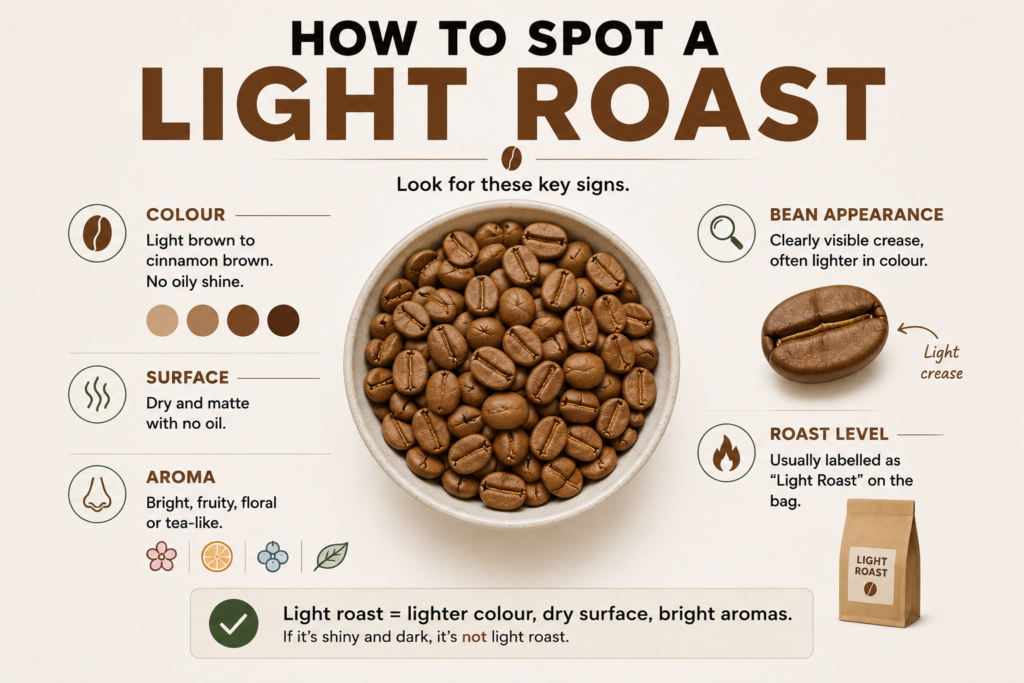
- Colour: Light tan to medium brown — never dark brown or black
- Surface: Completely dry. Specifically, no visible oil on the beans
- Roast scale on the bag: 1/5 to 2.5/5 (or “light” / “blonde” / “cinnamon” roast)
- Tasting notes: Fruity, floral, citrusy, winy, tea-like — not chocolatey or roasty
In the cup
- Colour: Lighter brown than typical coffee
- Aroma: Floral, fruity, complex — not “coffee-shop coffee” smell
- First sip: Bright, lively, distinctly flavoured
- Finish: Clean — the coffee leaves your palate quickly
What the bag should tell you
Furthermore, a proper speciality coffee bag should show:
- Roast date (not “best before” — the actual date it was roasted)
- Origin (country + region + ideally farm)
- Processing method (washed / natural / honey)
- Varietal (like a wine grape — e.g. Bourbon, Typica, Heirloom)
- Above all, tasting notes from the roaster
Above all, if a bag doesn’t tell you these things, it’s probably not proper speciality coffee. Furthermore, our own bags include all this information because transparency matters. As a result, you know exactly what you’re drinking.
How to Store Light Roast Coffee for Maximum Freshness
Specifically, light roast coffee is more sensitive to freshness loss than dark roasts. Furthermore, this is because the delicate origin flavours are the first to fade. Above all, proper storage genuinely makes a huge difference.
The four enemies of coffee freshness
- Oxygen: Specifically, oxidation starts within minutes of grinding, hours after opening a bag
- Light: Furthermore, UV light damages coffee compounds
- Heat: Above all, warmth accelerates staling
- Moisture: As a result, humidity destroys aromatics and can grow mould
The correct way to store light roast coffee
Specifically, here’s what genuinely works:
- Buy whole beans, grind as you brew. Above all, this is the single biggest freshness factor. Furthermore, pre-ground coffee stales within 15-30 minutes of grinding.
- Store in an airtight opaque container. Specifically, glass jars in cupboards, ceramic canisters, or purpose-built coffee vaults with one-way valves.
- Keep at room temperature away from heat sources. Furthermore, no fridge, no freezer, no near-the-cooker storage.
- Use within 4-6 weeks of roast date. Above all, this is when flavour peaks. As a result, older coffee tastes flat.
What to avoid
- The fridge: Specifically, condensation damages beans. Furthermore, coffee absorbs fridge odours
- The freezer: Above all, only acceptable for long-term (3+ month) storage in vacuum-sealed portions
- Clear glass jars in sunlight: Furthermore, UV damages coffee within days
- Original bag once opened: Above all, most coffee bags aren’t fully airtight after opening
Signs your coffee has gone stale
Specifically, stale coffee shows these signs:
- Loss of aroma when you smell the beans
- Furthermore, flat, one-dimensional flavour
- Above all, loss of the distinctive origin notes
- Cardboard or musty taste
By the way, this matters more for light roasts than any other roast level. Furthermore, dark roasts hide staleness through roast character. Above all, light roasts have nowhere to hide — freshness genuinely shows.
The Best Brewing Methods for Light Roast Coffee
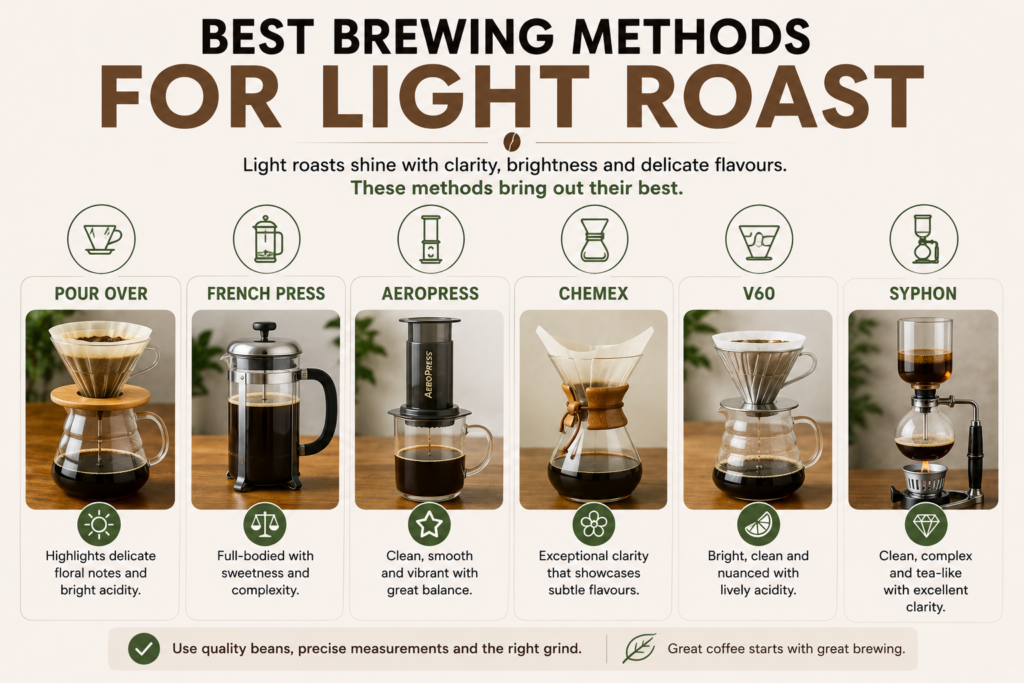
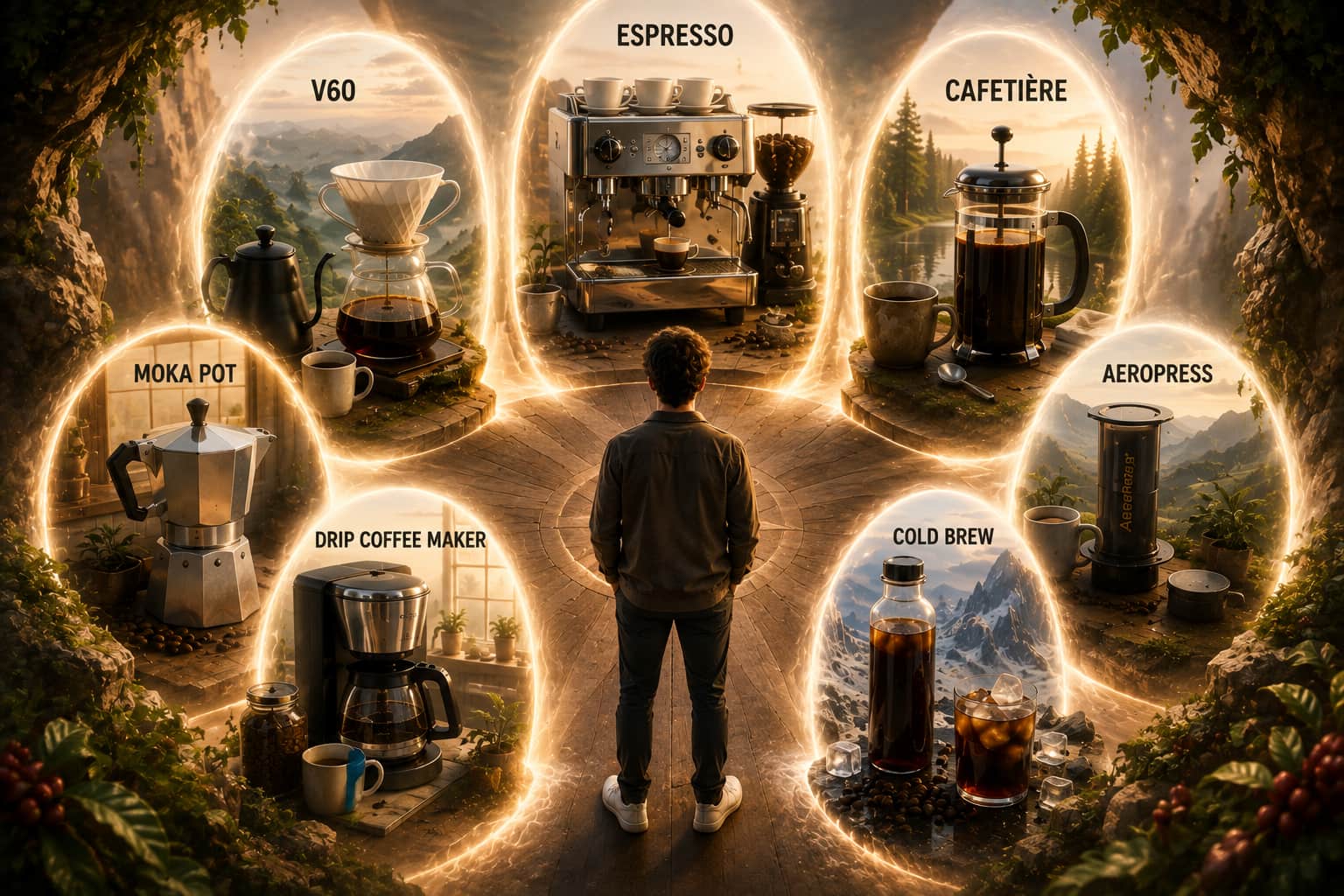
Light roasts shine in specific brewers. Specifically, the methods that work best are paper-filter pour-overs and cold brewing. As a result, the brewing method preserves the origin character without dampening it.
V60 / pour-over (the gold standard)
Paper-filter pour-over brewing is the world’s preferred method for showing off light roasts. Specifically, the paper filter clarifies the coffee, removing oils and fines. As a result, the bright origin character comes through cleanly.
• Coffee: 15g Jojo, ground medium-fine
• Water: 250g at 92–94°C
• Ratio: 1:16 (coffee to water)
• Bloom: 30g water for 30 seconds
• Main pour: Reach 250g total by 1:30
• Total brew time: 2:30–3:00
• Grind size: Fine sea salt texture
Chemex
Similar to V60 but with thicker filter paper. Furthermore, it produces an even cleaner cup. As a result, Chemex is brilliant for very bright, fruity light roasts.
- Coffee: 20g for 300g water (1:15 ratio)
- Water temp: 94°C
- Grind: Medium-coarse (slightly coarser than V60)
- Total time: 4:00-5:00
AeroPress
Versatile and forgiving. Specifically, AeroPress recipes can be tailored to bring out the best in any light roast coffee.
- Standard AeroPress recipe: 15g coffee, 200g water at 85°C, 2 minute steep, plunge over 30 seconds
- Furthermore, inverted method: Gives more control for delicate light roasts
Cold brew
Cold brewing extracts gently over 12–18 hours. As a result, the slow extraction preserves the delicate fruity notes that hot brewing can sometimes flatten.
- Ratio: 100g coffee to 1L water (1:10)
- Steep time: 14 hours at fridge temperature
- Grind: Coarse (like sea salt)
Furthermore, see our full cold brew guide for detailed method.
Filter machines
Standard drip coffee machines work fine with light roasts, provided they brew at a high enough temperature (above 90°C). Furthermore, single-cup pour-over machines like the Moccamaster are especially good.
Brewers to Avoid with Light Roast Coffee
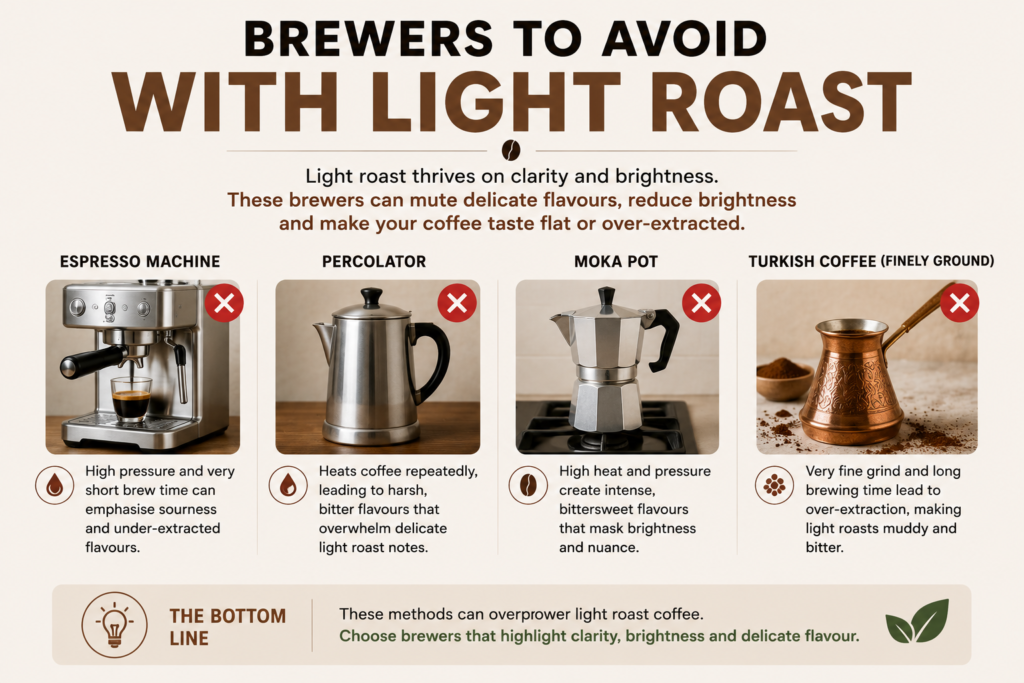
Specifically, some brewers don’t suit light roast coffee. As a result, you’ll get a sour, hollow, or thin cup if you use the wrong method.
Espresso machines
Light roasts can absolutely work in espresso, but they’re tricky. Specifically, light roasts need very fine grinding and careful dialling-in to extract properly. Furthermore, on a home espresso machine, light roasts often taste sour without expert technique. As a result, we’d save the light roasts for filter brewing on most home setups.
Moka pots
Moka pots’ pressure extraction emphasises body and roast character. Specifically, light roasts get lost in moka pots — the bright notes that make them special are masked. Therefore, save the light roasts for V60 and use dark roasts like our Ant in the moka pot.
Cafetière (French press)
The metal filter passes through oils and fines. Specifically, this works against the clean, bright character of light roasts. As a result, cafetière brewing tends to muddy light roasts. By contrast, it’s perfect for medium-to-dark coffees like our Komodo.
Bean-to-cup machines
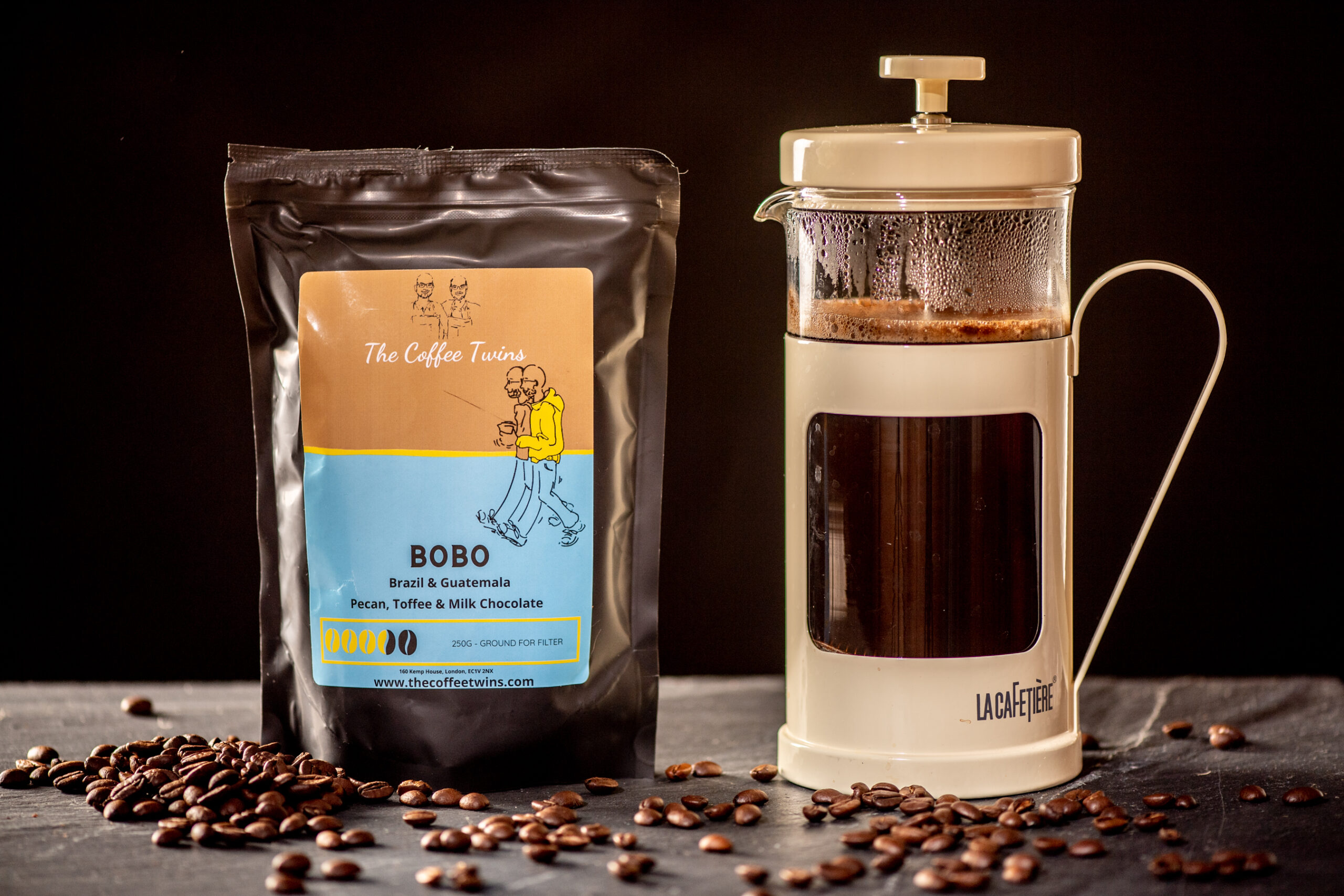
Most bean-to-cup machines (Sage Oracle, De’Longhi, etc.) struggle with light roasts. Specifically, the grinder settings and pre-infusion are calibrated for medium-to-dark blends. Therefore, use a medium-roast blend like our Bobo in bean-to-cup machines.
Light Roast Coffee Buying Guide: What to Look For
Specifically, when buying light roast coffee, five factors genuinely matter. Furthermore, getting these right transforms your home coffee experience.
1. Roast date matters most
Above all, look for beans roasted within the last 3-4 weeks. Specifically, light roasts peak between days 7-28 after roasting. Furthermore, any bag without a clear roast date is a red flag. As a result, avoid supermarket coffee — typically 3-9 months old.
2. Buy whole beans, not pre-ground
Specifically, pre-ground coffee loses 60% of its flavour compounds within 15 minutes. Furthermore, this is dramatically worse for light roasts than dark roasts. Above all, invest in a decent burr grinder if you can (£50-150 range is fine).
3. Choose single origins over blends
Above all, single origin light roasts showcase the specific character of one region. Furthermore, blends are typically designed for medium roasts. As a result, our Jojo and Parrot are both single origins — because that’s where light roasts shine.
4. Look for detailed origin information
Specifically, quality light roasts tell you:
- Country and region
- Furthermore, farm or cooperative name
- Above all, altitude of growing
- Varietal (bean type)
- Furthermore, processing method
By the way, if a bag just says “Colombia” or “Ethiopia” without more detail, it’s probably not proper speciality-grade coffee.
5. Trust the tasting notes
Above all, roaster tasting notes are genuinely useful. Furthermore, if a bag says “notes of blueberry, jasmine, and honey,” those flavours should actually come through. As a result, trust roasters who give specific descriptions over vague ones like “smooth” or “rich.”
Where to buy light roast coffee UK
Specifically, buy direct from speciality roasters rather than supermarkets. Furthermore, this ensures maximum freshness. Above all, see our best place to buy coffee beans online UK guide for detailed comparisons.
Our Light Roast Coffee: Jojo and Parrot
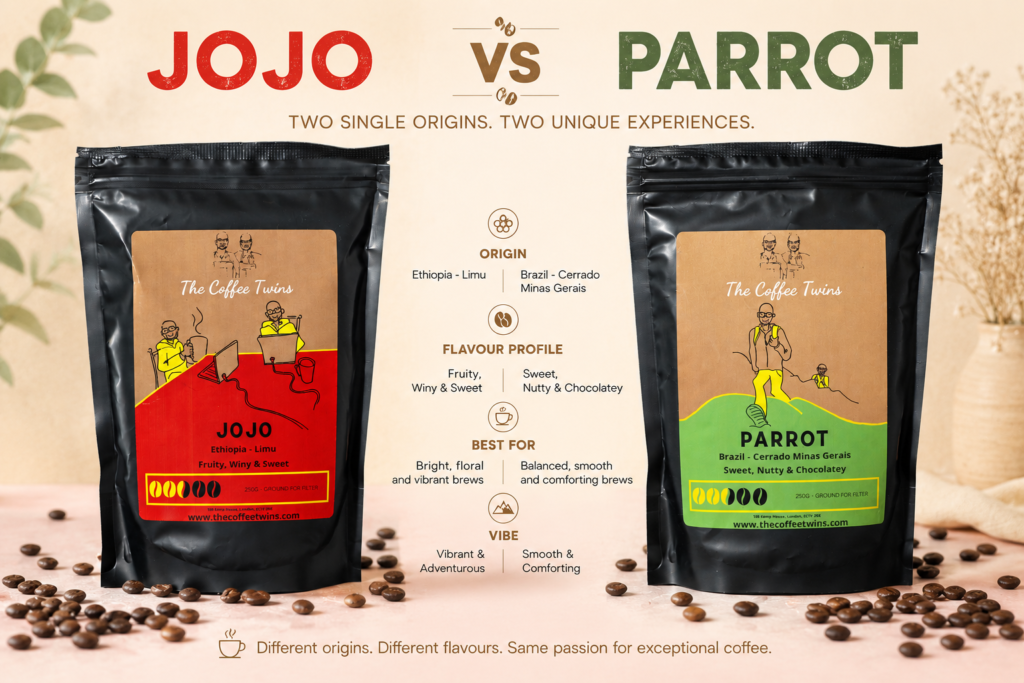
Two of our eight coffees are light roasts. Specifically, each one showcases what light roasting can do with a different origin.
Jojo (Ethiopian Limu single origin)
Origin: Ethiopia, Limu region
Roast: 2.5/5 (light) | Body: 3/5 | Sweetness: 4/5 | Acidity: 4/5
Processing: Washed
Tasting notes: Fruity, winy, sweet
Price: £9.50 / 250g
Buy Jojo →
Jojo is our flagship light roast — and the coffee that most clearly shows what light roasting unlocks. Specifically, Ethiopian Limu beans are naturally fruity and complex. Furthermore, the light roast preserves the stone fruit, red wine, and sweet floral notes that make Ethiopian coffee internationally famous.
In the cup, Jojo tastes like a different drink to most UK supermarket coffee — closer to a delicate red wine than to “instant coffee.” As a result, it’s the coffee we recommend to anyone curious about what speciality coffee can really taste like.
Best brewer for Jojo: V60 or Chemex.
Parrot (Brazilian Cerrado single origin)
Origin: Brazil, Cerrado Minas Gerais
Roast: 2.5/5 (light) | Body: 3/5 | Sweetness: 3/5 | Acidity: 3/5
Processing: Pulped natural (honey)
Tasting notes: Sweet, nutty, chocolatey
Price: £9.50 / 250g
Buy Parrot →
Parrot is our gentler light roast — Brazilian rather than Ethiopian, with nutty and chocolatey character instead of fruity brightness. Specifically, Brazilian coffee is naturally low-acidity and rounded, so light roasting brings out sweetness without the wild flavour intensity of Jojo.
As a result, Parrot is the perfect “first light roast” for someone curious to try but not quite ready for the fruit-bomb Ethiopian experience.
Best brewer for Parrot: V60, AeroPress, or cold brew.
Should You Try a Light Roast Coffee?
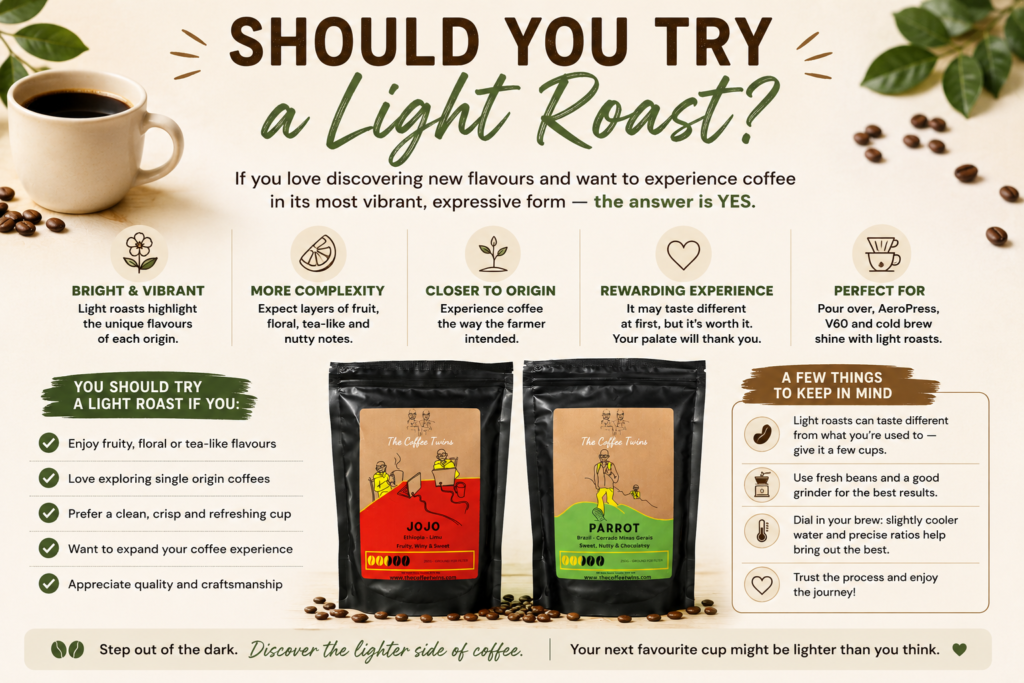
Honestly, yes — at least once. Specifically, here’s why:
Light roast coffee is what speciality coffee actually is. Furthermore, when coffee experts talk about “tasting notes” and “origin character,” they’re almost always talking about light to medium-light roasts. As a result, if you’ve never had a proper light roast, you’ve never tasted what speciality coffee is really about.
It might change how you think about coffee. Specifically, drinking a fruity Ethiopian for the first time genuinely makes most people say “this is coffee?” — in a good way.
It pairs brilliantly with food. By contrast to bitter dark roasts, light roasts cut through fatty breakfast foods, complement pastries, and work beautifully as an after-dinner alternative to dessert wine.
What to expect on your first light roast
Specifically, first-time light roast drinkers often experience:
- Initial surprise: “This tastes like fruit juice, not coffee”
- Furthermore, curiosity: “Where do these flavours come from?”
- Above all, palate development: Ability to taste more nuanced flavours over time
- New appreciation: Understanding why speciality coffee costs more than supermarket
Food pairings that work brilliantly with light roast
Furthermore, light roasts pair beautifully with:
- Breakfast: Croissants, pain au chocolat, buttery pastries
- Cheese: Specifically, aged cheddar, brie, goat’s cheese
- Above all, dessert alternatives: Dark chocolate, fruit tarts, panna cotta
- Snacks: Nuts, dried fruit, biscotti
Who might NOT enjoy light roast coffee
Specifically, light roast coffee isn’t for everyone:
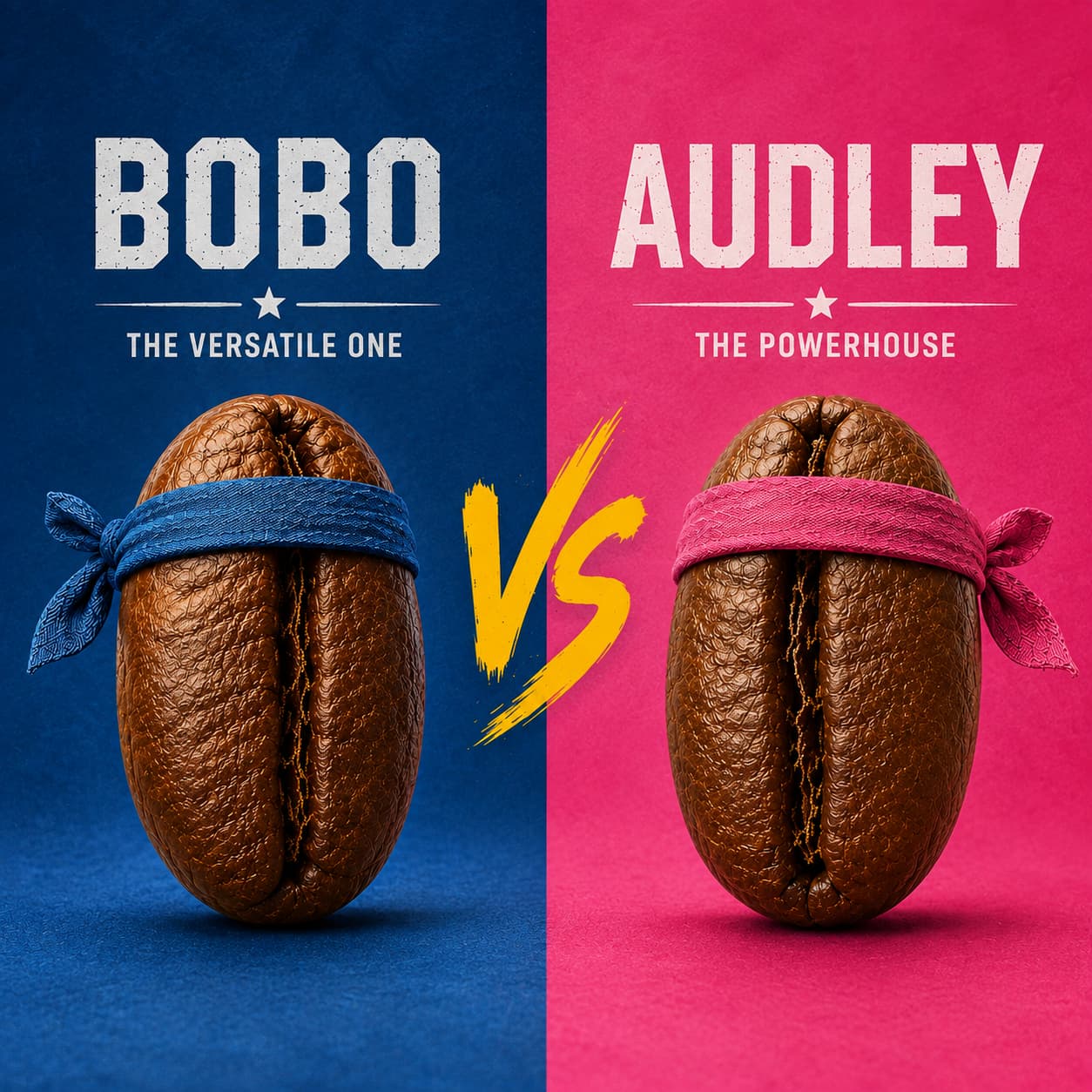
- If you drink your coffee with lots of milk: Light roasts get lost in milk. Therefore, stick to medium-to-dark blends like Bobo or Audley for lattes and flat whites.
- If you only have an espresso machine: Light roasts are difficult to extract on home espresso machines. As a result, you may find them sour.
- If you have a sensitive stomach: Light roasts contain more chlorogenic acid (broken down during longer roasting). Furthermore, this can trigger discomfort for some.
- If you prefer comforting, familiar coffee flavour: Specifically, light roasts can taste unusual to people used to supermarket coffee.
Frequently Asked Questions
What is a light roast coffee?
A light roast is coffee that’s been roasted for the shortest time at the lowest temperatures of any roast level. Specifically, the roasting is stopped just after the “first crack” at around 196–205°C. As a result, light roasts retain more of the bean’s natural origin character, including bright acidity, fruity or floral notes, and complex flavour.
What does light roast coffee taste like?
Light roast coffee tastes bright, fruity, floral, and clean — fundamentally different from medium or dark roasts. Specifically, you might taste notes of berries, stone fruit, citrus, jasmine, or red wine. Furthermore, light roasts have a lighter body (more tea-like than syrupy) and no chocolatey or roasty notes.
Does light roast coffee have more caffeine than dark roast?
Slightly yes. Specifically, dark roasting breaks down some caffeine molecules. As a result, the same beans light-roasted contain roughly 5–15mg more caffeine per cup than dark-roasted. By the way, the difference is smaller than most people think.
Is light roast coffee stronger than dark roast?
It depends what you mean by “strong.” Light roast contains slightly more caffeine. By contrast, dark roast tastes more intense and bitter. Specifically, “strength” in flavour comes from dark roasting, while “strength” in caffeine comes from light roasting. Therefore, the words “strong” and “weak” are often misleading.
How do I brew a light roast coffee?
Use a paper-filter pour-over method — V60, Chemex, AeroPress, or a filter machine. Specifically, brew with water at 92–94°C, use a medium-fine grind, and aim for a 2:30–3:30 total brew time. Furthermore, avoid espresso machines, moka pots, and cafetières for light roasts on most home setups.
Why is light roast coffee popular in speciality coffee?
Because light roasting preserves the origin character of the beans. Specifically, speciality coffee is about tasting where the coffee was grown — the country, the region, the farm, the processing method. As a result, light roasting lets all those flavours come through, while dark roasting masks them under roasted-bean character.
What’s the difference between washed and natural processed light roast coffee?
Specifically, washed processing removes the fruit before drying — producing cleaner, brighter flavours. Furthermore, natural processing dries beans with fruit attached — creating sweeter, fruitier flavours. Above all, both work brilliantly in light roasts but taste distinctly different. As a result, our Jojo is washed (clean and bright) and our Parrot is pulped natural (rounded sweetness).
How long does light roast coffee stay fresh?
Light roast coffee peaks between 7-28 days after roasting. Furthermore, it stays acceptable for up to 6 weeks if stored properly (airtight container, room temperature, away from light). Above all, older coffee loses the delicate origin flavours that make light roasts special.
Can I make a latte with light roast coffee?
You can, but the flavour will largely be lost. Specifically, light roasts have delicate fruit and floral notes that disappear in milk. Therefore, for milk drinks (lattes, flat whites, cappuccinos), use medium-to-dark blends like our Bobo or Audley.
Where can I buy light roast coffee in the UK?
The Coffee Twins — a UK speciality coffee brand with beans roasted in England. Specifically, our two light roasts are Jojo (Ethiopian Limu, fruity and winy) and Parrot (Brazilian Cerrado, sweet and nutty). Both £9.50 / 250g. Furthermore, free UK shipping over £30. Use NEW10 for 10% off your first order.
Summary
A light roast coffee is a coffee bean roasted for the shortest time at the lowest temperatures — typically pulled just after the first crack at around 196–205°C. Specifically, light roasts retain more of the bean’s natural origin character: bright acidity, fruity or floral notes, complex flavour, and a clean finish.
For brewing, light roasts shine in paper-filter pour-over methods like the V60, Chemex, and AeroPress. By contrast, they’re less suited to espresso machines, moka pots, and cafetières at home.
From our range, Jojo (Ethiopian Limu — fruity and winy) is the showcase light roast. Furthermore, Parrot (Brazilian Cerrado — sweet and nutty) is the gentler introduction. Above all, both are £9.50 / 250g, roasted in England, dispatched within 24 hours.
Try Jojo — Our Ethiopian Light Roast →
0 Comments