

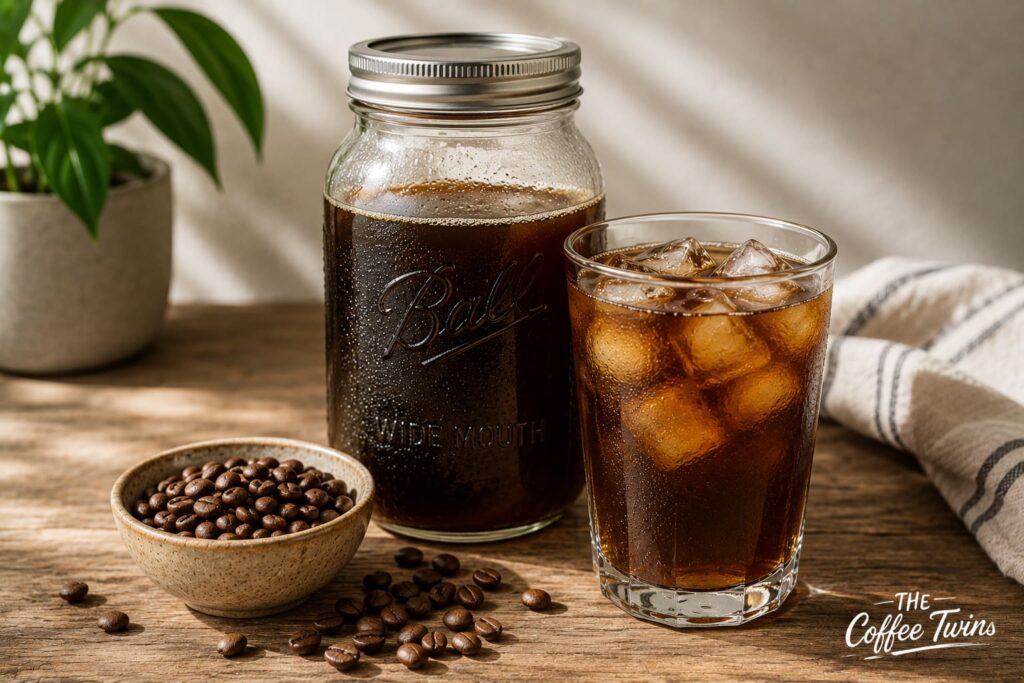
Quick answer: To make cold brew coffee at home in the UK, combine 100g of coarsely-ground coffee with 1 litre of cold filtered water. Specifically, steep in the fridge for 14 hours, strain through a paper filter, and store for up to 5 days. Furthermore, the right beans matter: naturally sweet, chocolatey, low-acidity single origins work best.
For cold brew, we recommend our Parrot (Brazilian Cerrado — sweet, nutty, chocolatey) as our top pick. £9.50 / 250g, free UK shipping over £30.
Why trust this guide?

We’re Jeremiah and Raja — The Coffee Twins. Before launching our UK speciality coffee brand, we trained in five-star hotel food and beverage and ran our own coffee shop in Farringdon. This guide is the exact recipe and technique we’d give a customer asking how to make cold brew coffee at home properly.
Table of contents
- What cold brew coffee actually is
- Cold brew vs iced coffee: what’s the difference?
- What you need (surprisingly little)
- The right beans for how to make cold brew coffee at home
- The recipe: how to make cold brew coffee at home step-by-step
- How to serve cold brew (concentrate vs ready-to-drink)
- Storage and shelf life
- Cold brew variations (nitro, milk, flavoured)
- Troubleshooting: why your cold brew tastes wrong
- FAQ
What Cold Brew Coffee Actually Is
Cold brew is coffee brewed with cold water over 12-18 hours. Specifically, this slow extraction produces a fundamentally different cup from hot coffee. Furthermore, cold brew contains around 60% less acidity than hot-brewed coffee — making it smoother, sweeter, and gentler on sensitive stomachs.
The chemistry (in simple terms)
Hot water extracts everything from coffee grounds quickly — good flavours AND bad ones like bitterness and acidity. By contrast, cold water only extracts the water-soluble compounds slowly. As a result, you get concentrated coffee flavour without the acidic or bitter compounds that need heat to release. Furthermore, Specialty Coffee Association research supports these extraction differences.
Furthermore, this is why cold brew tastes almost sweet compared to iced hot coffee. Specifically, the natural sugars in the beans come through without being masked by bitterness.
Cold Brew vs Iced Coffee: What’s the Difference?
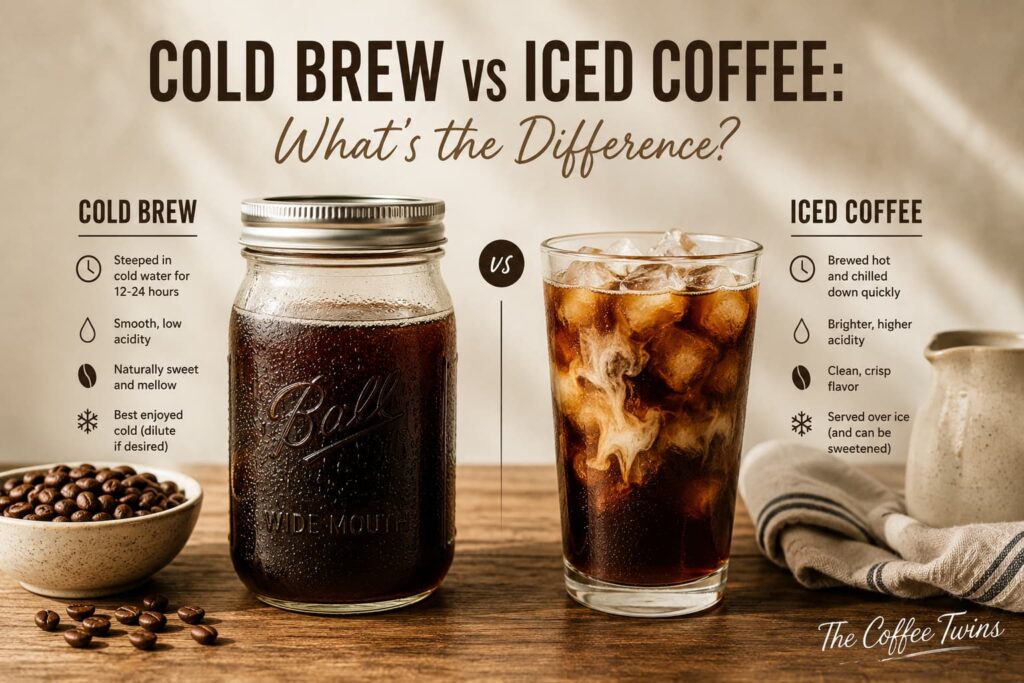
Specifically, this trips people up all the time. Let me clarify honestly.
Cold brew
- Brewing method: Cold water, 12-18 hours in the fridge
- Extraction: Slow and gentle
- Taste: Smooth, sweet, low-acid, chocolatey
- Caffeine: Higher than iced coffee (longer extraction)
- Batch-able: Yes — one brew lasts 5 days
Iced coffee (traditional)
- Brewing method: Hot brew, then cooled over ice
- Extraction: Fast, hot extraction
- Taste: Same as hot coffee, just chilled
- Caffeine: Standard levels
- Batch-able: Not really — best made fresh
Above all, cold brew is a different drink entirely — not just hot coffee that’s been chilled. As a result, if you want smooth, sweet iced coffee, cold brew is the answer. Furthermore, see our iced coffee guide for hot-brewed iced options.
What You Need (Surprisingly Little)
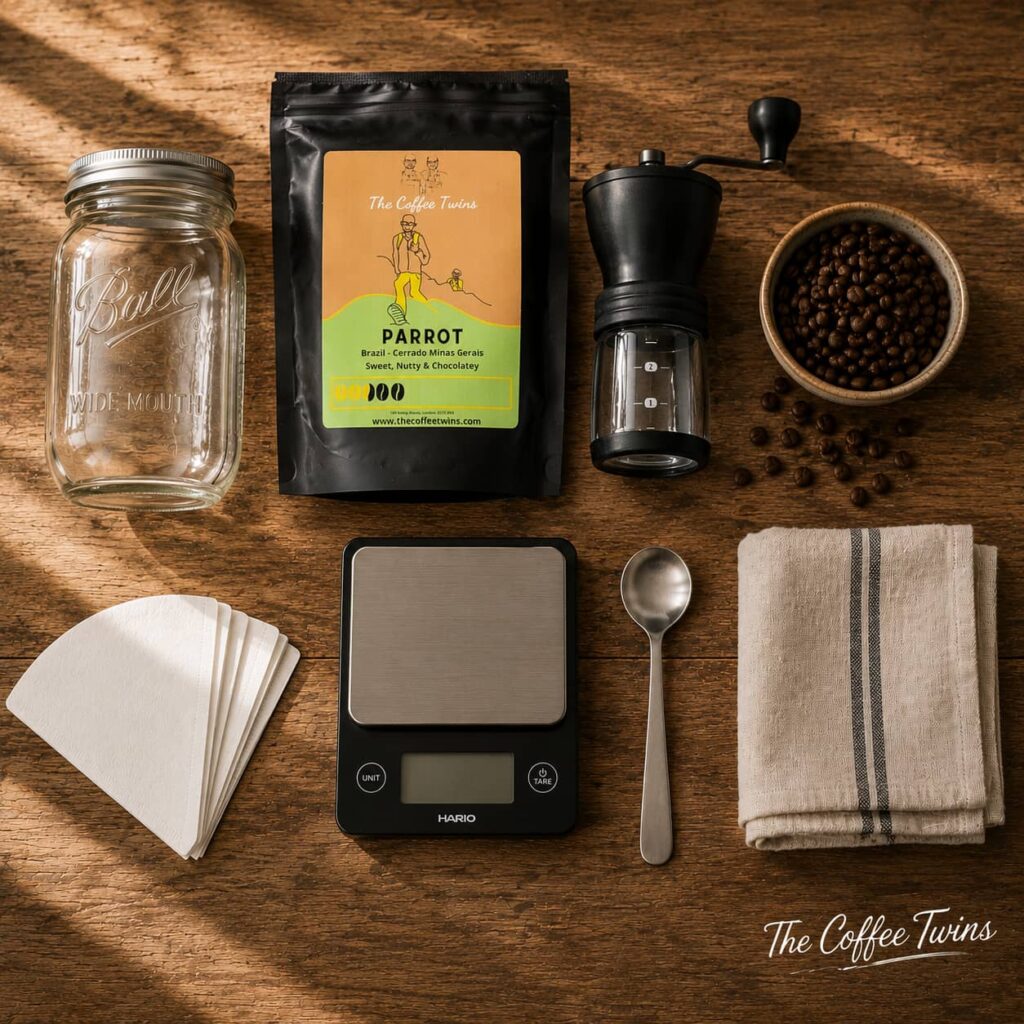
Cold brew is genuinely the simplest coffee brewing method there is. Specifically, you need almost nothing:
Essential kit:
- A container: Any jug, jar, or large bottle (1-2 litre capacity)
- A strainer: Paper coffee filter, cheesecloth, or fine mesh strainer
- Fresh coffee beans: Ground coarsely
- Cold filtered water
- Fridge space
Optional but useful:
- Dedicated cold brew maker: Specifically, a Hario Mizudashi (£25) has a built-in filter and is genuinely brilliant
- Kitchen scales: For consistent ratios
- Bottle for storage: Furthermore, a swing-top bottle looks lovely in the fridge
Above all, you don’t need to buy anything to start. Specifically, a large jam jar and a paper coffee filter get you 90% of the way. As a result, cold brew is genuinely the most beginner-friendly brewing method.
The Right Beans for How to Make Cold Brew Coffee at Home
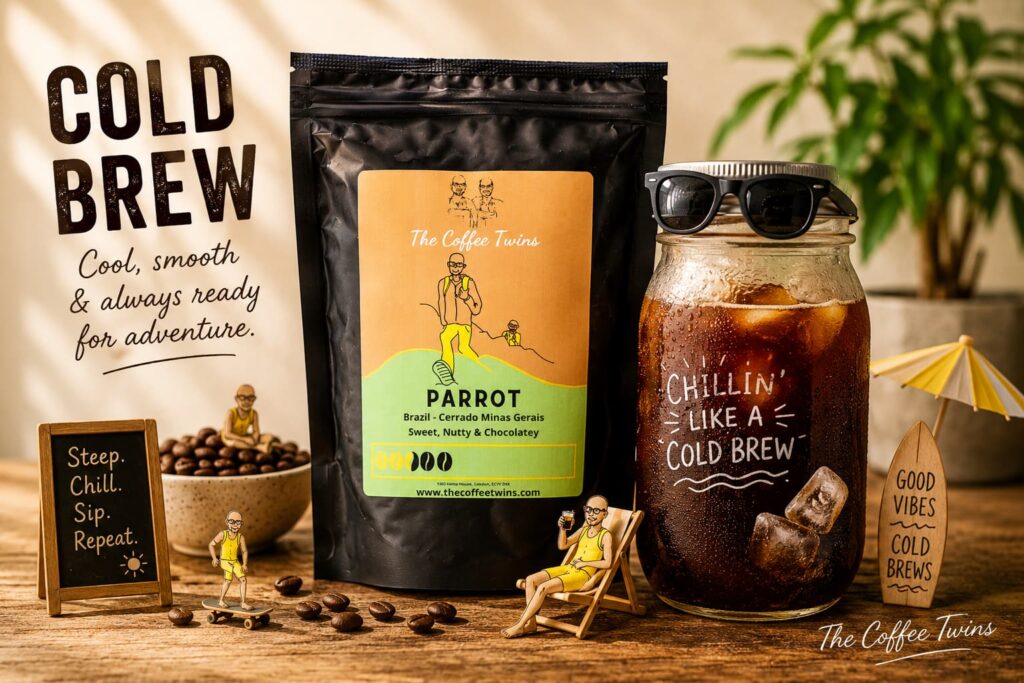
Beans matter more for cold brew than most people realise. Specifically, cold brew rewards natural sweetness and low acidity — and reveals bean defects mercilessly over 14 hours of extraction. As a result, use fresh, high-quality speciality coffee.
What to look for in cold brew beans:
- Naturally sweet: Furthermore, sweetness 3/5 or higher on our scale
- Chocolatey or nutty notes: Specifically, these translate beautifully to cold brew
- Medium roast: As a result, brings out sweetness without bitterness
- Low acidity: Specifically, 2-3/5 on our scale — brighter beans lose their character in cold brew
- Fresh: By the way, cold brew amplifies staleness, so beans within 28 days of roasting matter
From our range:
Top pick for cold brew: Parrot (Brazilian Cerrado single origin) — sweet, nutty, chocolatey. Body 3/5, sweetness 3/5, acidity 3/5. Specifically, Brazilian beans are naturally suited to cold brew’s slow extraction. £9.50 / 250g.
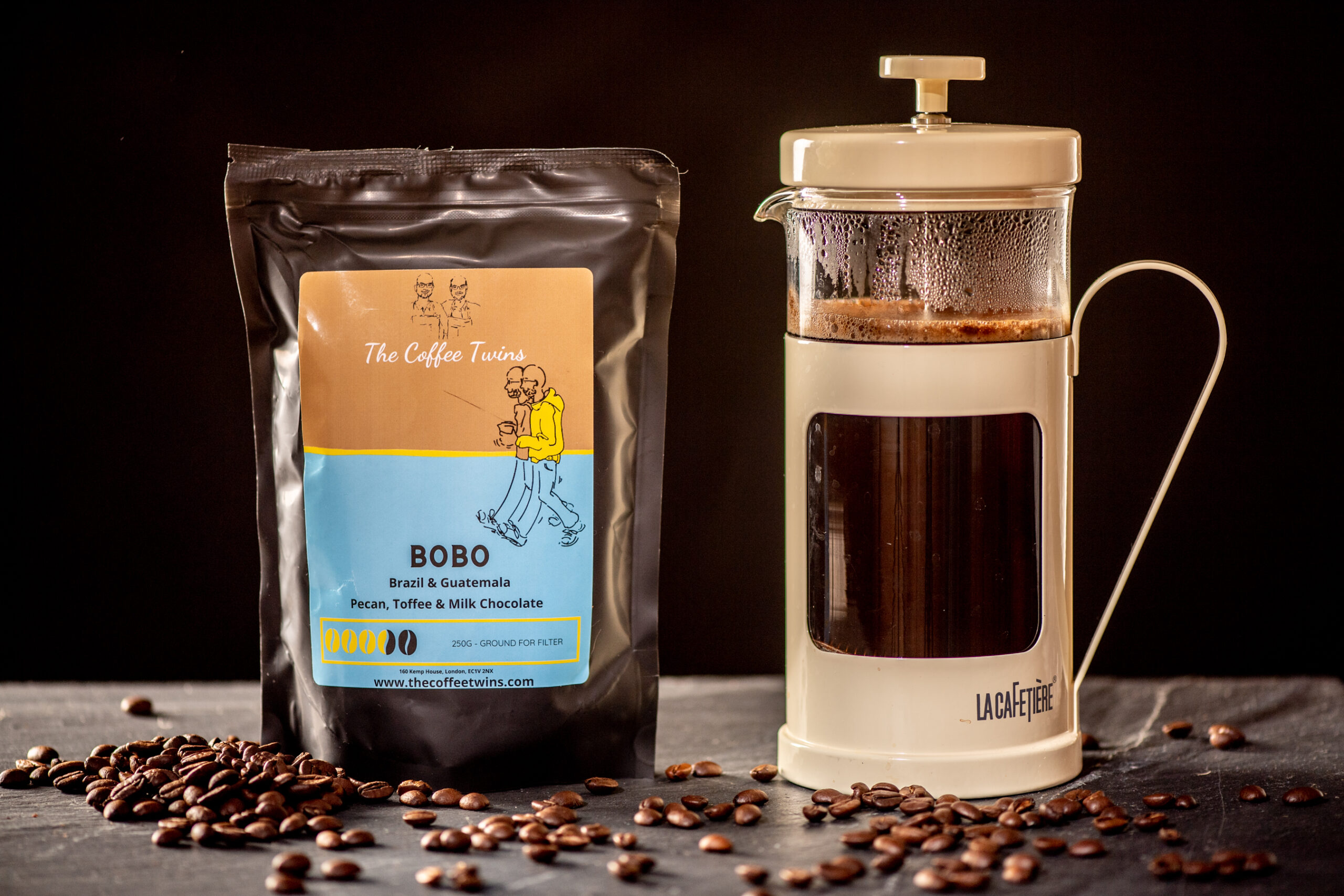
Best for milky cold brew: Bobo (Brazil + Guatemala blend) — pecan, toffee, milk chocolate. Body 4/5, sweetness 4/5, acidity 2/5. Furthermore, brilliant for cold brew lattes and iced oat milk drinks. £9.50 / 250g.
Best decaf cold brew: Hufflelump (Brazilian Swiss Water decaf) — dark chocolate, smooth, nutty. Body 4/5, acidity 2/5. As a result, brilliant for evening cold brew without caffeine disruption. £10.50 / 250g.
Beans we wouldn’t recommend for cold brew:
- Jojo (Ethiopian light roast, acidity 4/5) — specifically, the bright fruity character is what makes Jojo special. Furthermore, cold brew flattens exactly those notes. Save it for V60.
- Komodo — Sumatran with strong earthy character. Specifically, better suited to cafetière hot brewing than cold extraction.
The Recipe: How to Make Cold Brew Coffee at Home Step-by-Step
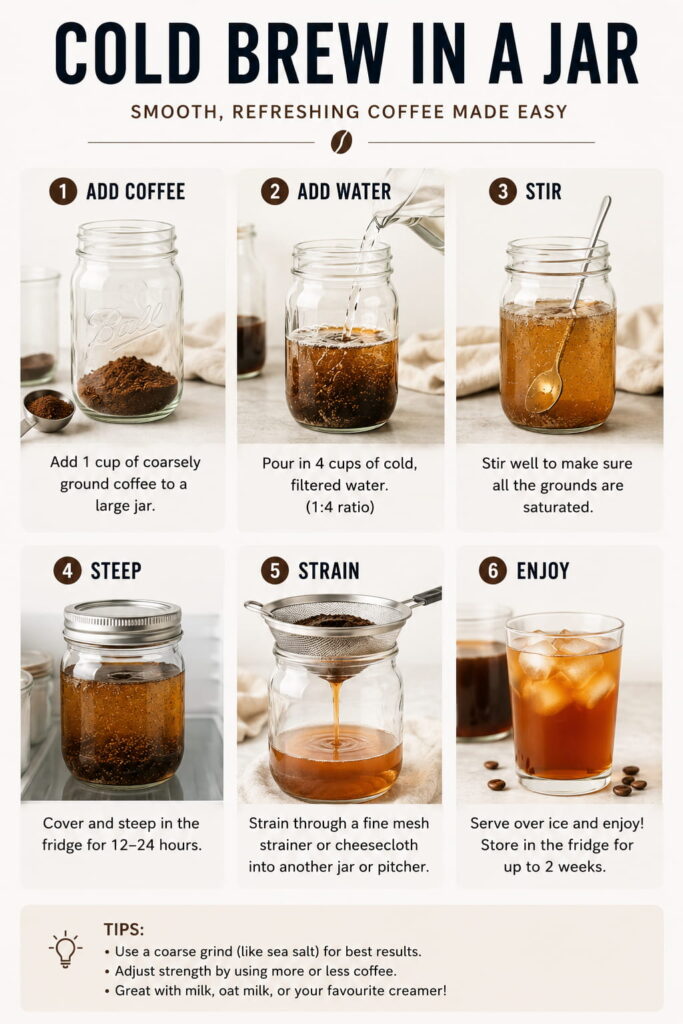
This is the exact recipe we used at our Farringdon café. Specifically, it produces roughly 800ml of ready-to-drink cold brew (or 400ml of concentrate — see the serving section).
• 100g Parrot or Bobo, ground coarse (like rough sea salt)
• 1 litre cold filtered water
• A container (jug, jar, or bottle)
• A paper coffee filter or fine strainer
• A clean container for storage
The step-by-step method:
- Grind 100g of coffee coarsely. Specifically, the grind should look like rough sea salt — coarser than filter, similar to cafetière grind. Furthermore, if you don’t have a grinder, order our beans pre-ground for “Cafetière.”
- Combine coffee and water in your container. Specifically, pour the ground coffee in first, then add the cold water slowly. As a result, this ensures all grounds are properly wetted.
- Stir gently for 30 seconds. Specifically, use a wooden spoon or long-handled spoon to ensure no dry pockets remain. Furthermore, don’t stir aggressively — you want gentle contact with the water.
- Cover the container. Specifically, use the lid, cling film, or a plate. As a result, this prevents the fridge from imparting odours to your cold brew.
- Refrigerate for 14 hours. Specifically, 12 hours minimum, 18 hours maximum. Furthermore, less than 12 hours produces weak, thin brew. As a result, over 18 hours starts producing bitter notes.
- Strain the coffee. Specifically, pour the mixture through a paper coffee filter placed in a pour-over dripper or fine mesh strainer. Furthermore, let it drip naturally rather than pressing — this takes 10-15 minutes but produces the cleanest cup.
- Transfer to a clean storage bottle. Specifically, a swing-top bottle or reused water bottle works fine. As a result, refrigerate immediately.
- Serve within 5 days. Furthermore, cold brew flavour peaks at 24-48 hours after brewing.
Timing summary:
- Hands-on time: 10 minutes (grinding, mixing, straining)
- Passive brewing time: 14 hours
- Total time: ~14.5 hours (but almost entirely hands-off)
How to Serve Cold Brew (Concentrate vs Ready-to-Drink)
Cold brew can be served two ways. Specifically, the 1:10 recipe above gives you a **concentrated cold brew** that you dilute before serving. Furthermore, or you can drink it neat if you want strong coffee.
Option 1: Ready-to-drink (recommended for most)
Fill a tall glass with ice. Then, pour cold brew and add cold water in a 1:1 ratio. Specifically, this gives you smooth iced coffee at normal drinking strength. Furthermore, this is how most UK cafés serve it.
Option 2: Concentrate (for stronger drinks)
Use the cold brew undiluted. Specifically, this is much stronger than normal coffee — perfect for cold brew lattes, cold brew mocktails, or when you want serious caffeine. As a result, add ice and cold milk in a 1:1 ratio for a cold brew latte.
Cold brew latte ratios:
- Cold brew latte (light): 100ml cold brew + 200ml cold milk + ice
- Cold brew latte (standard): 150ml cold brew + 150ml cold milk + ice
- Cold brew latte (strong): 200ml cold brew + 100ml cold milk + ice
Furthermore, our Bobo makes brilliant cold brew lattes with oat milk. Specifically, the chocolate-and-toffee notes complement barista oat milk perfectly. By the way, see our milk comparison guide for which milk to use.
Storage After How to Make Cold Brew Coffee at Home
Specifically, cold brew stores dramatically better than hot coffee. As a result, here’s the honest guide:
Storage rules:
- Container: Sealed glass or plastic bottle — specifically, no exposure to air
- Temperature: Refrigerator (2-4°C)
- Location: Furthermore, keep away from strong-smelling foods (curries, cheese, etc.)
Shelf life:
- Days 1-3: Peak flavour — genuinely excellent
- Days 3-5: Still very good — slight flavour dulling
- Days 5-7: Furthermore, noticeable decline — drinkable but tired
- Days 7+: Discard — specifically, oxidation makes it flat and slightly sour
Batch brewing schedule:
Specifically, brew fresh cold brew every Sunday evening. As a result, it’s ready by Monday morning, lasts through Friday, and you never run out. Furthermore, a 1-litre batch produces roughly 10 iced coffees.
Cold Brew Variations (Nitro, Milk, Flavoured)
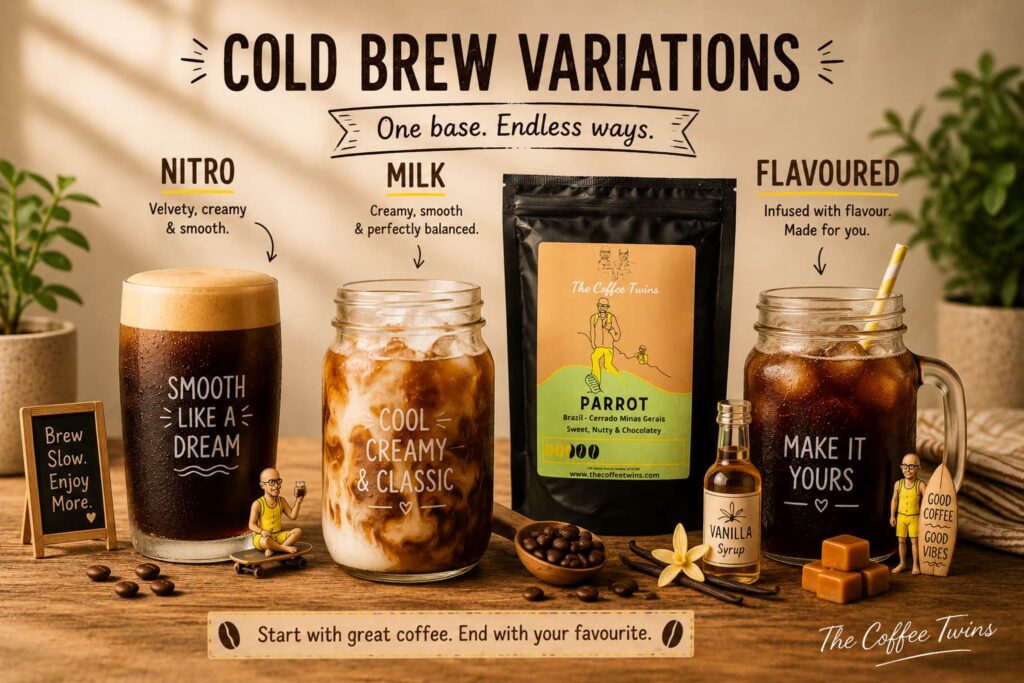
Nitro cold brew
Cold brew infused with nitrogen gas produces a Guinness-like cascade and creamy texture. Specifically, you need a nitrogen dispenser (£30-50) and nitrogen capsules. Furthermore, this is genuinely fun but not essential — standard cold brew tastes 95% as good.
Cold brew with milk
Add cold whole milk or barista oat milk directly to your cold brew. Specifically, ratios above. Furthermore, this is the most popular UK café cold brew presentation.
Flavoured cold brew
Add simple syrups to your finished cold brew:
- Vanilla cold brew: 1-2 tbsp vanilla syrup
- Caramel cold brew: 1-2 tbsp caramel syrup
- Chocolate cold brew: 1-2 tbsp chocolate syrup
- Cinnamon cold brew: ¼ tsp ground cinnamon added during brewing
Cold brew tonic
50ml cold brew concentrate + 150ml tonic water over ice + lemon peel. Specifically, this is a genuinely brilliant summer drink — sweet, bitter, coffee-forward.
Cold brew cocktails
By the way, cold brew makes excellent cocktail base. Specifically, cold brew + rum + Kahlúa, or cold brew + vodka + Baileys, both work brilliantly. Furthermore, this makes weekend batch brewing genuinely useful for entertaining.
Troubleshooting: How to Make Cold Brew Coffee at Home That Tastes Right
Cold brew tastes weak or watery
Either your ratio was off (too much water) or your steep time was too short. Specifically, use the 1:10 ratio (100g coffee to 1L water) and steep for at least 12 hours. Furthermore, using older beans also produces weak cold brew — fresh beans are essential.
Cold brew tastes bitter
You over-steeped it. Specifically, over 18 hours produces bitter notes. Furthermore, using overly fine grind also causes bitterness. As a result, coarse grind + 14 hour steep is the sweet spot.
Cold brew tastes sour
Either you used a light roast bean (like our Jojo) or the coffee wasn’t fresh. Specifically, switch to medium roast beans like Parrot or Bobo. Furthermore, check the roast date on your bag.
Cold brew has sediment
Your strainer wasn’t fine enough. Specifically, always use a paper coffee filter for cleanest results. Furthermore, mesh strainers alone let fine particles through — a double-filter (mesh + paper) works best.
Cold brew smells “off”
Either the beans were stale or the fridge imparted odours. Specifically, always cover the container while brewing. Furthermore, use beans within 28 days of roasting.
Frequently Asked Questions
How do you make cold brew coffee at home?
Combine 100g of coarsely-ground coffee with 1 litre of cold filtered water in a jug. Stir gently, cover, and refrigerate for 14 hours. Specifically, strain through a paper coffee filter into a clean bottle. Furthermore, store in the fridge for up to 5 days. Serve over ice, diluted 1:1 with water or milk if you prefer it lighter.
What’s the best coffee-to-water ratio for cold brew?
1:10 (100g coffee to 1 litre water) produces a concentrated cold brew that you dilute before serving. Specifically, this is the ratio most UK cafés use. Furthermore, you can go 1:15 (67g to 1L) for ready-to-drink cold brew that needs no dilution.
How long should cold brew steep?
14 hours is the sweet spot. Specifically, 12 hours minimum (weaker), 18 hours maximum (starts becoming bitter). Furthermore, brewing at room temperature reduces steep time to 8-10 hours but produces a slightly different flavour profile.
Does cold brew have more caffeine than regular coffee?
Yes, typically. Specifically, cold brew concentrate contains roughly 200-300mg of caffeine per 250ml — dramatically more than a standard cup (95-120mg). Furthermore, this is because the 14-hour extraction pulls more caffeine than hot brewing. By the way, when diluted 1:1 for serving, the caffeine per cup is closer to normal.
How long does homemade cold brew last?
Up to 5 days in a sealed container in the fridge. Specifically, peak flavour is days 1-3. Furthermore, after 5 days, oxidation makes it flat and slightly sour. As a result, batch brew every Sunday for a week’s worth of cold brew.
What’s the best coffee for cold brew UK?
Naturally sweet, chocolatey, medium-roasted beans with low acidity work best. Specifically, our Parrot (Brazilian Cerrado — sweet, nutty, chocolatey) is our top pick at £9.50 / 250g. Furthermore, Bobo is excellent for cold brew lattes.
Can I make cold brew without a coffee grinder?
Yes. Specifically, order our beans pre-ground for “Cafetière” grind — this is the correct coarse grind for cold brew. Furthermore, you can also buy pre-ground cafetière coffee from most UK supermarkets, but freshness will be dramatically lower than fresh-ground beans.
Where can I buy the best cold brew coffee beans in the UK?
The Coffee Twins — we roast all our coffee in England. Specifically, our Parrot and Bobo are both brilliant for cold brew, and Hufflelump is our decaf pick. £9.50-£10.50 / 250g. Furthermore, free UK shipping over £30. Use NEW10 for 10% off your first order.
Summary
How to make cold brew coffee at home in the UK: combine 100g of coarsely-ground coffee with 1 litre of cold filtered water, steep in the fridge for 14 hours, strain through a paper filter, and store for up to 5 days. Specifically, serve over ice with an optional 1:1 dilution.
Above all, the right beans matter — naturally sweet, chocolatey, low-acidity coffees like our Parrot (Brazilian Cerrado) or Bobo (Brazil + Guatemala blend) produce genuinely brilliant cold brew.
Furthermore, cold brew is the most beginner-friendly brewing method — no special equipment needed, just fresh beans, a container, and 14 hours of patience. As a result, this is where most UK home coffee drinkers should start their summer brewing.
Free UK shipping over £30. Use NEW10 for 10% off your first order.
Try Parrot — Perfect for Cold Brew →


0 Comments