

Why trust this guide?

We’re Jeremiah and Raja — The Coffee Twins. Before launching our UK speciality coffee brand, we trained in five-star hotel food and beverage and ran our own coffee shop in Farringdon. Specifically, we’ve made coffee in every conceivable way — from £15,000 commercial La Marzoccos to a mug and a kettle on camping trips. As a result, this guide covers the seven genuinely useful methods for making coffee without a coffee maker, ranked by quality and cost.
Table of contents
- Why you don’t need a coffee maker
- Method 1: Cafetière (French press)
- Method 2: Moka pot (stovetop espresso)
- Method 3: AeroPress
- Method 4: V60 pour-over
- Method 5: Cold brew (any container)
- Method 6: DIY pour-over with a tea strainer
- Method 7: The “cowboy” method (mug and spoon)
- Which method should you choose?
- The right beans for coffee-maker-free brewing
- FAQ
Why You Don’t Need a Coffee Maker
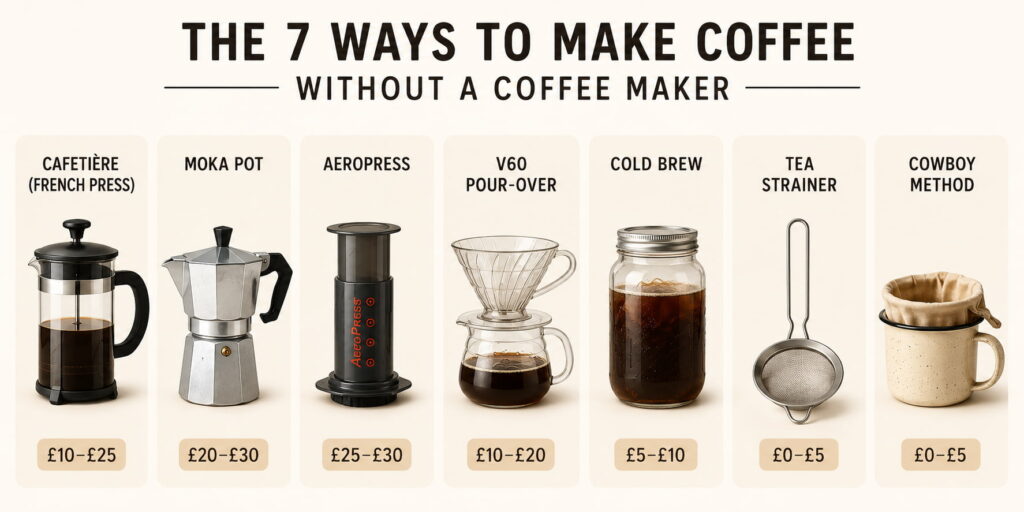
Honestly? Home coffee makers get overhyped. Specifically, some of the world’s best café-quality coffee gets made with equipment costing under £30. Furthermore, coffee makers often produce mediocre results because the water temperature is wrong, the brew time is fixed, or the machine can’t handle fresh speciality beans.
Above all, the three things that actually matter for good coffee are:
- Fresh beans: Specifically, coffee roasted within the last 28 days
- Correct grind size: Furthermore, matched to your brewing method
- Proper water temperature: As a result, 92-96°C for most methods
Specifically, none of these require a coffee maker. Furthermore, you can achieve all three with a kettle, a mug, and a £3 spoon. As a result, most home coffee lovers get better results by ditching their coffee maker entirely and switching to one of the methods below.
By the way, this also matches the current UK cost-of-living reality. Specifically, why spend £200+ on a coffee maker when £30 of kit gets you café-quality coffee at 40p per cup?
Method 1: Cafetière (French Press)
Kit cost: £15-30 for a decent cafetière
Skill level: ⭐ Beginner
Coffee style: Full-bodied, rich, textured
Best for: Weekend mornings, cold weather, filling multiple cups
Brew time: 4 minutes
Recommended beans: Komodo or Audley
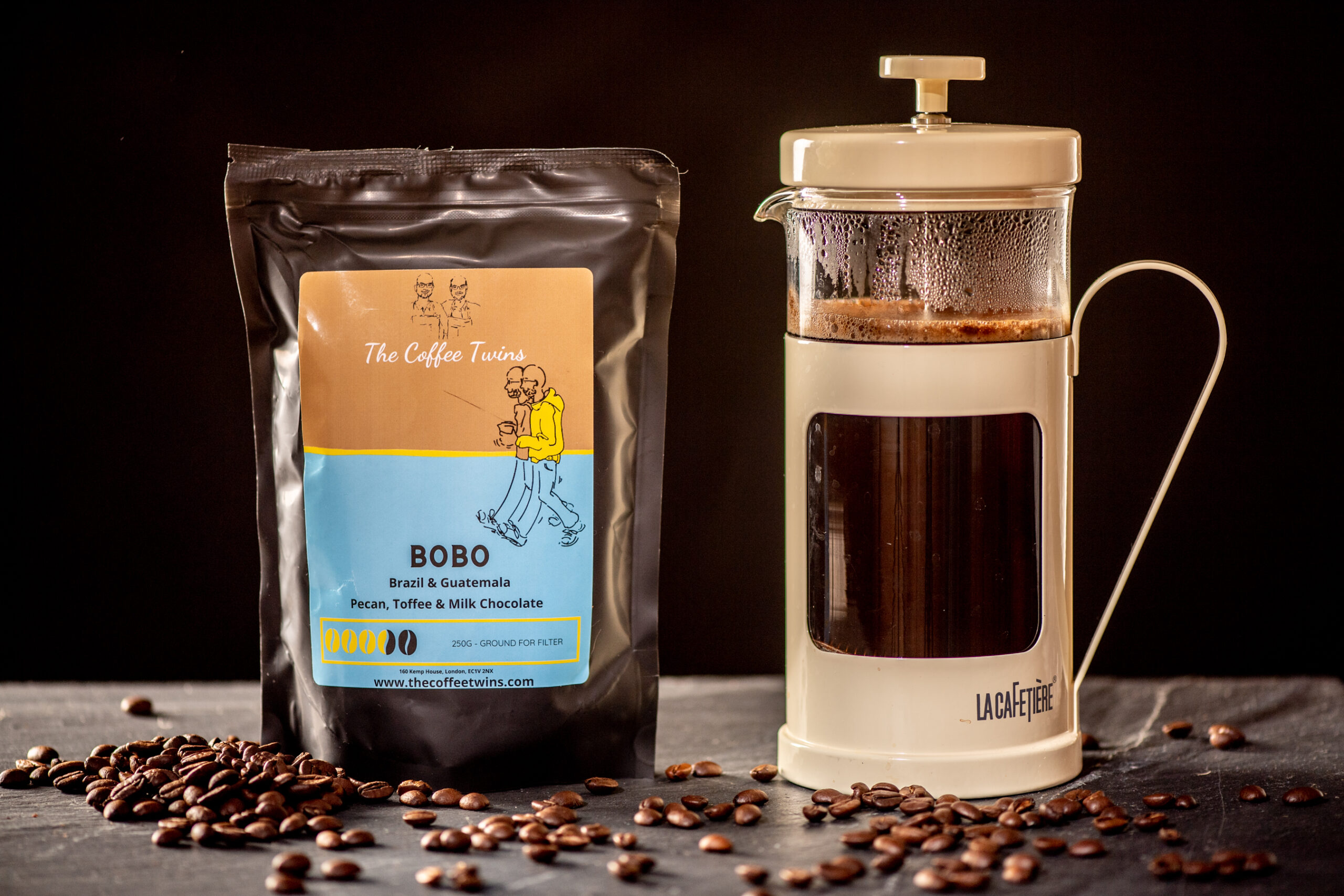
The cafetière (also called French press or plunger) is the classic no-coffee-maker option. Specifically, it uses a metal mesh filter and a plunger — no paper filters needed. As a result, you get a full-bodied, oily, textured cup that showcases dark and medium roasts brilliantly.
The method:
- Grind 30g of coffee to a coarse grind (like rough sea salt). Alternatively, order pre-ground “Cafetière” grind from us.
- Add the grounds to the empty cafetière.
- Pour 500g of water at 94°C over the grounds. Specifically, this is 30 seconds after a kettle boils.
- Stir gently to ensure all grounds are wet.
- Place the plunger on top but don’t press down yet. Furthermore, this keeps heat in.
- Wait 4 minutes exactly. Time it — this matters.
- Press the plunger down slowly and evenly. If it’s hard to press, your grind was too fine.
- Pour immediately. Specifically, coffee left in the cafetière continues to over-extract and becomes bitter.
Pro tips:
- Use the same 1:17 ratio for any size cafetière
- Furthermore, don’t reuse cafetière coffee — pour it all out into cups or a thermos
- Above all, rinse immediately after pouring — dried coffee residue is a nightmare
By the way, the cafetière is our top pick for beginners. Specifically, it’s forgiving, cheap, and produces genuinely excellent coffee.

Method 2: Moka Pot (Stovetop Espresso)
Kit cost: £20-30 for a Bialetti Moka Express
Skill level: ⭐⭐ Beginner-intermediate
Coffee style: Strong, concentrated, espresso-like
Best for: Espresso-style drinks, milk drinks, morning kick
Brew time: 5-7 minutes
Recommended beans: Ant or Audley
The moka pot is genuinely one of the great inventions in coffee. Specifically, it produces concentrated, espresso-like coffee using nothing but a stovetop. Furthermore, a £25 Bialetti gets you 80% of what an espresso machine delivers — for under 10% of the cost. As a result, this is our top pick for people who want strong coffee or milk-based drinks.
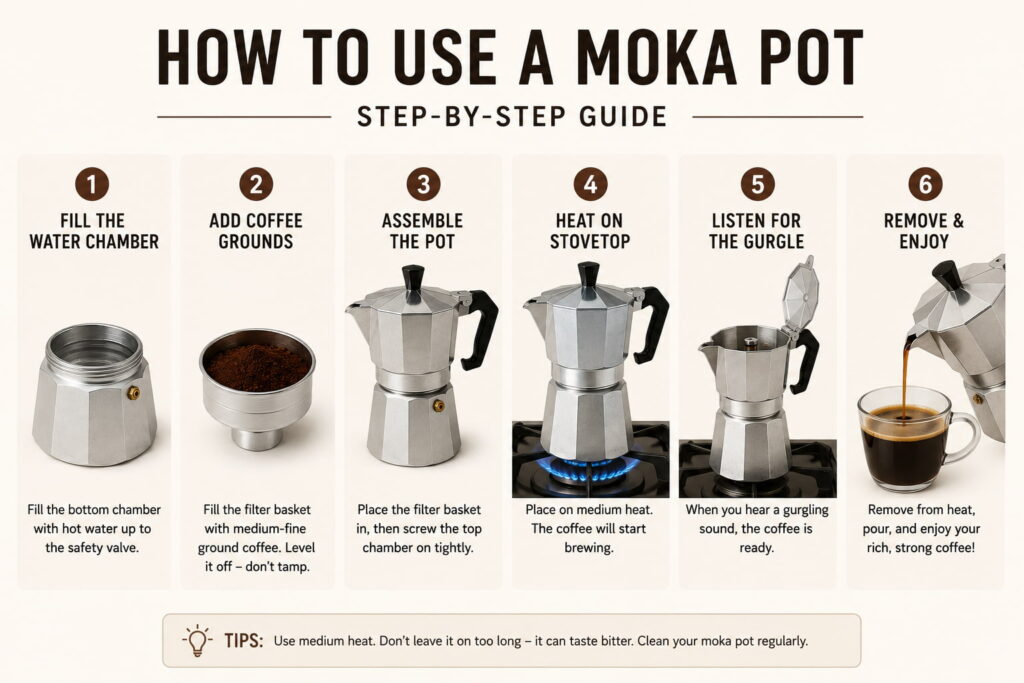
The method:
- Fill the base chamber with hot water up to the safety valve. Specifically, using pre-heated water shortens brew time and prevents bitterness.
- Add 18g of coffee to the filter basket, ground fine (finer than filter, coarser than espresso). Alternatively, order pre-ground “Espresso” grind from us.
- Level the grounds but don’t tamp — moka pots need loose grounds for water flow.
- Screw the top chamber on tightly but don’t force it.
- Place on medium heat with the lid open so you can watch.
- Wait for the coffee to bubble up into the top chamber. Furthermore, this takes 5-7 minutes.
- Remove from heat the moment it gurgles. Specifically, the gurgle means the water is spent.
- Pour immediately and drink.
Pro tips:
- Never use soap to clean a moka pot — specifically, water and a soft cloth. Furthermore, soap ruins the seasoning
- Replace the rubber gasket annually
- Above all, medium heat only — high heat causes bitterness
Specifically, see our full moka pot guide for more.
Method 3: AeroPress
Kit cost: £30 (includes filters for a year)
Skill level: ⭐⭐ Beginner-intermediate
Coffee style: Clean, smooth, versatile
Best for: Travel, single cups, experimenting
Brew time: 2-3 minutes
Recommended beans: Jojo or Parrot
The AeroPress is the Swiss Army knife of coffee brewing. Specifically, it’s a plunger-based brewer that uses paper filters and manual pressure. Furthermore, it’s incredibly versatile — you can make anything from espresso-style shots to cold brew with the same piece of kit.
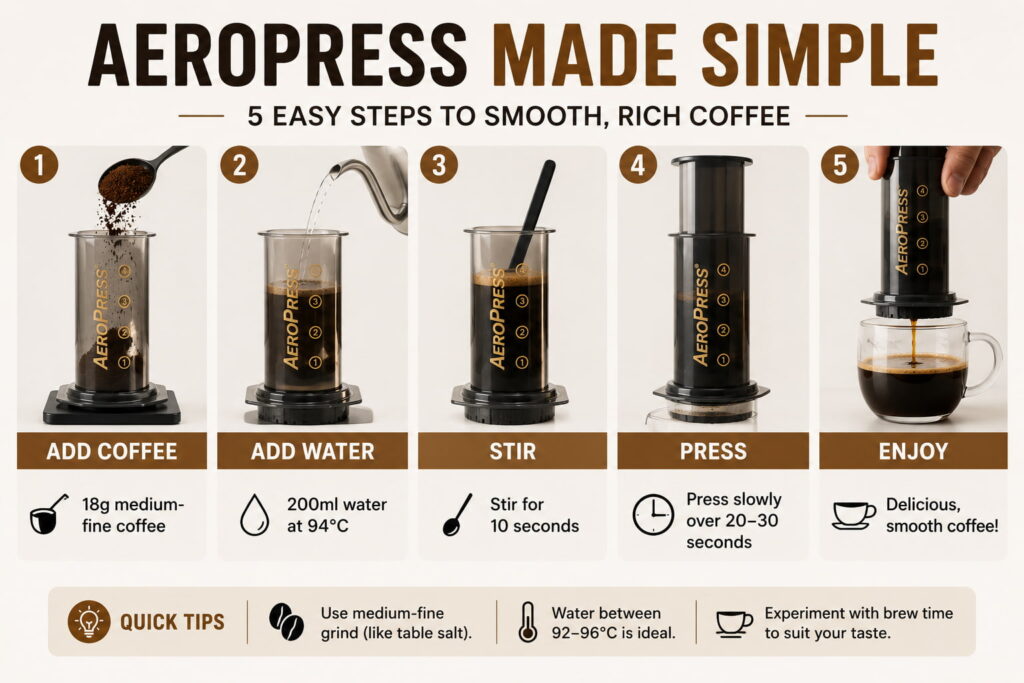
The method (standard recipe):
- Insert a paper filter into the AeroPress cap.
- Rinse the filter with hot water to remove paper taste.
- Attach the cap to the main chamber and place on your mug.
- Add 15g of medium-fine ground coffee (between filter and espresso grind).
- Pour 220g of water at 88°C and stir.
- Wait 90 seconds to steep.
- Insert the plunger and press down slowly over 30 seconds.
- Drink immediately or dilute with hot water for a longer drink.
Pro tips:
- Furthermore, the “inverted method” (flip the AeroPress upside down while steeping) gives even more control
- Specifically, AeroPress is brilliant for travel — it’s plastic, light, and unbreakable
- Above all, buy metal reusable filters if you want a more full-bodied cup
Method 4: V60 Pour-Over
Kit cost: £15-25 (V60 + paper filters)
Skill level: ⭐⭐⭐ Intermediate
Coffee style: Clean, aromatic, complex
Best for: Single origins, tasting notes, morning ritual
Brew time: 3-4 minutes
Recommended beans: Jojo or Parrot
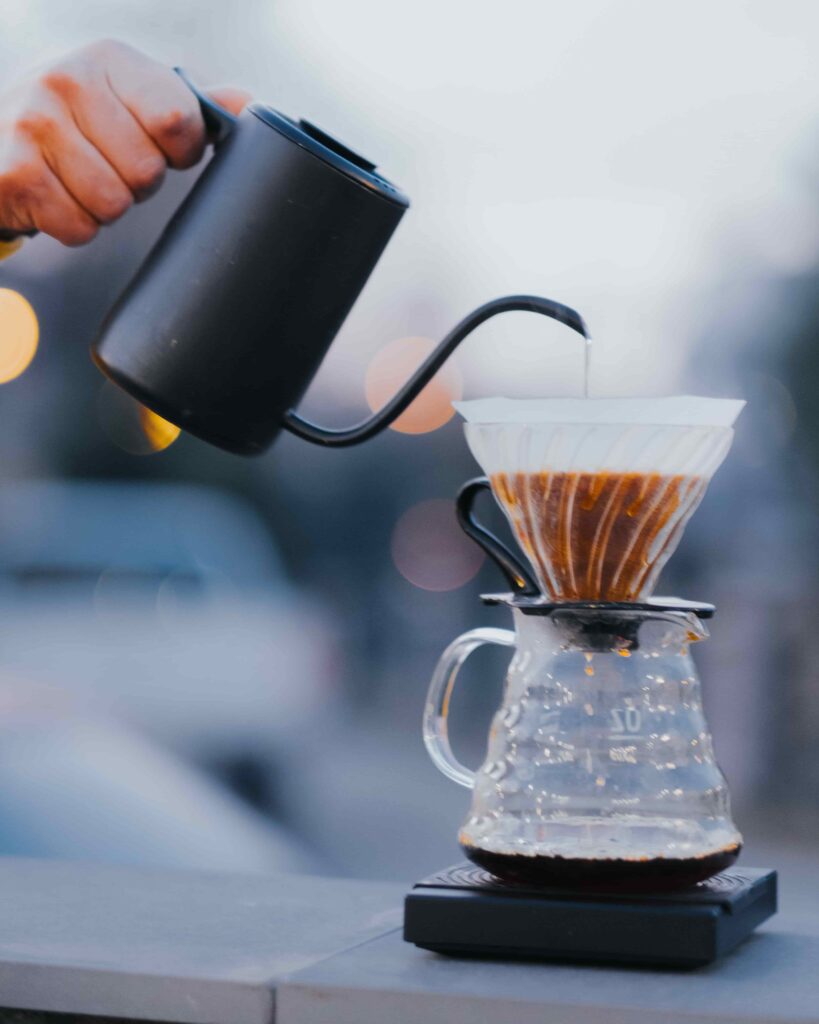
The Hario V60 is the classic Japanese pour-over — a plastic or ceramic cone with a paper filter. Specifically, this method produces the cleanest, most aromatic cup possible from any coffee. Furthermore, it’s what serious speciality coffee drinkers use to actually taste the beans.
The method:
- Insert a paper filter in the V60 and rinse with hot water.
- Add 15g of coffee ground medium-fine (like table salt).
- Level the bed by tapping the V60 gently.
- Bloom with 30g of water at 94°C and wait 30 seconds. Specifically, this releases CO2 for even extraction.
- Pour the remaining 220g of water in slow circles, aiming to finish by 2:30.
- Total brew time: 3:00-3:30.
Pro tips:
- Furthermore, water temperature matters massively for V60 — 92-96°C
- A gooseneck kettle helps but isn’t essential
- Above all, see our full V60 guide for the detailed method
Method 5: Cold Brew (Any Container)
Kit cost: £0 (use any jug or jar) or £10 for a dedicated cold brew kit
Skill level: ⭐ Beginner
Coffee style: Smooth, sweet, low-acid
Best for: Summer, sensitive stomachs, batch preparation
Brew time: 12-18 hours (but hands-off)
Recommended beans: Parrot or Bobo
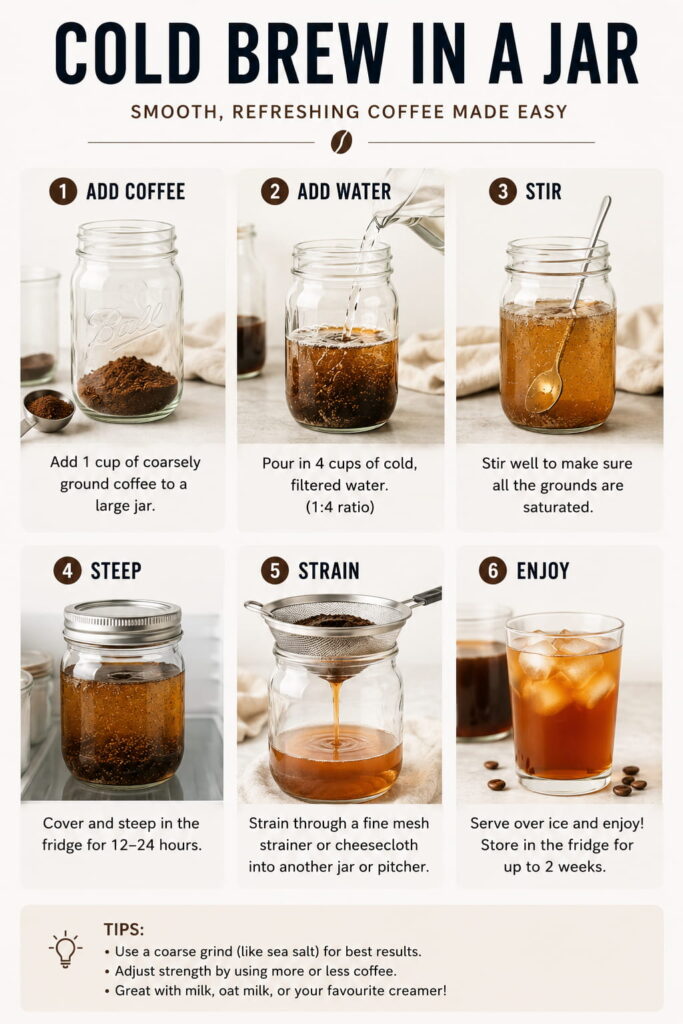
Cold brew is genuinely the simplest coffee method there is. Specifically, you steep coarsely-ground coffee in cold water for 12-18 hours. Furthermore, no equipment is required — a jam jar, jug, or protein shaker all work.
The method:
- Combine 100g of coarsely-ground coffee with 1 litre of cold water in any container.
- Stir gently to wet all grounds.
- Cover and refrigerate for 14 hours (12 minimum, 18 maximum).
- Strain through a paper coffee filter into a clean container. Furthermore, this may take 10-15 minutes.
- Store in the fridge for up to 5 days.
- To serve: pour over ice, dilute with water or milk if you want it lighter.
Pro tips:
- Specifically, cold brew is brilliant for batch making — one litre lasts a week
- Furthermore, cold brew contains MORE caffeine than hot coffee because of the longer extraction
- Above all, see our full iced coffee guide for more recipes
Method 6: DIY Pour-Over with a Tea Strainer
Kit cost: £3-5 (fine mesh tea strainer)
Skill level: ⭐⭐ Beginner-intermediate
Coffee style: Similar to V60 but slightly muddier
Best for: Emergencies, camping, absolute budget
Brew time: 3-4 minutes
Recommended beans: Any medium-ground coffee
Genuinely surprising method — but it works. Specifically, if you have a fine mesh tea strainer, you can make pour-over coffee with no dedicated brewer at all. Furthermore, this is our go-to method for hotel rooms, camping, and Airbnbs.
The method:
- Hold a fine mesh tea strainer over your mug.
- Add 15g of coffee to the strainer, medium-fine grind.
- Pour hot water at 94°C slowly over the coffee grounds.
- Continue pouring until you have 250ml of brewed coffee.
- Total brew time: aim for 3 minutes.
Pro tips:
- Specifically, this produces a cup with more body than V60 (fewer grounds are filtered out)
- Furthermore, the strainer needs to be genuinely fine mesh — colanders are too coarse
- Above all, this is a survival method, not a daily one
Method 7: The “Cowboy” Method (Mug and Spoon)
Kit cost: £0 (just a mug and spoon)
Skill level: ⭐ Beginner
Coffee style: Rough but drinkable
Best for: Genuine emergencies, camping, absolute basics
Brew time: 5 minutes
Recommended beans: Any coffee you have
Honestly, this is the “there’s genuinely no other option” method. Specifically, you can make drinkable coffee with nothing but a mug and a spoon. Furthermore, it’s how coffee was made for centuries before dedicated brewers existed.
The method:
- Add 10g of coffee to your mug, ground coarse (like sea salt).
- Pour 200ml of water at 90°C over the grounds.
- Stir vigorously and let steep for 4-5 minutes.
- Wait 2 more minutes — the grounds will settle at the bottom.
- Drink carefully from the top, avoiding the sediment.
Pro tips:
- Coarser grind = less sediment
- Furthermore, if you have kitchen roll or a coffee filter, straining is possible
- Above all, this method genuinely works — sometimes the simplest thing is fine
Which Method Should You Choose?
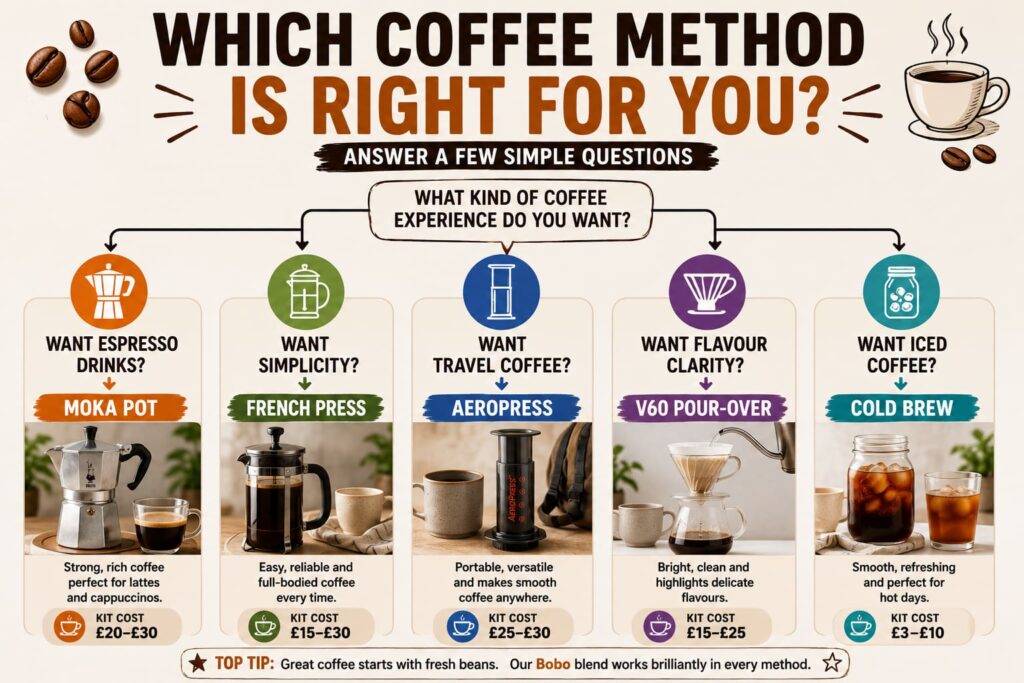
Quick decision guide:
Want the simplest option: Cafetière (French press)
Want strong coffee / espresso drinks: Moka pot
Want versatility and travel-friendly: AeroPress
Want the best possible cup: V60 pour-over
Want summer coffee / batch brewing: Cold brew
Genuine emergency: Tea strainer method
Absolutely nothing to hand: Cowboy method (mug + spoon)
Best for total beginners: Cafetière
Best value for money: Moka pot (£25)
Best under £30 total spend: Moka pot + our Audley
Our honest recommendation for most UK home brewers
Specifically, if you’re starting from zero and want the best possible home coffee for under £50:
- Buy a Bialetti Moka Express (3-cup, £25) — genuinely one of the best coffee investments possible
- Buy 250g of our Audley in Espresso grind (£9.50) — matched perfectly to moka pot brewing
- Add a £10 handheld milk frother if you want lattes and flat whites
- Total spend: under £45. As a result, this beats most £200 coffee makers.
Furthermore, once you’re comfortable with moka pot, add a cafetière (£20) for weekend mornings and full-bodied coffees like our Komodo.
The Right Beans for Coffee-Maker-Free Brewing
Specifically, different methods reward different beans. Furthermore, here’s our honest match-up:
Quick bean match guide:
Cafetière: Komodo, Audley, or Bobo
Moka pot: Ant, Audley, or Bobo
AeroPress: Jojo, Parrot, or Little Robot
V60: Jojo or Parrot
Cold brew: Parrot or Bobo
Decaf (any method): Hufflelump Swiss Water decaf
Above all, whichever method you choose, fresh beans matter more than the brewer. Specifically, see our UK online buying guide for why supermarket beans hold back home coffee — and where to buy fresh instead.
Frequently Asked Questions
How do I make coffee without a coffee maker?
Seven methods work well. Specifically, the easiest are cafetière (French press, £15-30), moka pot (£25), AeroPress (£30), and cold brew (uses any jug). Furthermore, you can even make coffee with just a tea strainer or a mug and spoon. As a result, no coffee maker is required for proper coffee.
What’s the easiest way to make coffee without a coffee maker?
The cafetière (French press) is the simplest. Specifically, add ground coffee, pour in hot water, wait 4 minutes, press down the plunger, and pour. Furthermore, a decent cafetière costs £15-30 and lasts for years. As a result, this is the easiest coffee-maker-free method for beginners.
Can I make espresso without an espresso machine?
Yes — the moka pot produces genuinely espresso-like coffee for under £30. Specifically, a Bialetti Moka Express creates strong, concentrated coffee using stovetop pressure. Furthermore, moka pot coffee is close enough to espresso for flat whites, lattes, and cappuccinos at home.
Can I make coffee with just a mug and hot water?
Yes, using the “cowboy method.” Specifically, add coarsely-ground coffee to a mug, pour hot water over, stir, wait 5-7 minutes for the grounds to settle, then drink carefully from the top. Furthermore, this method works for emergencies but produces a rougher cup than dedicated brewers.
What’s the cheapest way to make good coffee at home?
A £25 Bialetti moka pot with £9.50 of fresh speciality beans (like our Audley) is the cheapest way to make genuinely good coffee at home. Specifically, total kit spend is under £40, and per-cup cost drops to roughly 40p — dramatically cheaper than café coffee.
Do I need a special grinder for coffee-maker-free brewing?
No, but a grinder helps. Specifically, if you don’t have a grinder, order our beans pre-ground for your specific method — we grind to the right size for Cafetière, Filter, or Espresso. Furthermore, a basic burr grinder starts at £30 and improves any brewing method dramatically.
How much coffee do I use without a coffee maker?
The universal ratio is 1g coffee per 15-17g water for most methods. Specifically: cafetière is 1:17, V60 is 1:16, AeroPress is 1:15, moka pot is 1:8 (concentrated). Furthermore, use kitchen scales — measuring by spoon is inconsistent.
Where can I buy fresh coffee beans for making coffee without a coffee maker?
The Coffee Twins — we roast all our coffee in England and dispatch within 24 hours. Specifically, our 8-coffee range covers every method here — order as beans if you have a grinder, or select “Cafetière,” “Filter,” or “Espresso” grind for your specific brewer. Furthermore, £9.50-£10.50 / 250g, free UK shipping over £30. Use NEW10 for 10% off your first order.
Summary
How to make coffee without a coffee maker: use one of seven proven methods, ranging from £3 (tea strainer) to £30 (AeroPress or moka pot). Specifically, our top recommendation is the Bialetti moka pot at £25 — genuinely one of the best coffee investments possible. Furthermore, cafetière (French press) is the simplest option for beginners.
Above all, coffee-maker-free brewing produces café-quality coffee for under £45 total spend (moka pot + fresh beans + basic milk frother). As a result, most home coffee lovers get better results without a coffee maker than with one.
Whichever method you choose, our speciality coffee range covers every option. Specifically, Audley for moka pot, Komodo for cafetière, Jojo for V60, Parrot for cold brew. Furthermore, all £9.50-£10.50 / 250g, roasted in England, free UK shipping over £30.
Shop Fresh Beans for Every Method →


0 Comments