

Quick answer: The best coffee beans for espresso in the UK are medium-to-dark roasted, full-bodied (4/5 or higher), low-acidity (2/5 or below), 100% Arabica blends — and freshness matters as much as origin. Specifically, our pick is Audley — body 5/5, roast 4.5/5, smooth caramel and dark chocolate notes. £9.50 / 250g, free UK shipping over £30. Roasted in England, dispatched within 24 hours.
If you want to skip straight to the answer: Buy Audley here →
Why trust this guide?

We’re Jeremiah and Raja — The Coffee Twins. Before launching our UK speciality coffee brand, we trained in five-star hotel food and beverage and ran our own coffee shop in Farringdon. Specifically, we’ve pulled tens of thousands of espresso shots and trained baristas to dial in beans across every type of machine — from £200 entry-level home setups to £15,000 commercial La Marzoccos. As a result, this guide is the genuine version of what we’d teach you behind the bar.
| Coffee | Best for | Roast | Body | Acidity | Flavour |
|---|---|---|---|---|---|
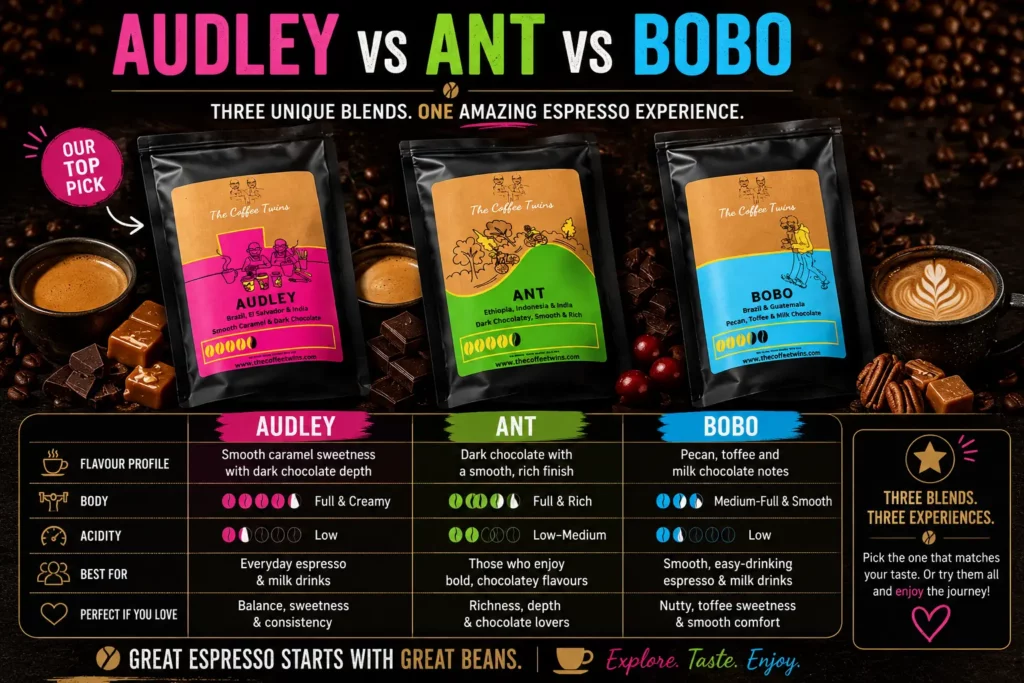
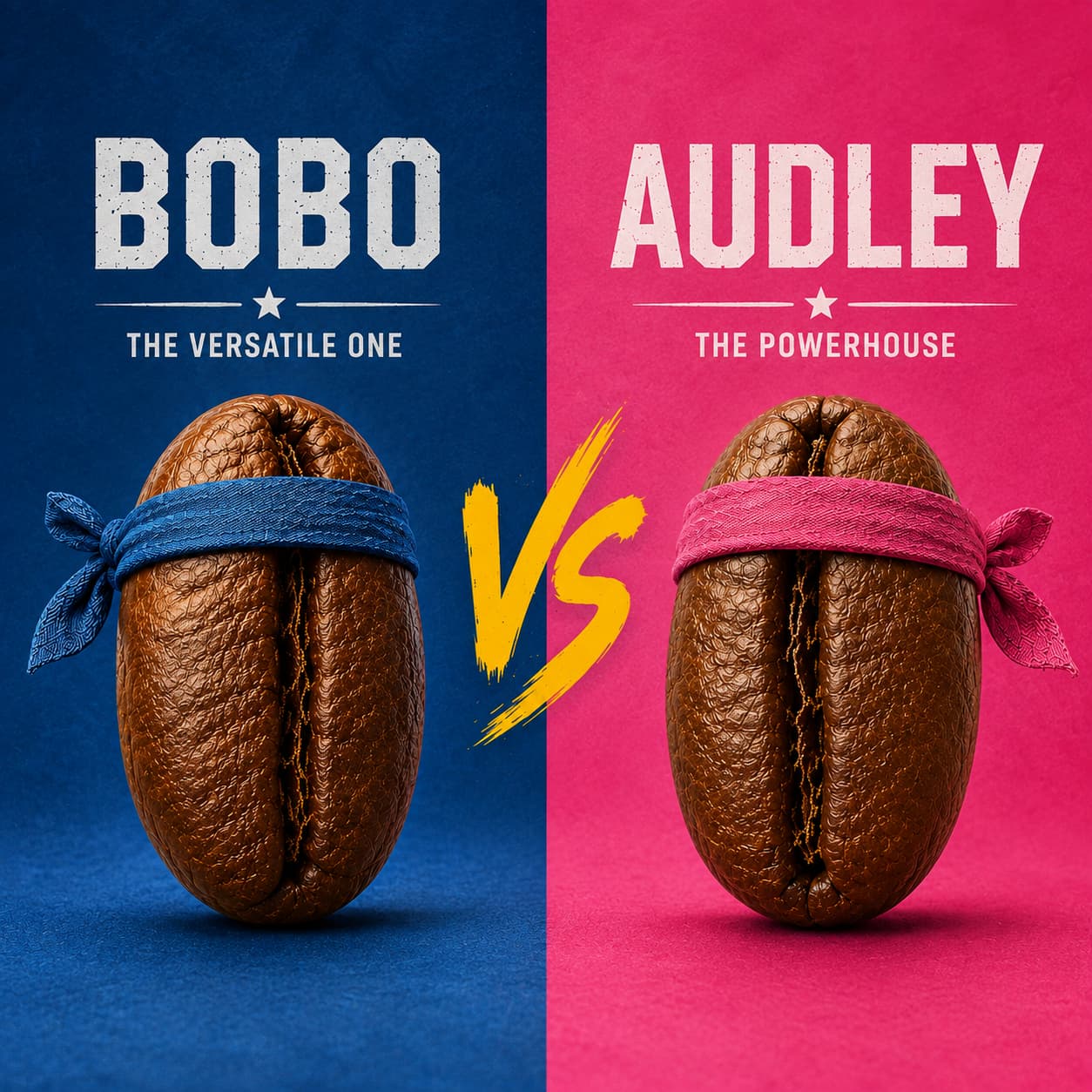
| Audley | ? Best overall | 4.5/5 | 5/5 | 2/5 | Caramel, dark chocolate |
| Ant | Complexity / drinking black | 4/5 | 5/5 | 3/5 | Dark chocolate, rich |
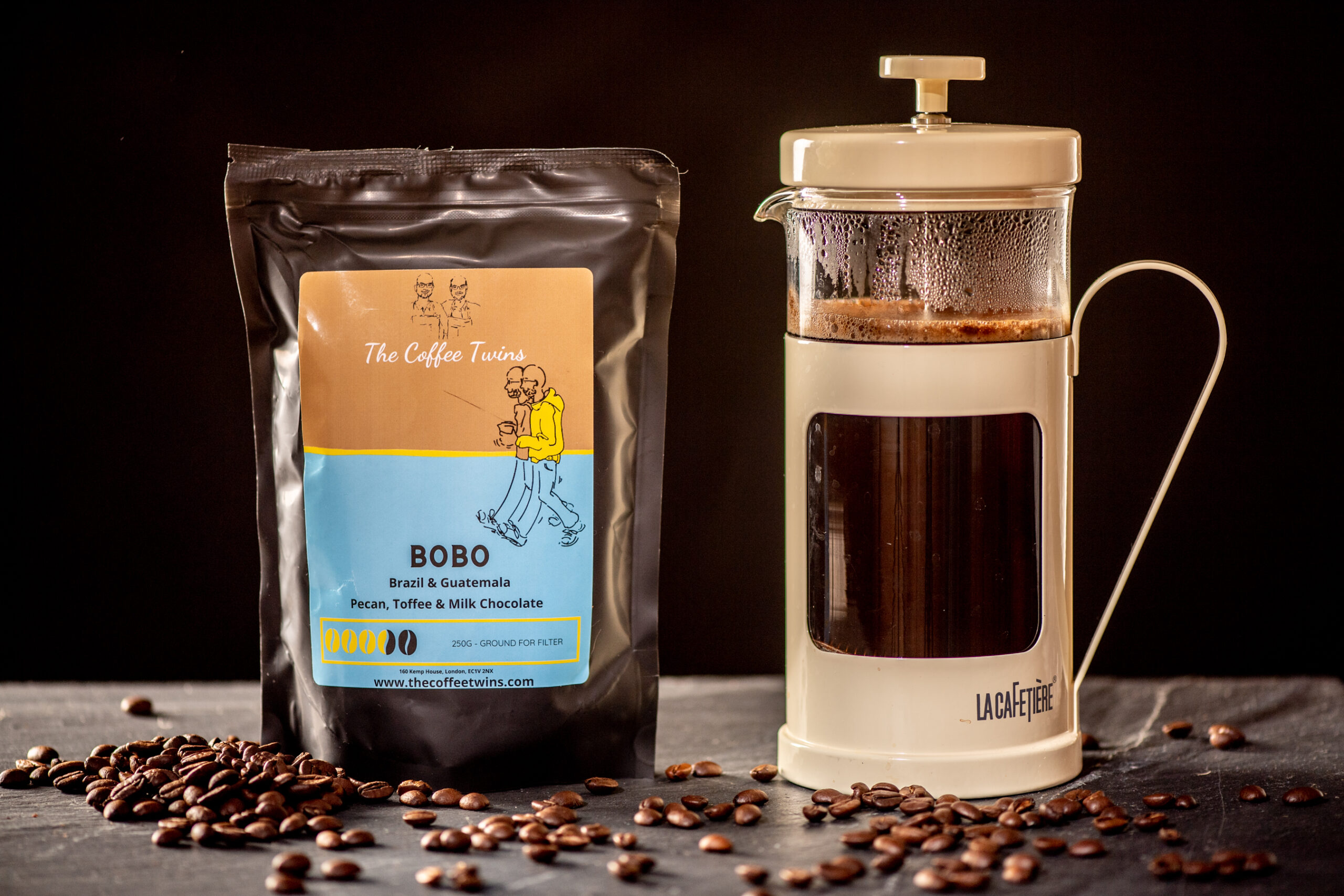
| Bobo | Milk drinks / beginners | 3.5/5 | 4/5 | 2/5 | Pecan, toffee, milk chocolate |
Table of contents
- Why most “best coffee beans for espresso UK” lists are useless
- What makes a coffee bean good for espresso
- The 5-question framework to choose your espresso beans
- Our top pick: Audley
- Runner-up: Ant (for complexity)
- Runner-up: Bobo (for milk drinkers)
- Coffee beans we’d avoid for espresso
- Should I buy whole beans or pre-ground espresso?
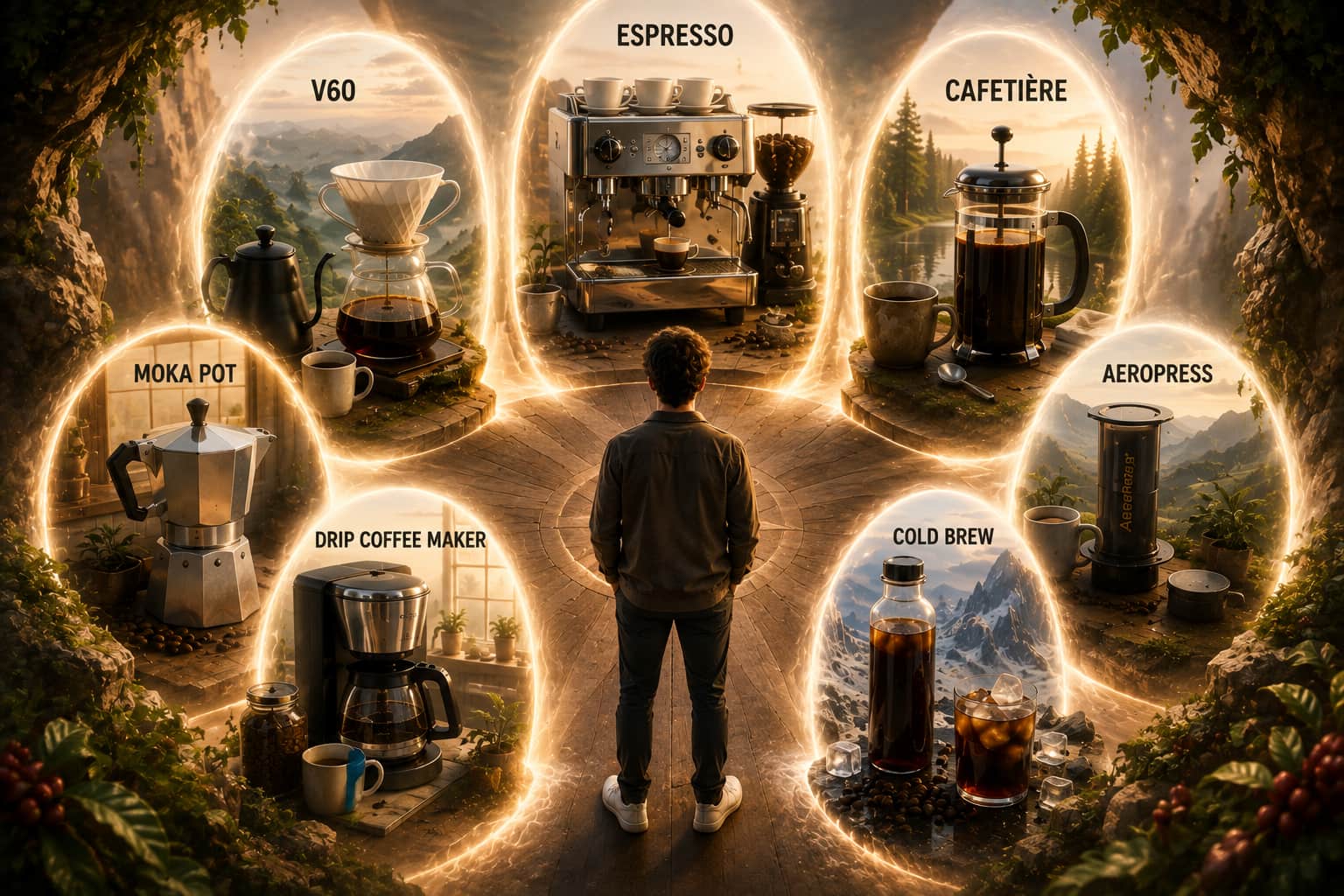
- Matching beans to your espresso machine
- FAQ
Why Most “Best Coffee Beans for Espresso UK” Lists Are Useless
Honestly? Most “best coffee beans for espresso UK” guides on Google are written by SEO agencies, not coffee people. Specifically, they list 10 brands, copy the marketing description from each, and call it a buying guide. As a result, you finish reading and still don’t know which bag to actually buy.
Furthermore, generic listicles miss the actually important question: which beans work for YOUR setup, palate, and budget? Specifically, the “best” espresso beans depend on:
- What machine you own (Sage Barista Express needs different beans to a Gaggia Classic)
- How you drink your coffee (straight espresso vs flat white vs latte)
- Your taste preference (chocolatey vs bright vs balanced)
- Whether you have a grinder or buy pre-ground
- How much you can spend per bag
In short, no single bag of beans is “the best for everyone.” Therefore, this guide does it differently: first the framework for choosing, then specific recommendations from our range matched to your situation. Above all, no fluff.
What Makes the Best Coffee Beans for Espresso
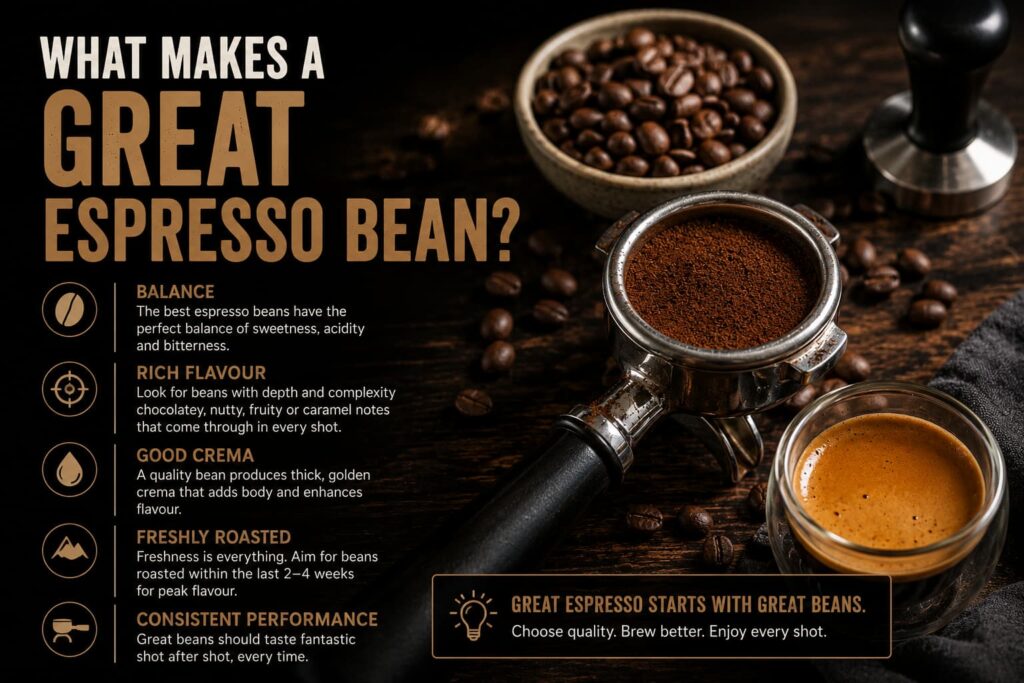
For most home espresso drinkers, medium to medium-dark roasts are the easiest place to start. They tend to produce plenty of body and sweetness while being more forgiving when you’re learning to dial in. Light roasts can make excellent espresso too, but they generally require more precise control of grind, dose, temperature and extraction.
Espresso is a brewing method that uses pressure to force hot water through finely-ground coffee. Specifically, this concentrated, intense extraction punishes some beans and rewards others. As a result, the best coffee beans for espresso share four characteristics:
1. Best coffee beans for espresso are medium-dark to dark roast (3.5/5 to 4.5/5)
Darker roasts develop the body, sweetness, and roasty character that espresso brewing concentrates beautifully. Specifically, the high-pressure extraction emphasises whatever’s in the bean — so dark roasts produce rich, syrupy shots, while light roasts often taste sour and hollow at home espresso settings. Furthermore, while skilled baristas can absolutely pull great light-roast espresso, it requires precise dialling-in that most home setups can’t reliably achieve.
By the way, this doesn’t mean light roasts are bad. Specifically, they’re brilliant for filter brewing — see our UK guide to light roast coffee for more on that.
2. Body: 4/5 or higher
Body is the weight and texture of the coffee on your tongue. Specifically, espresso brewing produces a syrupy, mouth-filling shot when the body is there. By contrast, thin-bodied coffees pull as watery, hollow shots. Therefore, look for full-bodied beans for espresso.
3. Acidity: low (2/5 or below)
Acidity can be particularly noticeable in espresso because the concentrated brew intensifies the coffee’s flavour characteristics. For a smoother, more forgiving shot, we tend to prefer coffees with relatively low acidity.
4. Freshness: roasted within the last 28 days
Freshness matters enormously for espresso. Look for a clearly printed roast date rather than relying only on a best-before date. Freshly roasted coffee also needs some time to degas before it reaches its best for espresso.
For our coffees, we generally recommend using them within the first few weeks after roasting for the best espresso experience.
See our UK guide to storing coffee beans for more.
5. Arabica or Robusta for espresso?
Both Arabica and Robusta can be used for espresso. Arabica is generally prized for its wider range of sweetness and flavour, while Robusta can add body, bitterness and crema. Some traditional espresso blends deliberately include Robusta for those characteristics.
Our espresso blends are 100% Arabica because that’s the flavour profile we’ve chosen for The Coffee Twins.
5-Question Framework to Choose the Best Coffee Beans for Espresso
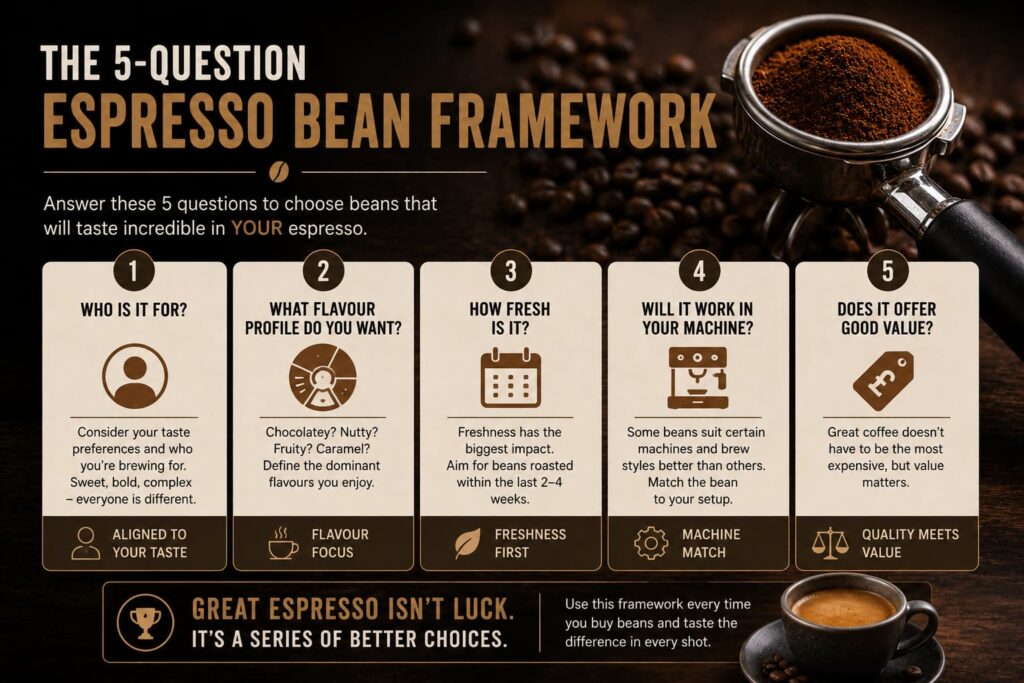
Answer these five questions and you’ll quickly know which coffee beans are right for your espresso setup.
Question 1: How do you actually drink your espresso?
- Straight espresso shots: You want a complex, layered blend like Ant that has depth to enjoy black
- Flat whites and cappuccinos: You want body and chocolatey notes that cut through milk — Audley or Ant
- Lattes and milkier drinks: You want sweetness and approachability — Bobo
- Mostly milk-based but want flavour: A balance — Audley
Question 2: How experienced are you with home espresso?
- Beginner (under 6 months): Choose a forgiving bean. Specifically, our Bobo or Audley both pull drinkable shots even with imperfect dialling-in.
- Intermediate (6 months–2 years): Try our Ant for more complexity and reward.
- Advanced (2+ years): Any of our coffees, including the light roasts if you’ve got a grinder with precise stepless adjustment.
Question 3: What machine do you have?
- Sage Barista Express / Bambino / Touch: All three of our espresso blends work — see our Sage Barista Express guide
- Gaggia Classic / Rancilio Silvia: Audley or Ant — these traditional machines reward darker roasts
- De’Longhi Dedica / La Specialista: Bobo or Audley
- Bean-to-cup (Jura, De’Longhi Magnifica, Sage Oracle): Bobo — most forgiving of grinder limitations
- Moka pot: Ant — see our moka pot guide
Question 4: Do you have a grinder?
- Yes, with stepless adjustment: Buy whole beans. Specifically, you can dial in any bean precisely.
- Yes, with stepped settings (most home grinders): Buy whole beans of a forgiving blend (Bobo, Audley)
- No grinder: Order pre-ground “Espresso” grind from us — we grind for your specific brewer
Question 5: What’s your budget per bag?
- £8–£10 per 250g: All our espresso blends sit here — £9.50 for Bobo, Audley, and Ant
- £15+ per 250g: If you want to go further, look at our Jojo or other speciality roasters’ rare single-origin lots
By the way, this 5-question framework is what we’d actually walk a new customer through if they came into our Farringdon shop. As a result, it gets you to the right bag in under 60 seconds.
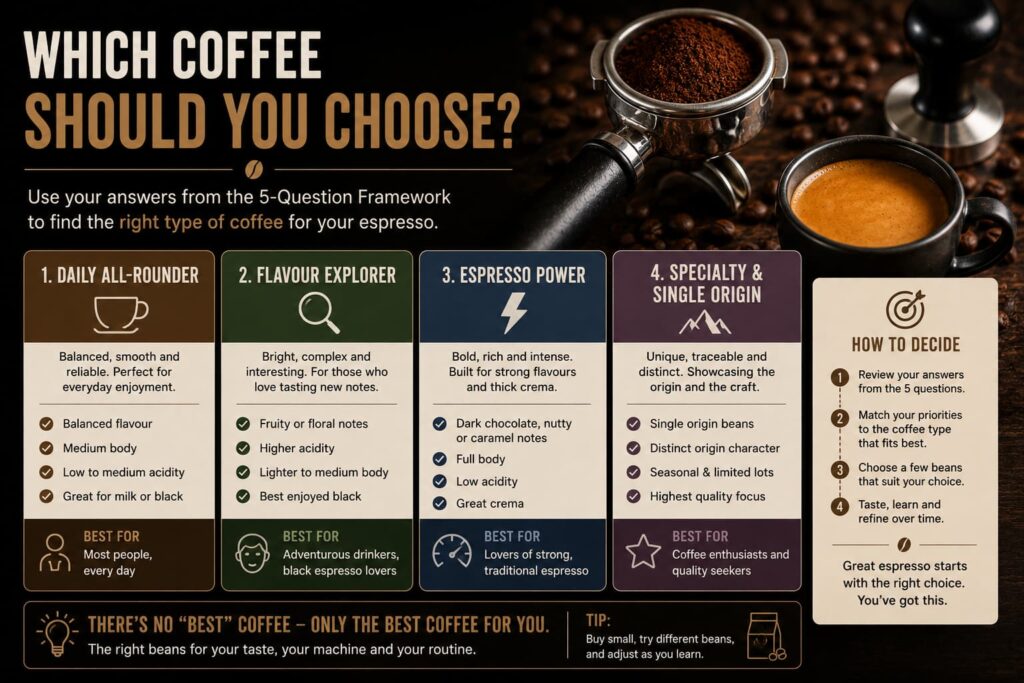
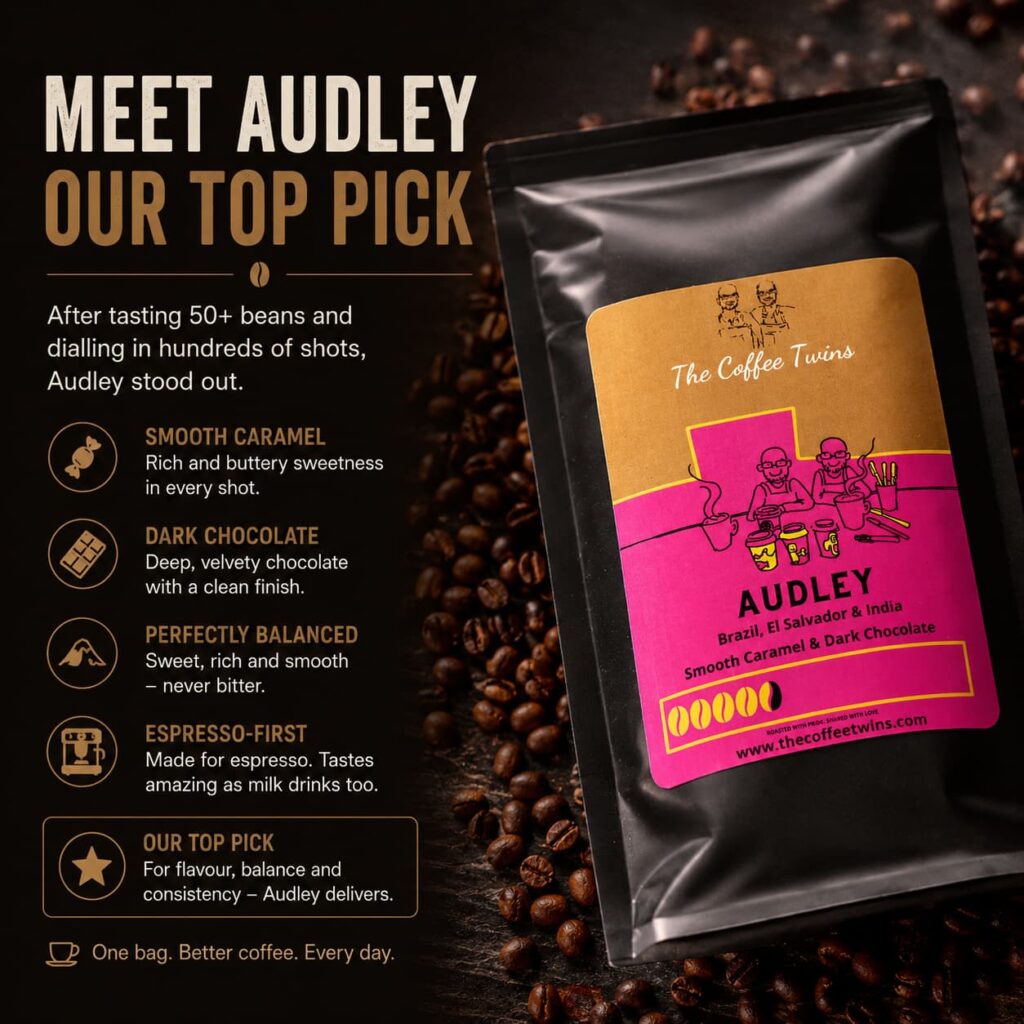
Our Top Pick for the Best Coffee Beans for Espresso: Audley
Origin: Brazil + El Salvador + India
Type: Three-origin espresso blend
Roast: 4.5/5 (our darkest) | Body: 5/5 | Acidity: 2/5
Tasting notes: Smooth, caramel, dark chocolate
Price: £9.50 / 250g (£32 / 1kg)
Order as: Beans or Espresso grind
Buy Audley →
Audley is our top pick for the best coffee beans for espresso in the UK. Specifically, every characteristic is calibrated for espresso brewing:
- Roast 4.5/5: Dark enough to forgive imperfect dialling-in, not so dark it tastes burnt
- Body 5/5: Produces the syrupy, mouth-filling shot that defines proper espresso
- Acidity 2/5: No sour shots even if your grind is slightly off
- Three-origin blend: Brazilian for chocolate, El Salvadoran for caramel, Indian for body
In the cup as straight espresso: smooth caramel sweetness up front, dark chocolate depth in the middle, long roasty finish. Furthermore, in milk drinks, the caramel and dark chocolate notes hold up beautifully in flat whites, cappuccinos, and lattes. As a result, Audley is the bean we’d recommend if you could only buy one espresso coffee.
Best for: Anyone with a home espresso machine, especially beginners and intermediate brewers. Above all, the most forgiving and reliable espresso bean in our range.
Runner-Up: Ant (For Complexity)
Origin: Ethiopia + Indonesia + India
Type: Rich espresso blend
Roast: 4/5 | Body: 5/5 | Sweetness: 3/5 | Acidity: 3/5
Tasting notes: Dark chocolate, smooth, rich
Price: £9.50 / 250g
Buy Ant →
If you’re a more experienced home barista, Ant is the more interesting espresso bean. Specifically, the Ethiopian beans bring subtle lift and complexity to what’s otherwise a classic dark blend. Furthermore, the Indonesian beans add depth, and the Indian beans provide body.
In milk drinks, Ant develops a nougaty sweetness with baker’s chocolate notes. As a result, it makes the most “wow” flat white in our range. By contrast, on factory settings, it can occasionally taste slightly sour — therefore, dial in carefully and you’re rewarded with the most interesting espresso we sell.
Best for: Experienced home baristas with properly dialled-in machines. Furthermore, people who want espresso that’s interesting enough to enjoy black.
Runner-Up: Bobo (For Milk Drinkers)
Origin: Brazil (Cerrado Minas Gerais) + Guatemala
Type: Two-origin blend
Roast: 3.5/5 (medium) | Body: 4/5 | Sweetness: 4/5 | Acidity: 2/5
Tasting notes: Pecan, toffee, milk chocolate
Price: £9.50 / 250g
Buy Bobo →
If your espresso machine mostly makes flat whites, lattes, or oat milk lattes, Bobo is the friendly milk-drinker pick. Specifically, the slightly lighter roast (3.5/5 vs Audley’s 4.5/5) brings more chocolate-and-nut sweetness through milk. Furthermore, the body 4/5 still gives you proper espresso, just with more approachability.
Above all, Bobo is genuinely the most forgiving coffee in our range. As a result, even on day one with a new machine, you’ll get a drinkable shot before you’ve properly dialled in. Specifically, this is what makes it our top pick for absolute beginners.
Best for: Beginners, milk-drink enthusiasts, bean-to-cup machine owners, and anyone who finds darker roasts too intense.
Coffee Beans for Espresso We’d Avoid (And Why)
The honesty section matters. Specifically, out of our eight coffees, three are not the right pick for home espresso:
- Jojo (Ethiopian Limu, roast 2.5/5, acidity 4/5) — beautiful in a V60, sour through home espresso machines. Specifically, the brightness gets amplified by espresso pressure.
- Parrot (Brazilian Cerrado single origin, roast 2.5/5) — too light for reliable home espresso. Furthermore, it’ll need finer grinding than most home machines can deliver.
- Little Robot (body 3/5) — body too low for proper espresso. As a result, save it for V60, AeroPress, or filter brewing.
And from the wider UK market
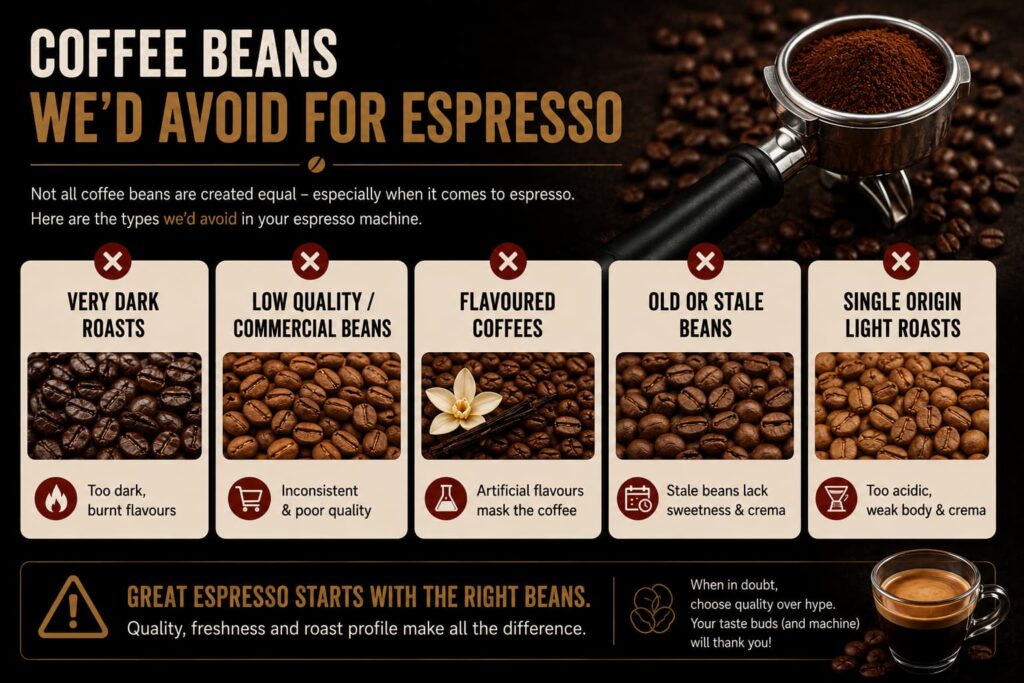
By the way, things to avoid more broadly when buying espresso beans:
- Supermarket “Strong” or “Extra Strong” coffees: Almost always contain bitter Robusta beans
- Bags without a roast date: Likely 3–9 months old already
- Bags labelled “espresso roast” but with no origin information: Generic, often over-roasted commodity coffee
- Pre-ground bags older than 30 days: Ground coffee goes stale within hours, not weeks
Whole Beans or Pre-Ground: Which Is Best for Espresso?
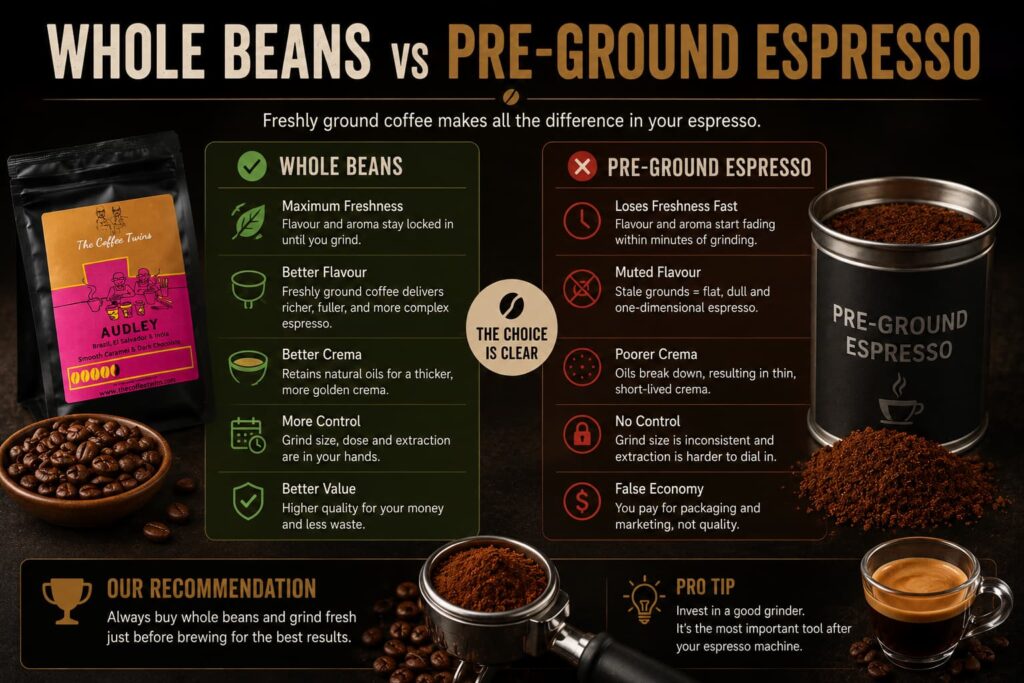
Buy whole beans for espresso if:
- You have a burr grinder (even a basic one)
- Your bean-to-cup or espresso machine has a built-in grinder
- You want maximum freshness
Buy pre-ground espresso if:
- You don’t have a grinder and aren’t planning to buy one
- You’re using a moka pot or AeroPress without a grinder
- You want a quick, no-faff setup
Specifically, when ordering from us, select “Espresso” as the grind option at checkout. Furthermore, we grind to the right fineness for your brewer. As a result, you get genuine espresso-grade grind — finer than supermarket “espresso ground” coffee, which is often actually filter grind.
Above all, pre-ground speciality coffee goes stale faster than whole beans — use within 2 weeks of opening for best results.
Best Coffee Beans for Espresso by Machine Type
Quick match guide by machine:
Sage Barista Express / Bambino / Touch: Audley (top), Bobo (forgiving), Ant (advanced)
Gaggia Classic / Rancilio Silvia: Audley or Ant
De’Longhi Dedica / La Specialista: Bobo or Audley
De’Longhi Magnifica / Eletta: Bobo (bean-to-cup-friendly)
Jura E6 / E8: Bobo
Sage Oracle / Oracle Touch: Audley or Ant
Lelit Bianca / Mara X: Any of the three — your machine handles it
Moka pot (Bialetti, etc.): Ant
AeroPress for espresso-style: Audley
Nespresso reusable pods: Bobo or Audley
Specifically, for more on the Sage Barista Express, see our dedicated Sage guide. Furthermore, for moka pot brewing, see our moka pot guide.
Frequently Asked Questions
What are the best coffee beans for espresso?
The best coffee beans for espresso in the UK are medium-to-dark roasted, full-bodied (4/5 or higher), low-acidity (2/5 or below), 100% Arabica blends — roasted within the last 28 days. Specifically, our Audley (£9.50 / 250g) is our top pick: roast 4.5/5, body 5/5, smooth caramel and dark chocolate. Furthermore, all our espresso blends are roasted in England and dispatched within 24 hours.
Are dark roast beans better for espresso?
Medium-to-dark roasts (3.5/5 to 4.5/5) generally work best for home espresso. Specifically, they’re more forgiving of dialling-in errors and produce richer, syrupy shots. By contrast, light roasts (2.5/5 and below) can absolutely make great espresso but require precise grinding and water temperature control that most home setups can’t reliably achieve.
What’s the difference between espresso blend and single origin for espresso?
Blends combine beans from multiple origins to create balanced, layered espresso. Specifically, our Audley blends Brazilian, El Salvadoran, and Indian beans for chocolate, caramel, and body. By contrast, single origins showcase one farm or region — more distinctive but less forgiving for espresso. Therefore, blends are generally easier for home espresso, while single origins reward expertise.
How fresh should espresso beans be?
Drink within 7–28 days of roasting for peak flavour. Specifically, beans under 5 days old can taste slightly sharp (the CO2 hasn’t dissipated yet). Furthermore, beans over 6 weeks old start losing flavour. As a result, look for a printed roast date on the bag — supermarket beans typically have a “best before” but no roast date, meaning they’re often months old already.
Should I buy whole beans or pre-ground for espresso?
Whole beans always taste fresher because grinding exposes coffee to oxygen. Specifically, if you have any kind of burr grinder — including a built-in one on a bean-to-cup machine — buy whole beans. By contrast, if you don’t have a grinder, pre-ground “Espresso” grind is fine for a moka pot or AeroPress, but home espresso machines really need fresh-ground beans for proper extraction.
What’s the best UK espresso coffee for beginners?
A forgiving, low-acidity, medium-bodied blend. Specifically, our Bobo (£9.50 / 250g) is our most beginner-friendly espresso bean — pecan, toffee, milk chocolate notes with body 4/5 and acidity 2/5. Furthermore, it pulls drinkable shots even when your machine isn’t perfectly dialled in.
Can I use any coffee for espresso?
Technically yes, but the result varies wildly. Specifically, light roasts taste sour in home espresso machines, low-body coffees taste thin and watery, and stale beans taste flat regardless of brewing skill. Therefore, choose beans built for espresso — medium-dark roast, full body, low acidity, fresh.
What’s the best UK speciality coffee for espresso machines?
The Coffee Twins — we roast all our coffee in England. Specifically, our three espresso-built blends are Audley (smooth, caramel, dark chocolate), Ant (rich, complex, dark chocolate), and Bobo (sweet, milk chocolate, beginner-friendly). All £9.50 / 250g. Furthermore, free UK shipping over £30. Use NEW10 for 10% off your first order.
Summary
The best coffee beans for espresso in the UK are medium-to-dark roasted (3.5/5 to 4.5/5), full-bodied (4/5 or higher), low-acidity (2/5 or below), 100% Arabica blends — roasted within the last 28 days. Specifically, the right bag depends on your machine, experience level, and how you drink your espresso.
From our range:
- Top pick: Audley — most forgiving and reliable espresso bean. £9.50 / 250g.
- For complexity: Ant — interesting enough to enjoy black. £9.50 / 250g.
- For milk drinkers: Bobo — sweet and beginner-friendly. £9.50 / 250g.
Above all, the right bean depends on your specific setup and palate. Specifically, use our 5-question framework above to decide. Furthermore, all three of our espresso blends ship within 24 hours of order, roasted in England. Free UK shipping over £30.
Buy Audley — Our Espresso Top Pick →
0 Comments