


Why trust this guide?

We’re Jeremiah and Raja — The Coffee Twins. Before launching our UK speciality coffee brand, we trained in five-star hotel food and beverage and ran our own coffee shop in Farringdon. Specifically, we’ve troubleshot bitter coffee for thousands of customers and trained baristas to spot the cause within a sip or two. This guide is the straightforward version of what we’d teach you behind the bar.
Table of contents
- What “bitter” actually means in coffee
- Cause 1: Water that’s too hot
- Cause 2: Grind size is too fine
- Cause 3: Brewing for too long
- Cause 4: Too much coffee for your water
- Cause 5: Your beans are stale
- Cause 6: Your equipment is dirty
- Cause 7: The beans are over-roasted
- Brewer-specific bitterness fixes
- When it’s not technique — it’s the beans
- FAQ
What “Bitter” Actually Means in Coffee
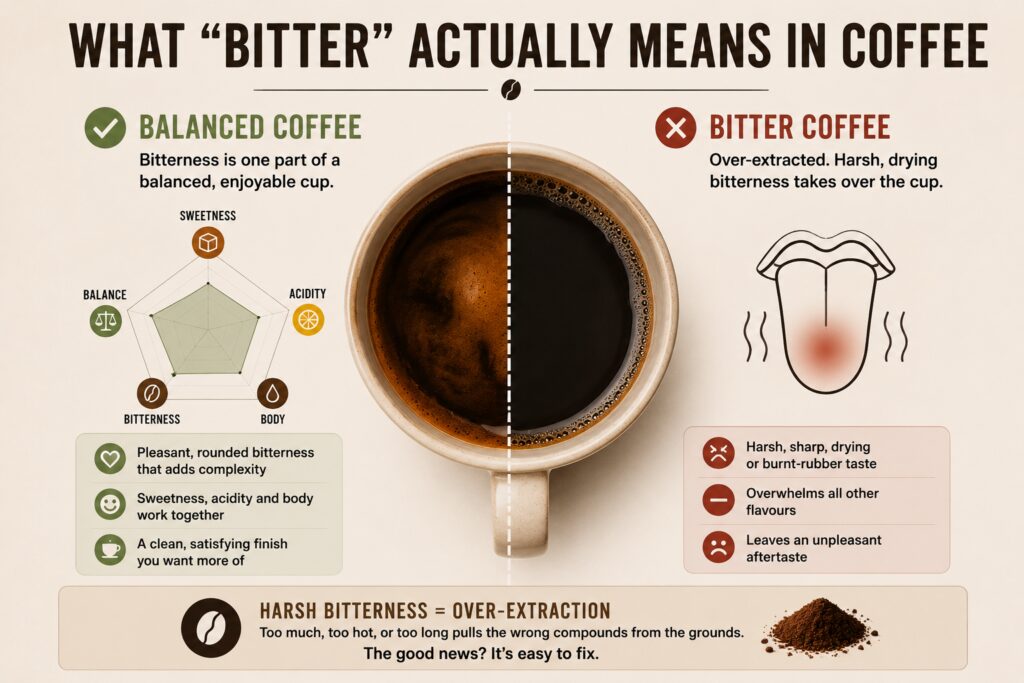
First, a quick distinction. Coffee should have some natural bitterness — it’s one of the five basic tastes, and a balanced cup has a hint of it alongside sweetness, acidity, and body. However, the bitterness you’re worried about is the harsh, dry, almost burnt-rubber sensation that takes over the whole cup. As a result, you reach for sugar or milk to mask it.
That kind of bitterness is a flaw, not a flavour. Moreover, it has a specific cause: over-extraction. In other words, your water has spent too long, too hot, or too aggressively pulling compounds out of the coffee grounds — and the last compounds to come out are the harsh, bitter ones.
The good news? Fixing it is almost always free. Therefore, you rarely need new beans or new equipment — just a small adjustment to one of seven variables.
Cause 1: Water That’s Too Hot
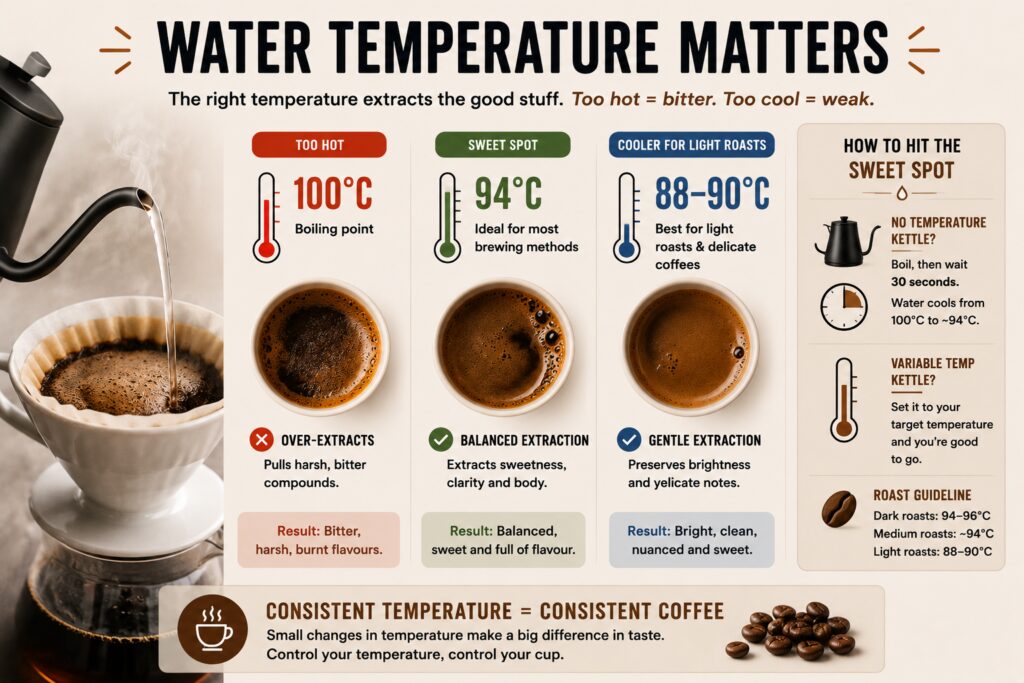
Boiling water (100°C) is too hot for most speciality coffee. Specifically, it over-extracts the grounds and produces a bitter cup. As a result, the sweet spot for most brewing is 94°C.
The fix
After boiling the kettle, wait 30 seconds before pouring. As a result, the water drops from 100°C to roughly 94°C — exactly where you want it. Alternatively, if your kettle has a temperature setting, just set it to 94°C directly.
For darker roasts like our Audley or Komodo, you can push to 96°C. By contrast, for light Ethiopians like our Jojo, drop to 88–90°C to keep the brightness without harshness.
Cause 2: Grind Size Is Too Fine
Grind size controls how fast water flows through coffee. Specifically, finer grinds slow the water down, so it spends more time in contact with the grounds — and over-extracts. As a result, the cup tastes bitter.

The fix
Match your grind to your brewer:
- Cafetière / French press: Coarse — like rough sea salt
- V60 / pour-over: Medium-fine — like table salt
- AeroPress: Medium-fine
- Moka pot: Fine — between espresso and filter
- Espresso: Very fine — like caster sugar
If your coffee tastes bitter, go one notch coarser and try again. By the same logic, if it now tastes sour or weak, you’ve gone too far — go one notch finer.
Furthermore, if you don’t have a grinder, order from us with the correct grind selected at checkout — Cafetière, Filter, or Espresso. We grind to the right size for each brewer.
Cause 3: Brewing for Too Long
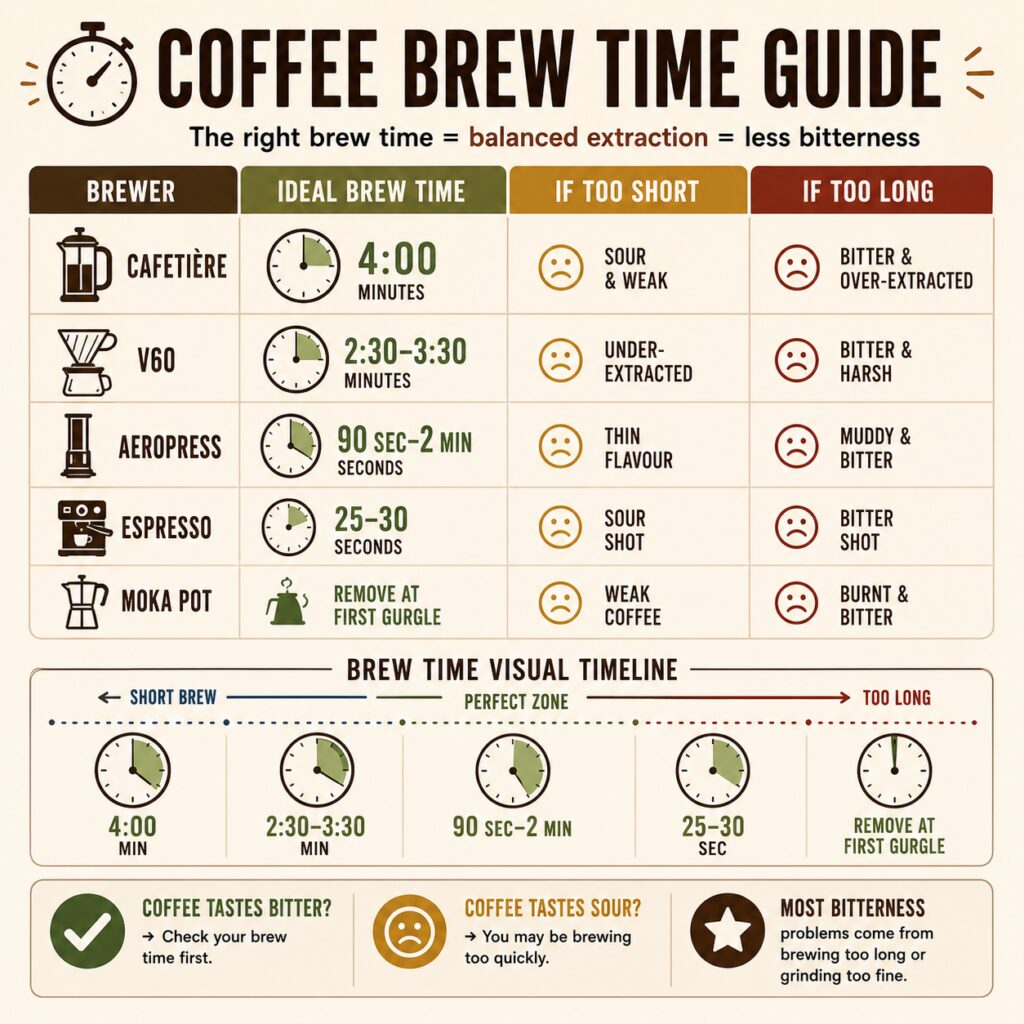
The longer water sits on coffee grounds, the more it extracts. Eventually, it extracts the bitter compounds you don’t want.
The fix — by brewer
- Cafetière: Stop at 4 minutes. Plunge slowly, then pour immediately. Don’t leave coffee sitting on the grounds.
- V60: Aim for a total brew time of 2:30–3:30. Longer than that and you’re over-extracting.
- AeroPress: Steep for 90 seconds–2 minutes, then press over 30 seconds.
- Moka pot: Take it off the heat as soon as the coffee gurgles up — don’t let it cook.
- Espresso: Aim for 25–30 seconds from when the pump starts.
In particular, if you’re consistently over-time, your grind is probably too fine — see Cause 2.
Cause 4: Too Much Coffee for Your Water
Using too much coffee for the amount of water creates over-saturation. Consequently, water passes over already-extracted grounds and starts pulling bitter compounds.
The fix — the golden ratios
- Filter / V60: 1g coffee per 16–17g water (e.g., 15g coffee : 250g water)
- Cafetière: 1g coffee per 17g water (e.g., 30g coffee : 500g water)
- AeroPress: 1g coffee per 15g water (e.g., 15g coffee : 220g water)
- Espresso: 1g coffee in : 2g espresso out (e.g., 18g in : 36g out)
Therefore, get a £10 set of digital kitchen scales and actually weigh your coffee and water. Without scales, “one scoop” varies wildly. As a result, your coffee will be inconsistent week to week.
Cause 5: Your Beans Are Stale
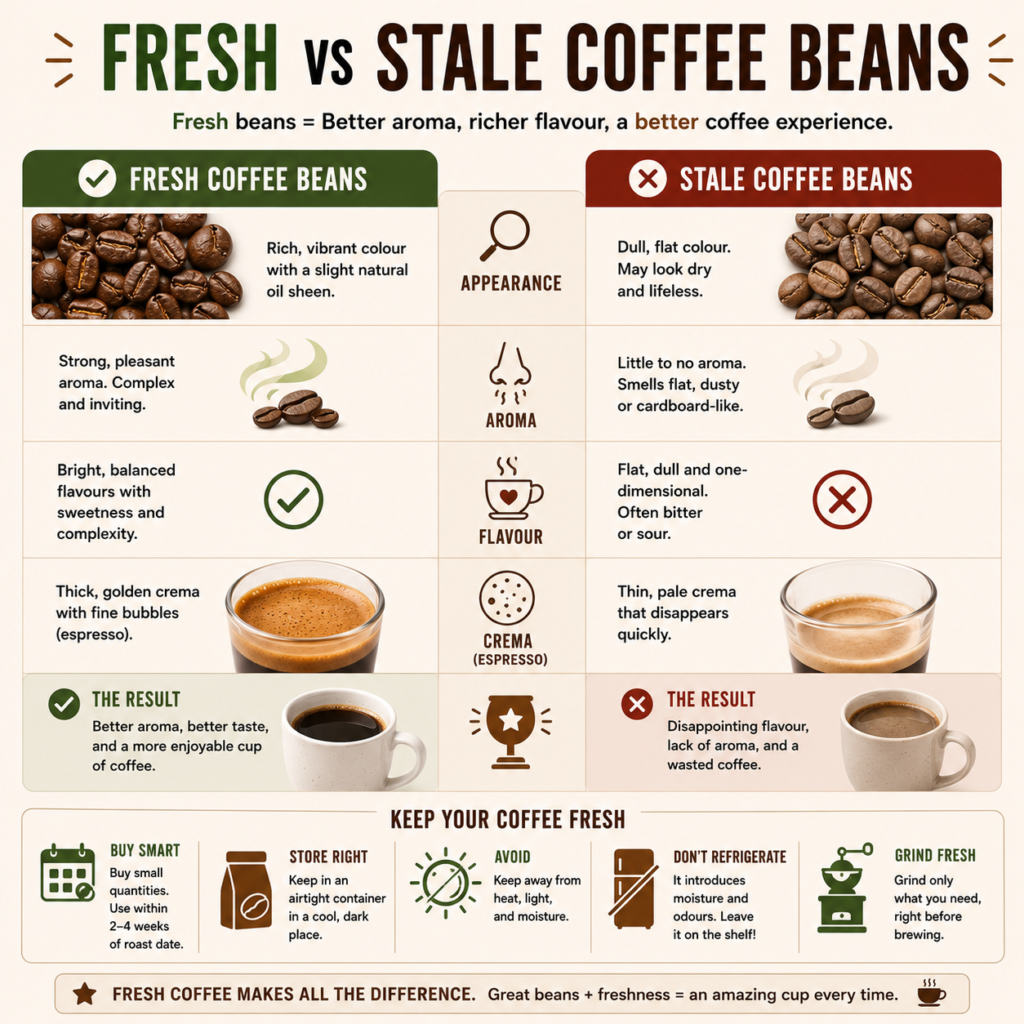
Coffee starts losing flavour the moment it’s roasted, and oxidation accelerates after grinding. Stale beans don’t just taste flat — instead, they often taste bitter, woody, or vaguely cardboard-like.
The fix
- Drink beans within 28 days of roasting for peak flavour
- Buy from speciality roasters with a roast date on the bag — like us
- Avoid supermarket beans if you can — they’re often 3–9 months old by the time they reach your kitchen
- Grind fresh for every brew if possible. Ground coffee goes stale within hours
- Store beans in an airtight container at room temperature, away from light
In short, if your coffee has been bitter for months despite trying everything, the beans are almost certainly stale. As a result, switching to a freshly-roasted bag fixes the problem instantly. Our whole range ships within 24 hours of order, roasted in England.
Cause 6: Your Equipment Is Dirty
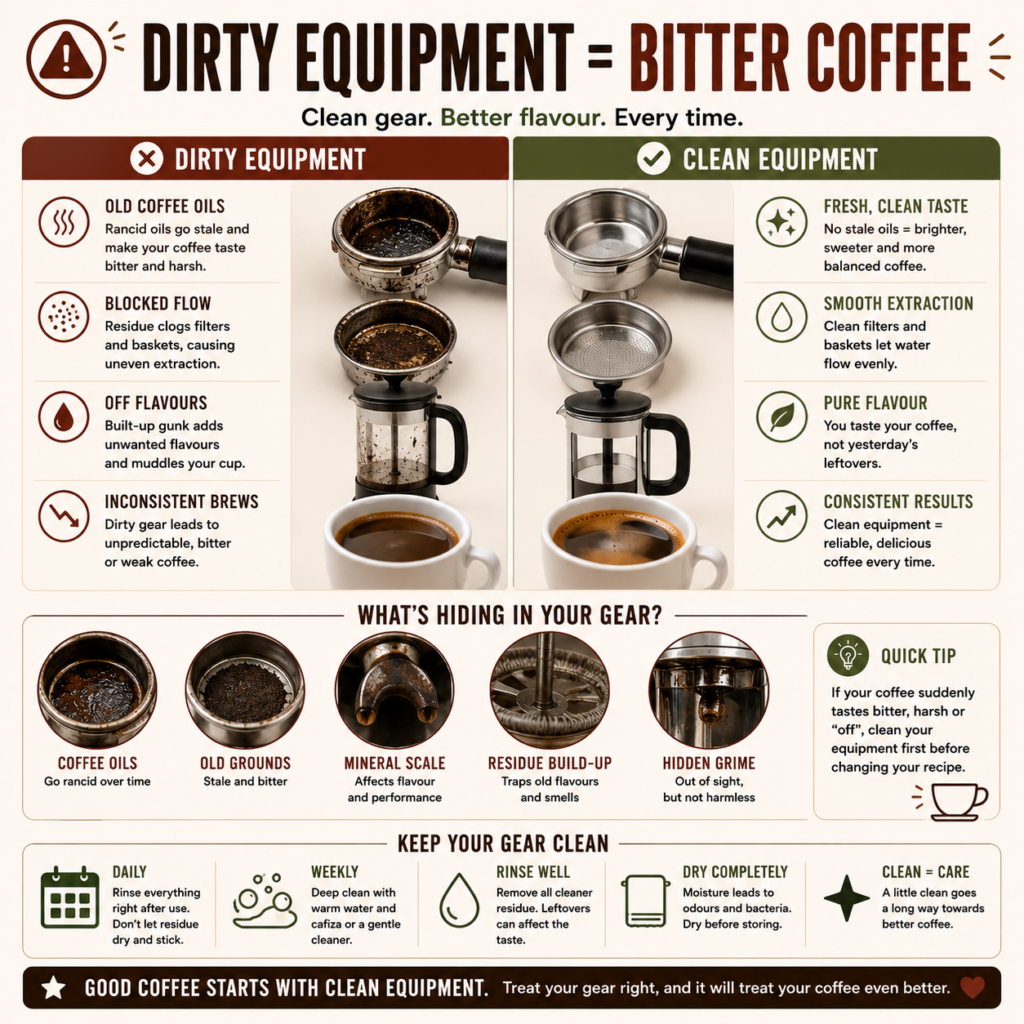
Old coffee oils build up in espresso machines, moka pots, AeroPresses, and even cafetières. Specifically, those oils go rancid and add a bitter, slightly stale taste to every cup — even when you’ve changed beans, grind, and technique.
The fix
- Espresso machines: Backflush with espresso machine cleaner weekly. In addition, descale monthly if you’re in a hard-water area like London.
- Bean-to-cup machines: Run the descaling cycle when the machine asks. Furthermore, clean the brew unit weekly.
- Cafetières: Disassemble and wash all parts in hot soapy water after every use. By the way, the mesh filter holds oils invisibly.
- AeroPress: Rinse thoroughly after each brew. Replace the rubber seal once a year.
- Moka pot: Rinse with hot water after each use — never soap, which damages the seasoning. Additionally, replace the rubber gasket annually.
- Grinder: Brush out the burrs weekly. Furthermore, run cleaning tablets through monthly.
For UK home brewers in particular, descaling matters enormously. London, Cambridge, Reading, Norwich, and most of the South East have very hard water. As a result, limescale builds up in espresso machines and kettles, which interferes with brewing temperature and adds bitterness. Therefore, descale monthly if you’re in one of these areas.
Cause 7: The Beans Are Over-Roasted
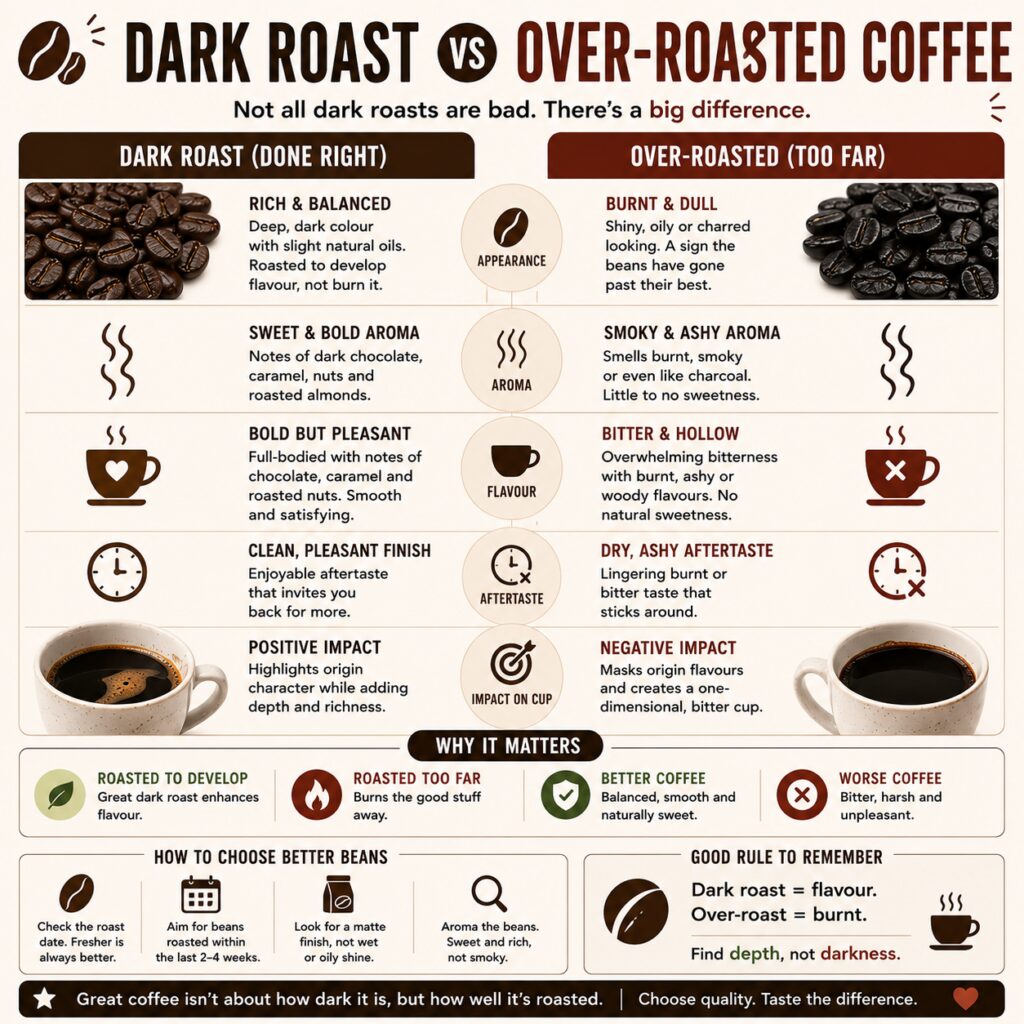
Some bitterness is locked in at the roaster. Specifically, when beans are roasted too dark — past the second crack and into oily, black territory — they pick up a burnt, ashy character that no brewing technique can fix.
This is the secret behind why supermarket “Strong” or “Extra Strong” coffee tastes burnt. To clarify, roasters use heavy roasting to mask the flavour of low-quality green beans. As a result, you get a bitter cup, not a strong one.
The fix
Look for these things on the bag:
- A roast level stated clearly (we score ours out of 5)
- 100% Arabica — speciality grade
- A named origin or blend — not just “Italian Roast” or “Strong”
- Specific tasting notes — “milk chocolate, hazelnut, caramel” rather than “rich and full-bodied”
For example, our Audley is roast 4.5/5 — proper “strong” coffee that tastes smooth, caramel, dark chocolate. By contrast, supermarket “strength 5” coffee tastes burnt because it’s hiding cheap Robusta beans under heavy roasting.

Brewer-Specific Bitterness Fixes
Bitter cafetière coffee?
The most common cause is leaving the coffee sitting on the grounds after plunging. In short, plunge, pour into mugs, and finish the cafetière. Don’t let it sit. In addition, check your grind — too fine is the second most common cause.
Bitter V60 / pour-over?
Usually your water is too hot or your grind is too fine. Specifically, drop to 94°C and try a coarser grind. Furthermore, total brew time should be 2:30–3:30.
Bitter espresso?
Three possible causes: shot is running too long (over 30 seconds), grind is too fine, or machine needs cleaning. Therefore, time your next shot and start by going one notch coarser on the grind.
Bitter moka pot?
You’re cooking it. Specifically, take it off the heat the moment the coffee starts gurgling out — don’t wait for the chamber to fill. In addition, pour immediately, don’t let it sit on the heat.
Bitter bean-to-cup machine?
Almost always a cleaning issue. As a result, run the descaling cycle, clean the brew unit, and brush out the grinder. Furthermore, if the problem persists, try a slightly coarser grind setting.
When It’s Not Technique — It’s the Beans
Sometimes you’ve done everything right and the coffee still tastes bitter. In that case, the beans themselves are the problem. The fixes are simple, though — switch to a fresher, better-quality, less-aggressively-roasted bag.
From our range, the three coffees least likely to ever taste bitter:
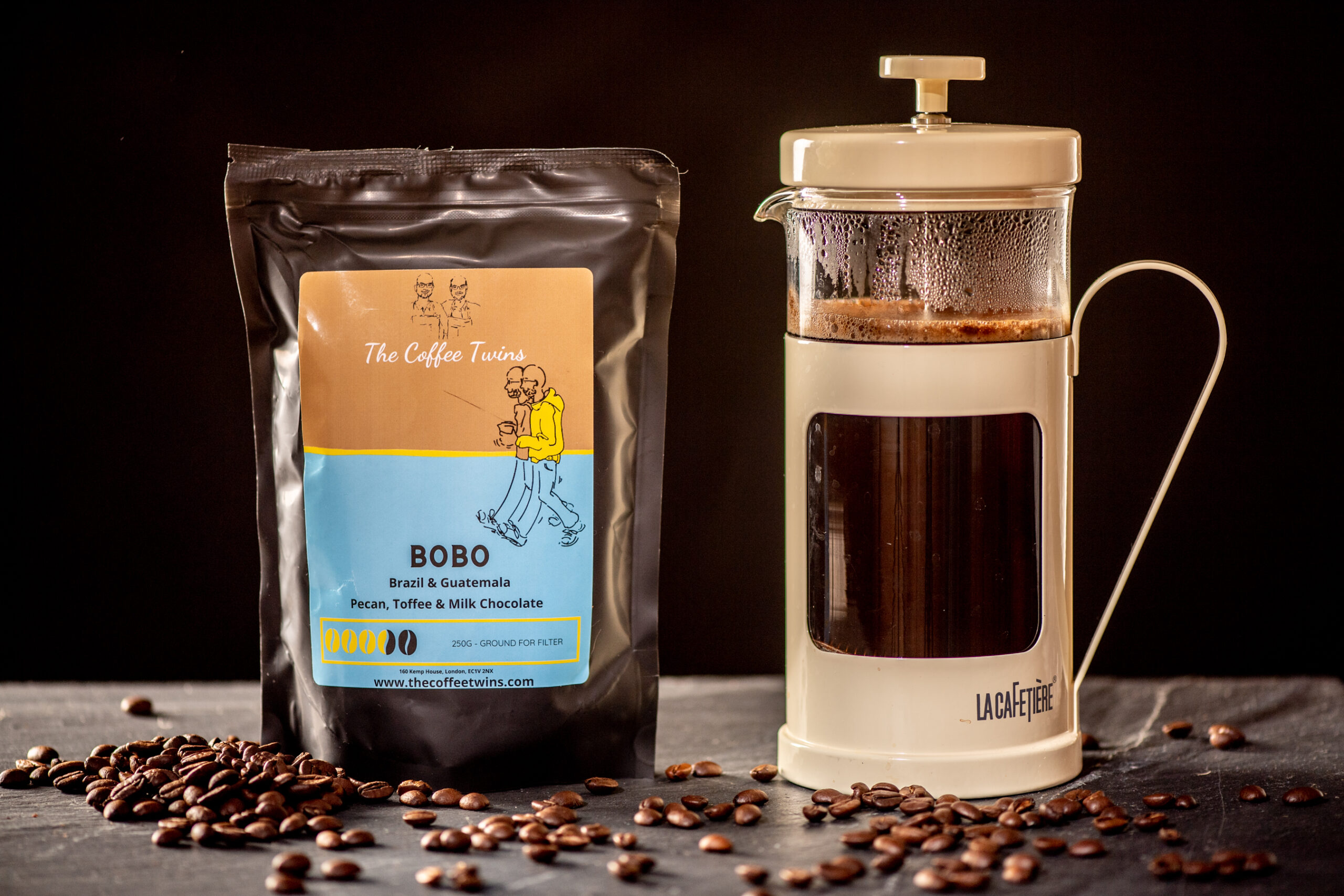
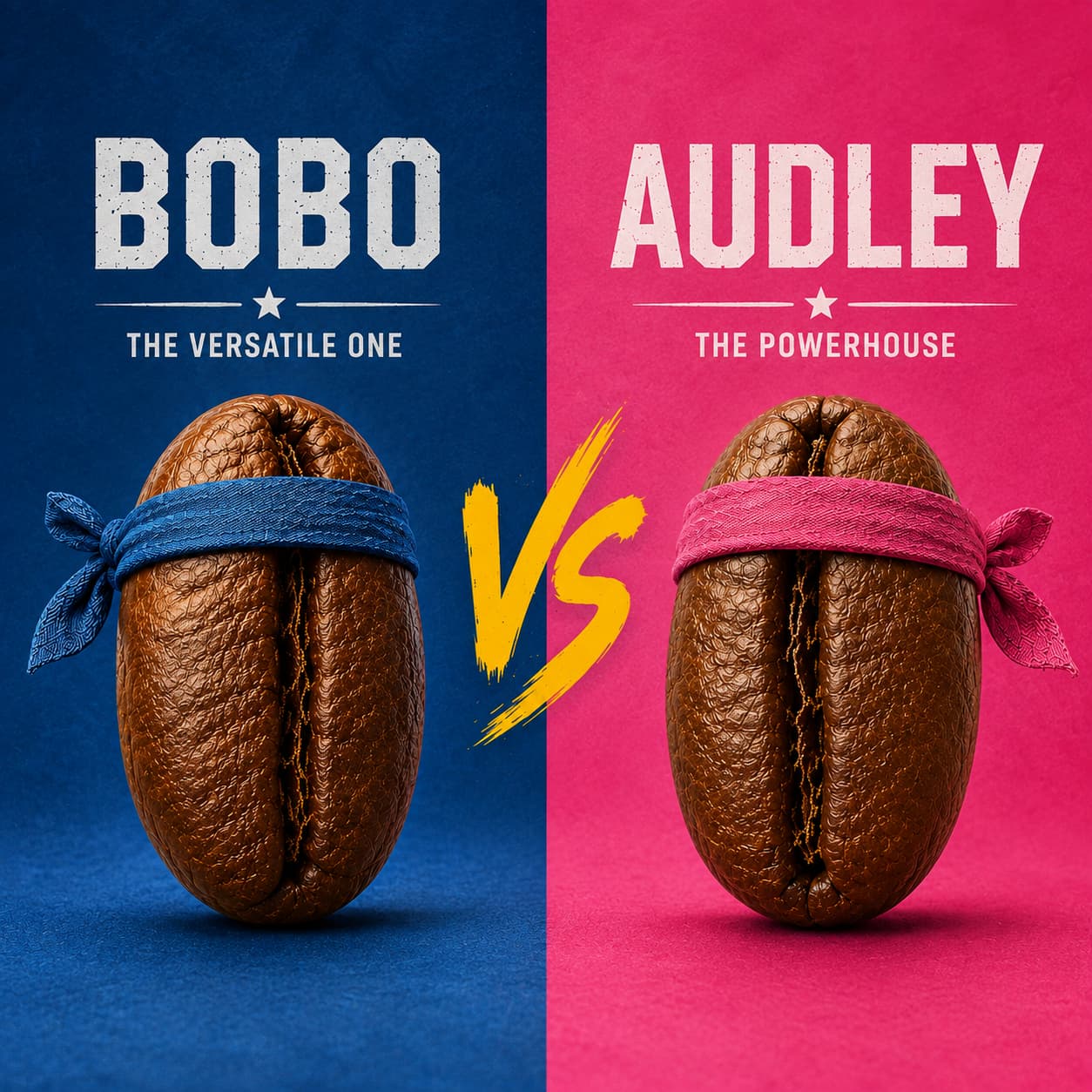
- Bobo — Body 4/5, sweetness 4/5, acidity 2/5. Naturally smooth and sweet. £9.50 / 250g.
- Parrot — Brazilian single origin. Sweet, nutty, chocolatey. Designed to be easy-drinking. £9.50 / 250g.
- Hufflelump — Swiss Water decaf. Body 4/5, acidity 2/5, dark chocolate and nutty. £10.50 / 250g.
Above all, all three are 100% Arabica speciality-grade, roasted in England, shipped within 24 hours. Therefore, you’ll never get a “burnt supermarket” bitter cup from any of them.
Frequently Asked Questions
Why does my coffee taste bitter even with good beans?
Almost always over-extraction — water too hot, grind too fine, or brewing too long. Specifically, drop your water temperature to 94°C, try a slightly coarser grind, and check your brew time. As a result, you’ll fix most bitter-coffee complaints.
Why does my cafetière coffee taste bitter?
The most common cause is leaving the coffee sitting on the grounds after plunging. Specifically, plunge at 4 minutes, pour into mugs, finish the cafetière. Furthermore, don’t reheat or leave coffee in the press.
Why does my espresso taste bitter?
Three causes: shot running too long (aim for 25–30 seconds), grind too fine, or the machine needs cleaning. Therefore, time your shot first, then go one notch coarser on the grind if it’s still bitter.
Does dark roast coffee always taste bitter?
No. A well-roasted dark coffee like our Audley tastes smooth, roasty, and chocolatey — not bitter. By contrast, supermarket “strong” or “extra strong” coffees often taste bitter because they’re over-roasted to hide low-quality beans.
Does fresh coffee taste less bitter than stale coffee?
Yes, dramatically. Specifically, stale coffee loses its natural sweetness and complexity, leaving bitterness more exposed. As a result, drinking beans within 28 days of roasting is the single biggest improvement you can make.
Can hard water make coffee taste bitter?
Yes. Specifically, very hard UK water (common in London, Cambridge, the South East) extracts coffee differently and can amplify bitterness. Therefore, use a Brita-filtered water for brewing, and descale your kettle and machine monthly.
Does adding salt to coffee reduce bitterness?
It’s a real technique — a tiny pinch of salt can suppress bitter taste receptors. However, it’s a workaround, not a fix. Specifically, you’re better off solving the root cause (extraction, grind, beans) so the coffee tastes good on its own.
Where can I buy smooth, low-bitterness coffee in the UK?
The Coffee Twins — we roast all our coffee in England. Specifically, our Bobo, Parrot, and Hufflelump are naturally smooth and low in bitterness, with sweetness 4/5 and acidity 2/5. £9.50–£10.50 / 250g. Furthermore, free UK shipping over £30. Use NEW10 for 10% off your first order.
Summary
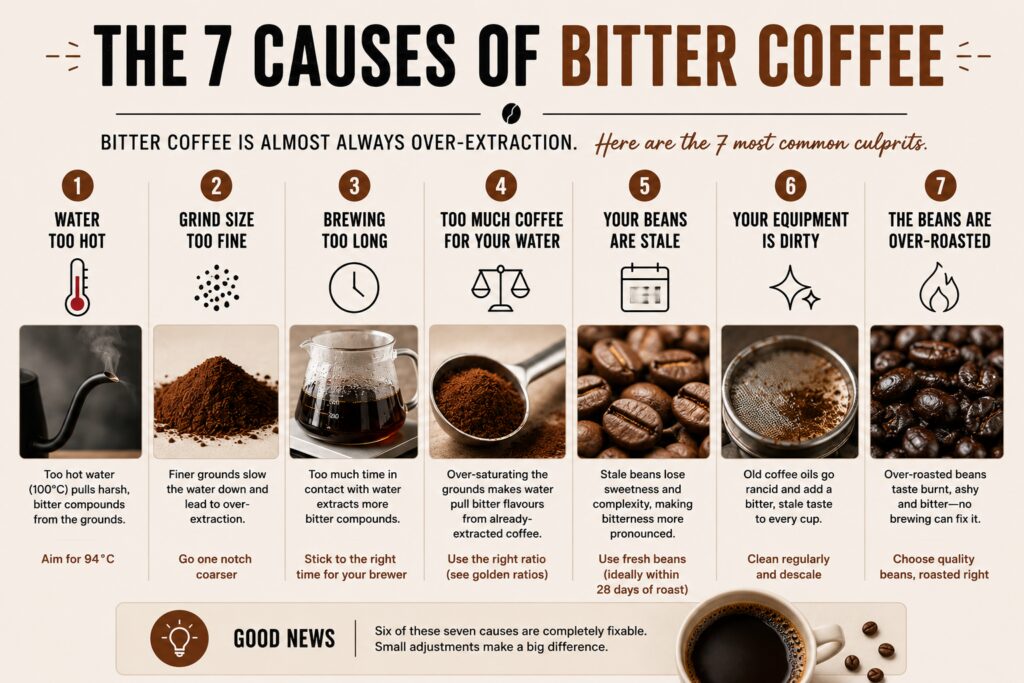
Bitter coffee is almost always caused by over-extraction. Specifically, the seven causes are: water too hot, grind too fine, brewing too long, too much coffee for the water, stale beans, dirty equipment, or over-roasted beans. Fortunately, six of the seven are free to fix.
To begin troubleshooting, start with the cheapest fixes:
- Wait 30 seconds after boiling before pouring (94°C)
- Go one notch coarser on the grind
- Stick to the right brew time for your method
- Clean your equipment
If those don’t work, the issue is your beans. As a result, switch to a fresher, better-quality bag. Our Bobo, Parrot, and Hufflelump are the three least likely to ever taste bitter.

0 Comments