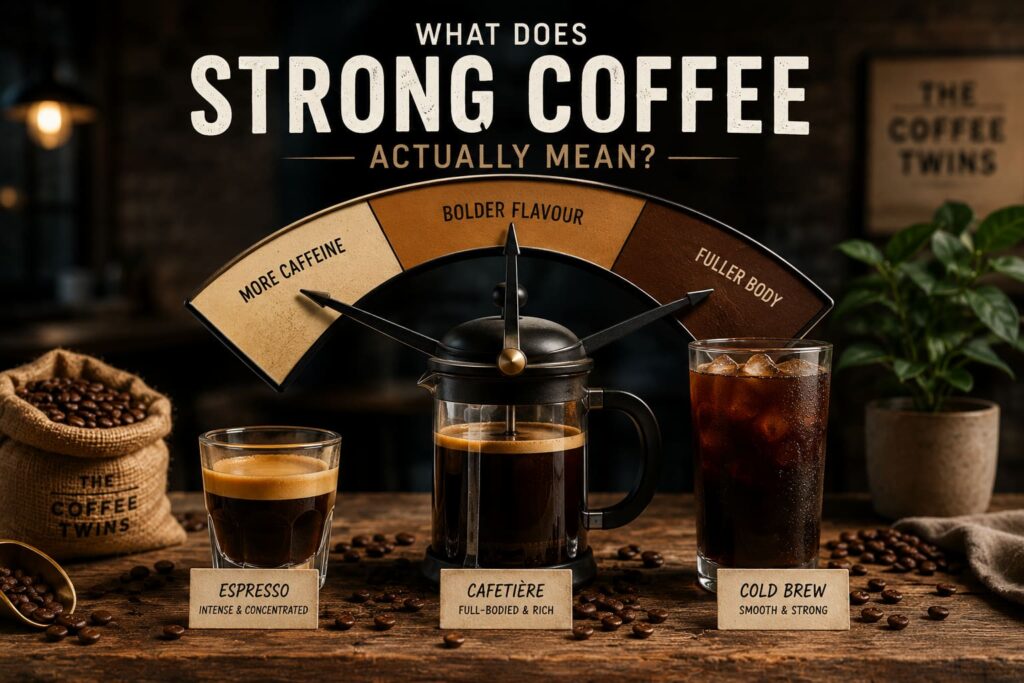
Quick answer: This UK coffee strength guide explains what “strong” really means in coffee, because caffeine content, body, roast level and flavour intensity are four different things. By caffeine, a 250ml mug of filter or cafetière coffee usually carries more than a single espresso (see the chart below). By taste, however, a dark-roasted espresso blend feels the most intense. So the right kind of “strong” depends on which of the four you actually want.
If you’re after a bold bag to brew at home, our three boldest picks are in a separate guide, linked further down this page.
Why trust this guide?

We’re Jeremiah and Raja — The Coffee Twins. We’re a UK speciality coffee brand, and our beans are roasted to order for us by a partner roastery in England. We trained in five-star hotel food and beverage, ran our own coffee shop in Farringdon, and our coffee is now stocked in five-star London hotels. As a result, we’ve spent years explaining coffee strength to customers who often mean four different things when they ask for “strong coffee.” This guide covers what strength actually means, and how to get the right kind of strong for you.
Table of contents
- What “strong” actually means in coffee
- Caffeine strength: the objective measure
- Body strength: what your mouth feels
- Roast level and perceived strength
- Brewing method strength comparison
- The definitive UK coffee strength chart 2026
- Understanding “supermarket strength” ratings (1-5)
- How to choose the right strong coffee for you
- Looking for the strongest coffee to buy?
- FAQ
What “Strong” Actually Means in the UK Coffee Strength Guide
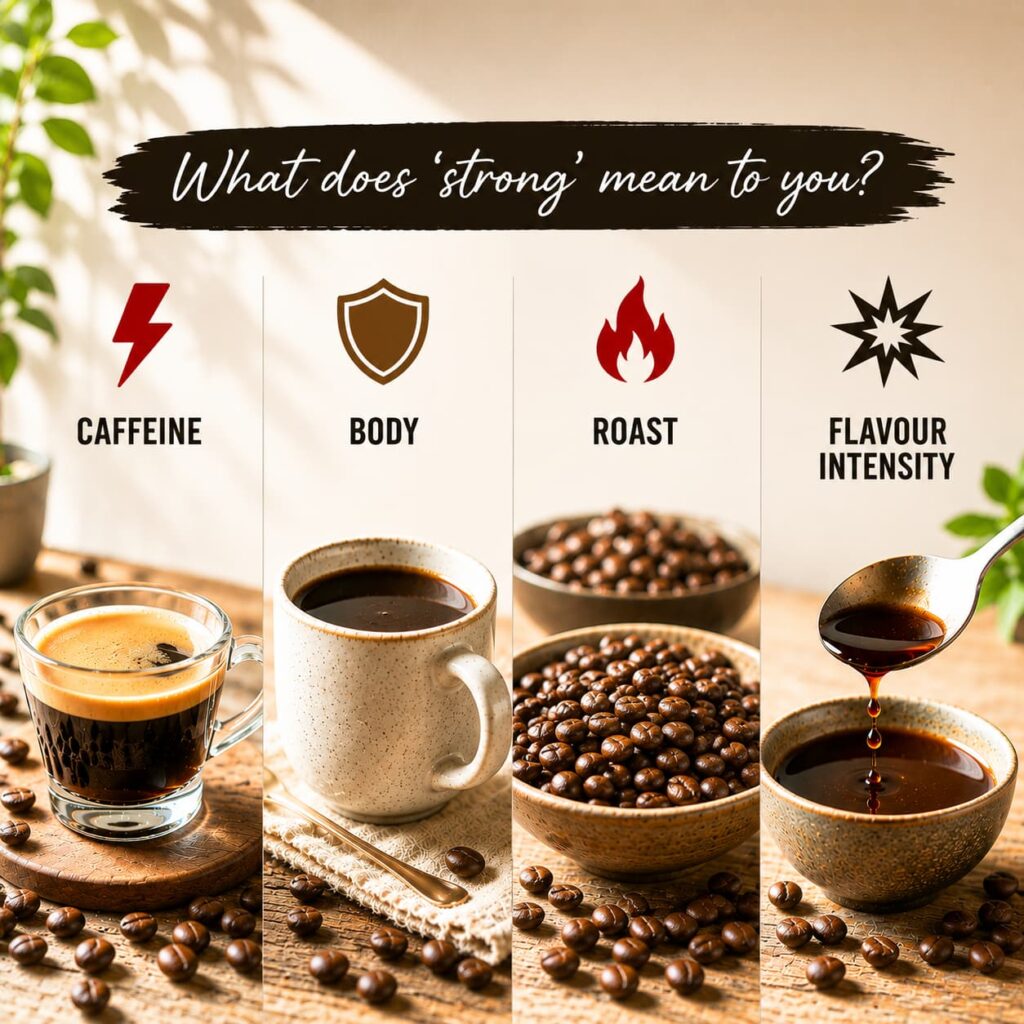
In fact, “strong coffee” means four different things depending on who’s using the term. Also, understanding these differences is genuinely important because they lead to very different coffee choices.
The four types of coffee strength
- Caffeine strength: How much caffeine is in your cup (measured in mg)
- Body strength: How heavy and thick the coffee feels in your mouth
- Roast strength: How dark the beans have been roasted
- Flavour intensity: As a result, how bold or subtle the taste is
Why this matters
Ultimately, most UK coffee drinkers say “strong coffee” when they mean “coffee that tastes intense and full-bodied.” In short, they’re not usually asking for maximum caffeine. In addition, if you order a “strong latte” at a café, they’ll typically add an extra espresso shot — which increases caffeine but the drink still tastes mild because of the milk.
As a result, when someone asks us for “the strongest coffee,” we ask three questions:
- Do you want the most caffeine? (Answer: drip filter or double espresso)
- Do you want the boldest flavour? (Answer: dark-roasted espresso blend)
- Do you want the fullest body? (Answer: cafetière with dark-roast beans)
Also, this UK coffee strength guide addresses each of these separately. Additionally, this is what separates good coffee advice from generic recommendations. As a result, you’ll finish this guide knowing exactly which “strong” you want.
Caffeine Strength: The Objective Measure
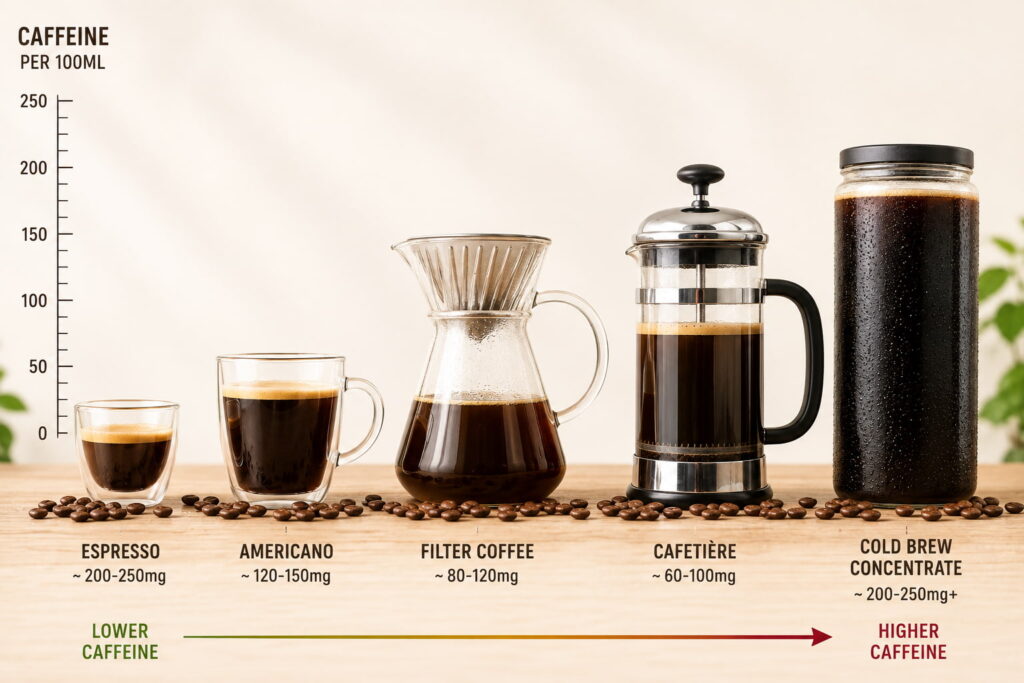
In other words, caffeine content is the only measurable form of coffee strength. On top of that, everything else is subjective. As a result, here’s the honest breakdown of caffeine by drink type, based on standard measurements from bodies including the Specialty Coffee Association.
UK caffeine content by coffee type (2026 data)
Approximate caffeine content per standard UK serving:
Single espresso (30ml): 60-80mg
Double espresso (60ml): 120-160mg
Americano (300ml): 120-160mg (same as double espresso)
Long black (200ml): 120-160mg
Flat white (150ml): 120-160mg (double espresso base)
Latte (300ml): 120-160mg (double espresso base)
Cappuccino (180ml): 120-160mg (double espresso base)
Filter coffee (250ml): 95-165mg
Drip filter (250ml): 95-165mg
Cafetière (250ml): 80-135mg
Moka pot (60ml): 80-100mg
AeroPress (200ml): 70-120mg
V60/pour-over (250ml): 70-130mg
Cold brew (concentrate, 250ml): 200-300mg (undiluted)
Cold brew (diluted 1:1, 500ml): 100-150mg
Instant coffee (250ml): 30-90mg
Decaf coffee (any brewing method): 2-15mg
The genuine winners for maximum caffeine
- Cold brew concentrate: The highest caffeine per volume — 200-300mg undiluted
- Drip filter / cafetière: 95-165mg per cup — the highest per cup for hot coffee
- Double espresso (or any drink using it): 120-160mg concentrated in one shot
The surprising truth about espresso
Indeed, espresso has LESS total caffeine than filter coffee per cup. Also, this is because you drink less espresso — a single shot is only 30ml compared to 250ml of filter. As a result, filter drinkers actually consume more caffeine per session than espresso drinkers.
See our UK coffee caffeine guide for detailed brewing method comparisons. In addition, the NHS advises no more than 200mg of caffeine a day during pregnancy, while the European Food Safety Authority considers up to 400mg a day safe for most healthy adults.
Body Strength: What Your Mouth Feels
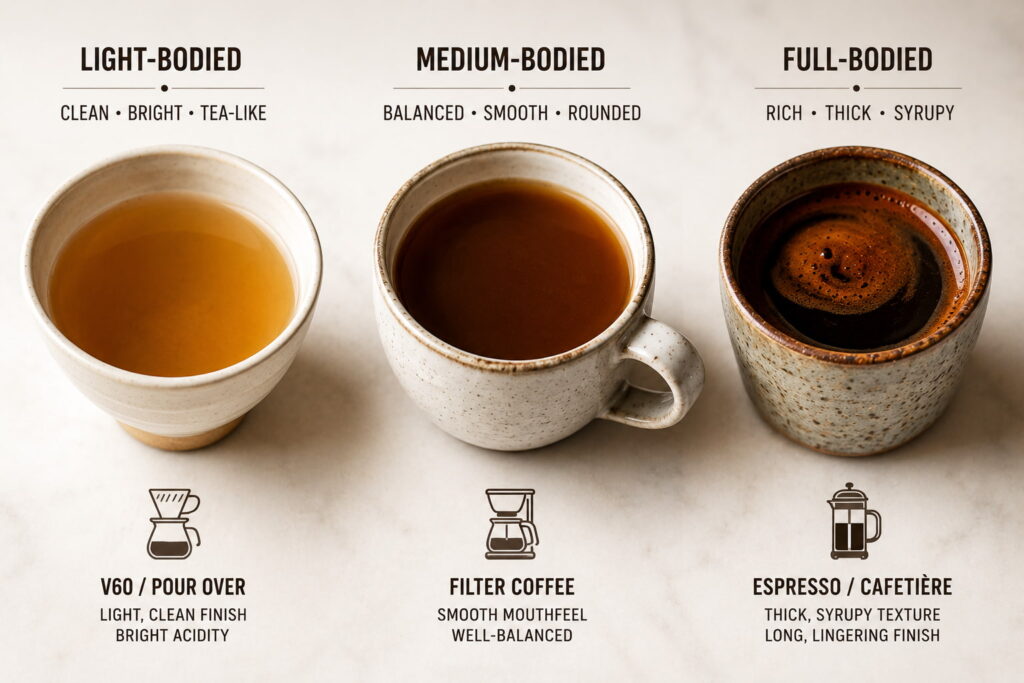
In fact, “body” refers to how heavy or thick the coffee feels in your mouth. Additionally, this is subjective but genuinely important — most people asking for “strong coffee” actually want full body more than they want caffeine.
The body scale (1-5)
- Body 1/5: Very light, watery mouthfeel (some V60 single origins)
- Body 2/5: Light, clean, tea-like
- Body 3/5: Medium, balanced (most filter coffees)
- Body 4/5: Full, satisfying (cafetière-brewed medium roasts)
- Body 5/5: Heavy, syrupy, mouth-coating (dark espresso blends, cafetière with dark roasts)
What creates strong body
Four main factors determine coffee body:
- Bean origin: Sumatran and Indonesian coffees have naturally full body
- Roast level: Darker roasts develop more body
- Brewing method: As a result, cafetière and moka pot preserve more oils = more body
- Grind and dose: More coffee per volume of water = more body
From our range: the body 5/5 winners
Full-body champions:
Audley — Body 5/5, roast 4.5/5, dark chocolate, caramel
Ant — Body 5/5, rich espresso blend
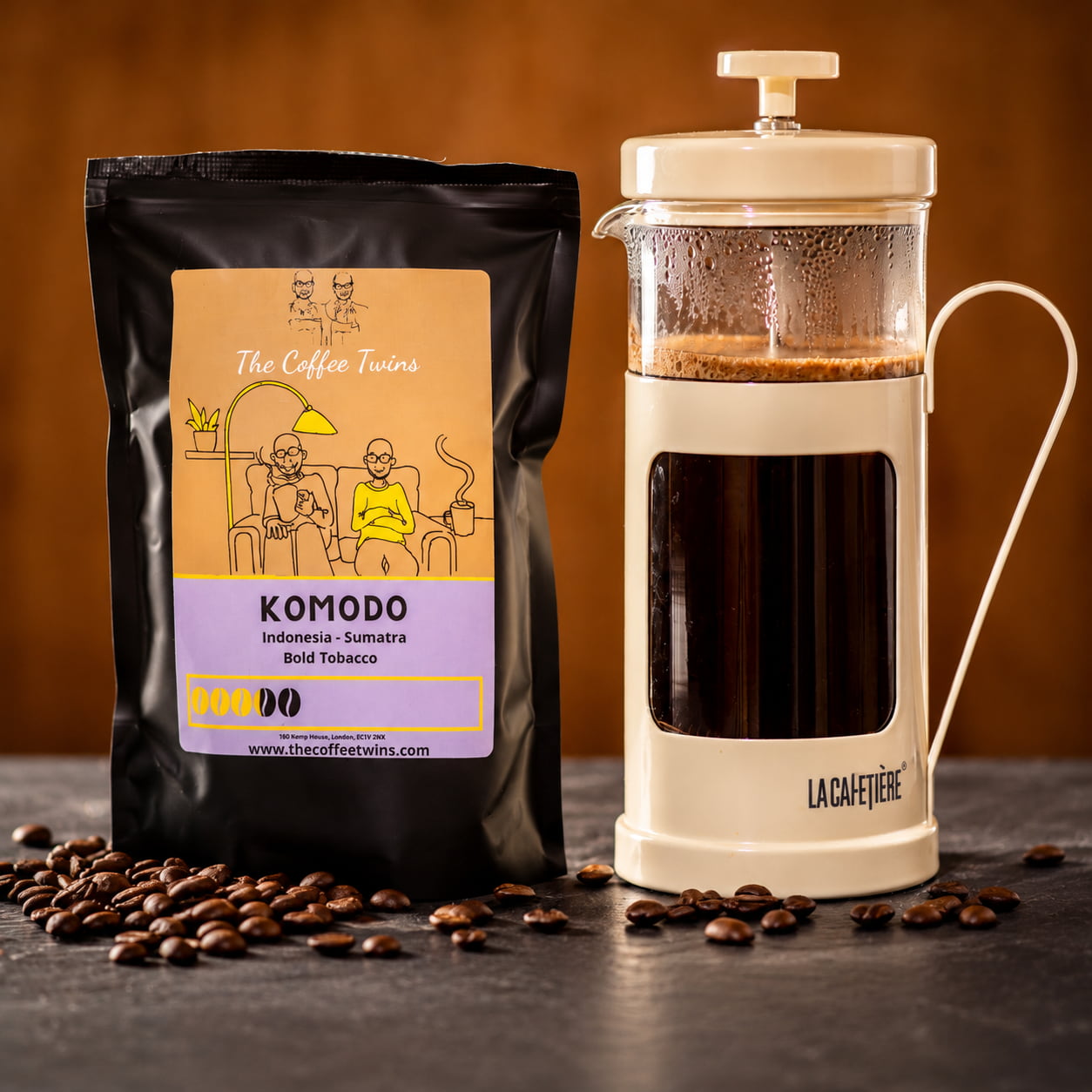
Komodo — Body 5/5, Sumatran single origin, spicy, bold, tobacco
Roast Level and Perceived Strength
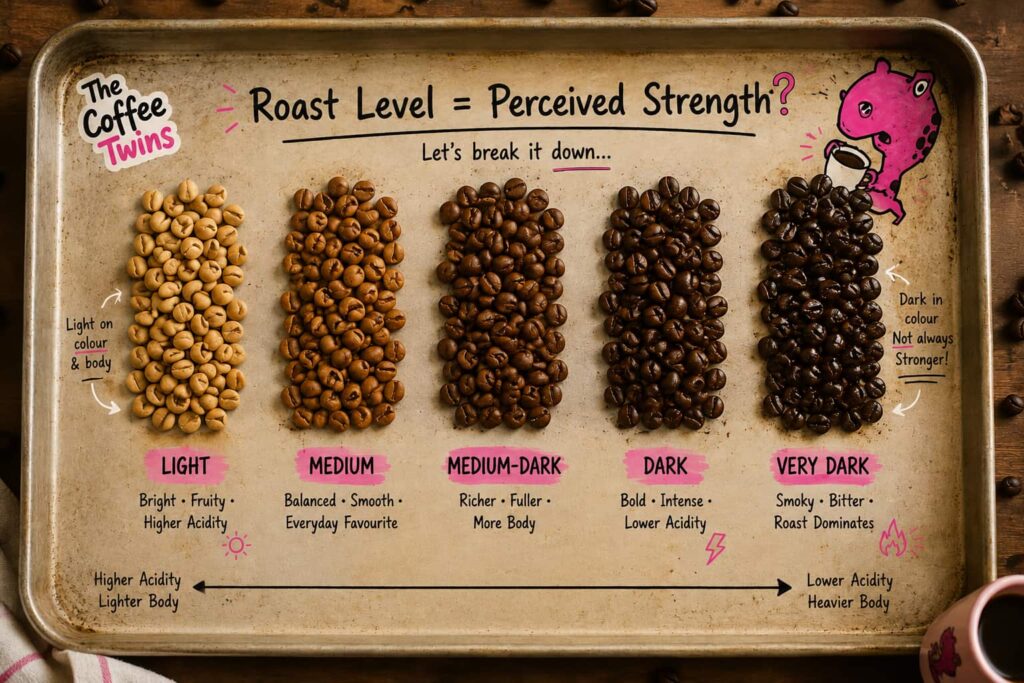
In short, roast level dramatically affects perceived strength. On top of that, darker roasts taste “stronger” even when caffeine is identical to lighter roasts.
The counterintuitive truth about roast and caffeine
Overall, this surprises most UK coffee drinkers: dark roasts have slightly LESS caffeine than light roasts. In other words, the roasting process burns off small amounts of caffeine. Also, this means the “strong dark coffee” you’re drinking may actually have fewer stimulants than the light roast you thought was mild.
Roast levels explained
- Light roast (2-3/5): Bright, acidic, fruity. Highest caffeine but least “strong” perceived taste.
- Medium roast (3-3.5/5): Balanced sweetness with body. Popular UK choice.
- Medium-dark roast (3.5-4/5): As a result, richer chocolate and caramel notes emerge.
- Dark roast (4-4.5/5): Bold, smoky, full-bodied. Perceived as strongest.
- Very dark roast (5/5): French/Italian roast. Nearly all origin character replaced by roast character.
Also, see our roast profiles guide for detailed comparisons. In addition, our Audley at roast 4.5/5 is our darkest roast — genuinely strong perceived flavour.
Brewing Method Strength Comparison
Brewing method strength ranking (combined caffeine + body + intensity):
1. Cold brew concentrate — Maximum caffeine, moderate body, very smooth
2. Double espresso — High caffeine concentrated, maximum intensity per volume
3. Moka pot — Espresso-like intensity, full body, high caffeine per cup
4. Cafetière (dark roast) — Full body, high caffeine, rich flavour
5. Drip filter — Highest total caffeine, moderate body
6. AeroPress (short brew) — Concentrated flavour, moderate caffeine
7. Long black / Americano — Espresso caffeine, diluted intensity
8. Flat white — Espresso caffeine, milk-softened intensity
9. V60 / pour-over — Clean flavour, moderate caffeine and body
10. Latte / cappuccino — Espresso caffeine, mildest overall
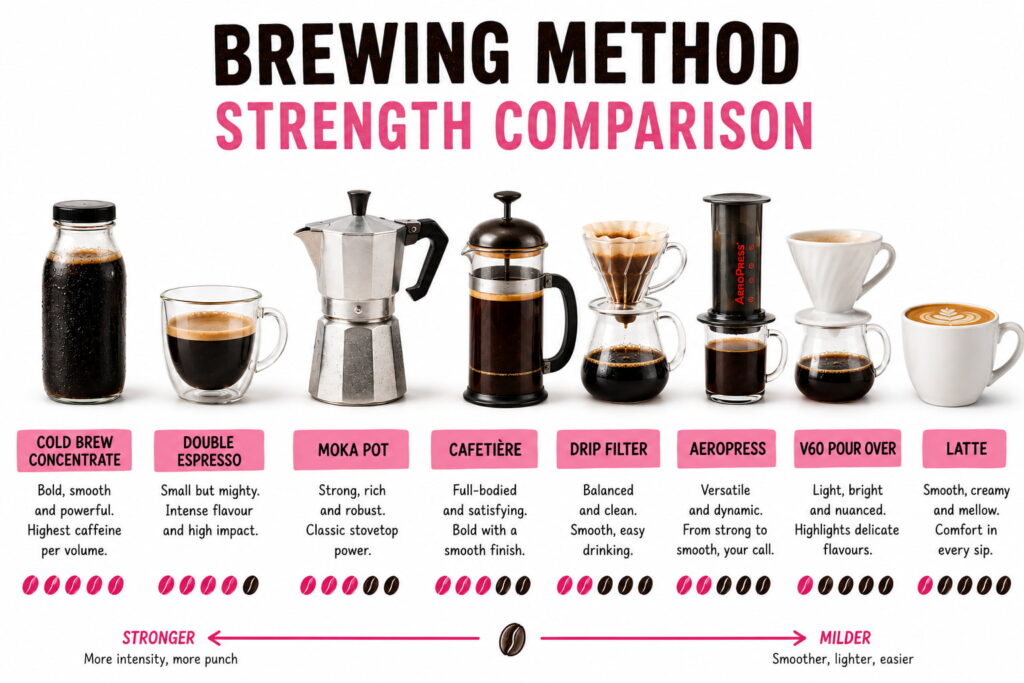
What this ranking means practically
Indeed, if you want maximum perceived strength (caffeine + body + intensity), your best options are:
- Double espresso made from a dark roast like Audley
- Moka pot brewed strong with Ant
- Cafetière with dark roast and 1:15 ratio using Komodo
For detailed technique, see our UK coffee brewing methods guide for each method.
The Definitive UK Coffee Strength Chart 2026
The UK coffee strength guide chart (combined ranking):
Extreme strength (⭐⭐⭐⭐⭐):
• Cold brew concentrate (undiluted)
• Ristretto (concentrated espresso)
• Moka pot with dark roast + short pull
Very strong (⭐⭐⭐⭐):
• Double espresso (dark roast)
• Moka pot standard brew
• Cafetière with dark roast, 1:15 ratio
• Turkish coffee
Strong (⭐⭐⭐):
• Long black
• Americano
• AeroPress standard method
• Drip filter (dark roast)
• Cafetière (medium roast, standard ratio)
Medium (⭐⭐):
• Flat white
• V60 / pour-over
• Drip filter (medium roast)
• AeroPress with dilution
Mild (⭐):
• Latte
• Cappuccino
• Cold brew (diluted 1:1)
• Instant coffee
• Decaf (any method)
Understanding “Supermarket Strength” Ratings (1-5)
In fact, most UK supermarket coffee brands use a 1-5 strength rating. Honestly, this is misleading marketing rather than a genuine measurement.
What supermarket ratings actually measure
Ultimately, supermarket strength ratings measure roast darkness, not caffeine content. Here’s how the scale usually maps:
- Strength 1: Very light roast
- Strength 2: Light roast
- Strength 3: Medium roast
- Strength 4: Medium-dark roast
- Strength 5: Dark roast (often over-roasted commodity beans)
The truth about “strength 5” supermarket coffees
In short, “extra strong” supermarket coffees typically contain Robusta beans mixed with over-roasted commodity Arabica. On top of that, Robusta has roughly twice the caffeine of Arabica but tastes harsh and bitter. As a result, “strong” supermarket coffee genuinely does have more caffeine — but tastes worse than any speciality coffee.
Why speciality coffee doesn’t need “strength ratings”
In practice, speciality coffee brands (including us) provide detailed information: roast level, body, sweetness, acidity, and origin. In other words, this is dramatically more useful than a single “strength” number. Also, you can build the exact cup you want by matching characteristics to your preference. As a result, our range shows all four characteristics on every bag.
Using This UK Coffee Strength Guide to Choose the Right Strong Coffee
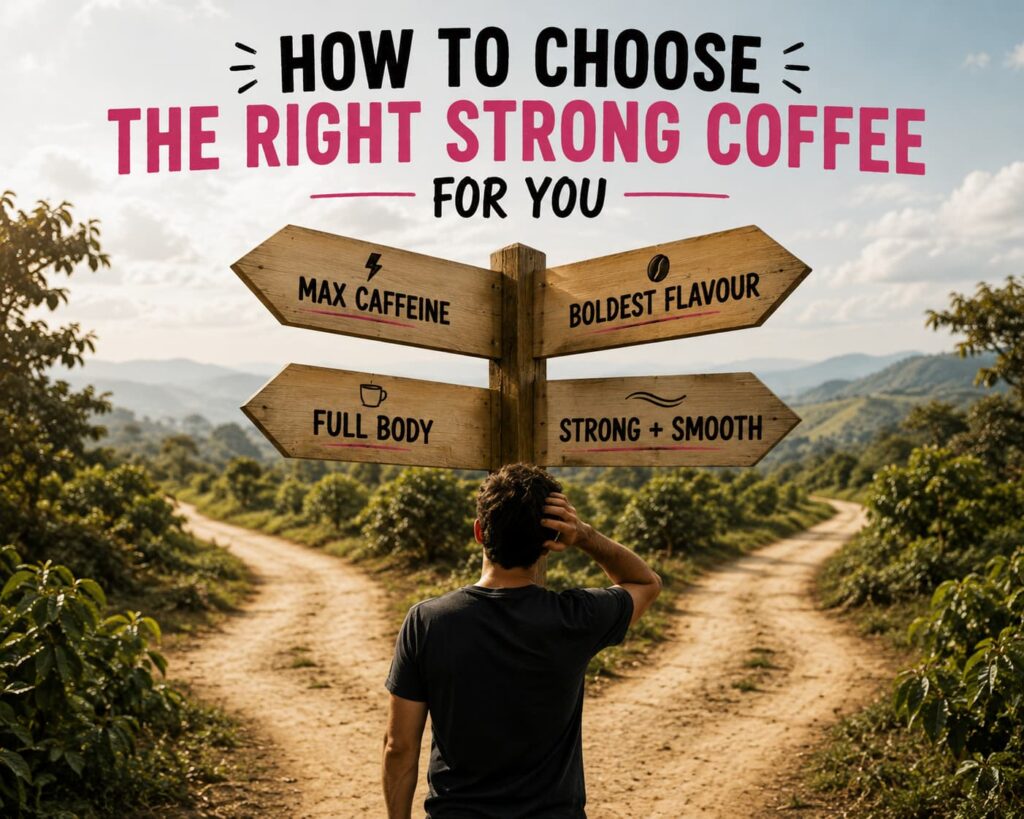
Match your “strong” need to the right coffee:
I want maximum caffeine kick: Cold brew concentrate or double espresso using Audley
I want the boldest flavour: Dark espresso using Audley or Ant
I want the fullest body: Cafetière using Komodo Sumatran
I want strong milk drinks: Double espresso latte using Audley
I want strong but smooth: Cold brew using Parrot Brazilian Cerrado
I want strong flavour with less caffeine: Dark roast decaf using Hufflelump
I want strong but complex: AeroPress with Ant for concentrated complexity
Looking for the Strongest Coffee to Buy?

This guide is about what strength means, so we keep our buying advice in one place. If you want our picks for the strongest coffee in the UK, that guide compares three bold coffees from our range and shows how to brew each one. In short, Audley is the boldest and darkest, Komodo has the fullest, earthiest body, and Ant brings the most complexity.
Frequently Asked Questions
What does “strong coffee” actually mean in the UK?
“Strong coffee” in the UK typically means one of four things: high caffeine content, full body/mouthfeel, dark roast level, or bold flavour intensity. Indeed, most UK coffee drinkers mean “bold flavour with full body” when they ask for strong coffee — not necessarily maximum caffeine. In addition, this UK coffee strength guide covers all four measurements separately.
Which UK coffee has the most caffeine?
Cold brew concentrate has the highest caffeine per volume (200-300mg per 250ml). In fact, for hot coffee, drip filter and cafetière typically contain the most caffeine per standard UK cup (95-165mg). Additionally, a double espresso contains 120-160mg concentrated in a small serving.
Does dark roast coffee have more caffeine?
No — the opposite is true. In short, dark roasts have slightly LESS caffeine than light roasts because the roasting process burns off small amounts of caffeine. On top of that, dark roasts just taste stronger due to bolder flavour and fuller body. As a result, “strong-tasting” doesn’t mean “high caffeine.”
What’s the strongest UK coffee brand?
For genuinely strong-tasting speciality coffee, our Audley delivers body 5/5 and roast 4.5/5. Also, see our strongest coffee UK guide for detailed brand comparisons.
Do supermarket “strength 5” coffees really contain more caffeine?
Yes — supermarket “extra strong” coffees typically contain Robusta beans mixed with Arabica. In other words, Robusta has roughly twice the caffeine of Arabica. However, Robusta tastes harsh and bitter. As a result, “strength 5” supermarket coffee genuinely has more caffeine but tastes worse than speciality coffee.
Is espresso stronger than filter coffee?
Per volume, yes — espresso is dramatically more concentrated. However, per serving, filter coffee often contains MORE total caffeine because you drink more of it. Indeed, a single espresso shot (30ml, 60-80mg) has less caffeine than a filter coffee mug (250ml, 95-165mg).
Which brewing method makes the strongest coffee?
For maximum perceived strength (caffeine + body + intensity combined), double espresso from dark-roasted beans is genuinely the strongest hot coffee. In fact, cold brew concentrate is even stronger by caffeine but has less immediate intensity. In addition, moka pot brewing produces espresso-like strength for a fraction of the equipment cost.
Where can I buy strong UK coffee online?
Our Audley is our strongest bean, roasted to order for us by a partner roastery in England and usually dispatched within 24 hours. Komodo and Ant are also excellent strong coffee options. You can also use NEW10 for 10% off your first order.
Summary
This UK coffee strength guide reveals what “strong” actually means: four different things — caffeine, body, roast level, and flavour intensity. In short, understanding these differences is what separates asking for “strong coffee” from getting the right strong coffee for you.
By caffeine, drip filter and cold brew concentrate come out on top. By perceived intensity, dark-roasted espresso leads, while for body it’s cafetière-brewed dark roasts. As a result, choose based on which “strong” matters most to you.
For genuinely strong speciality coffee, our Audley delivers body 5/5, roast 4.5/5, and dark chocolate depth. It’s roasted to order for us in England, and you can use NEW10 for 10% off your first order.
Try Audley — Our Strongest Coffee →
Enjoying this article?
If you find our coffee guides useful, you can add The Coffee Twins as a preferred source in Google so our latest articles are easier to find in your search results.
Add The Coffee Twins as a preferred source on Google →
Thanks for supporting our little coffee corner of the internet.
0 Comments