

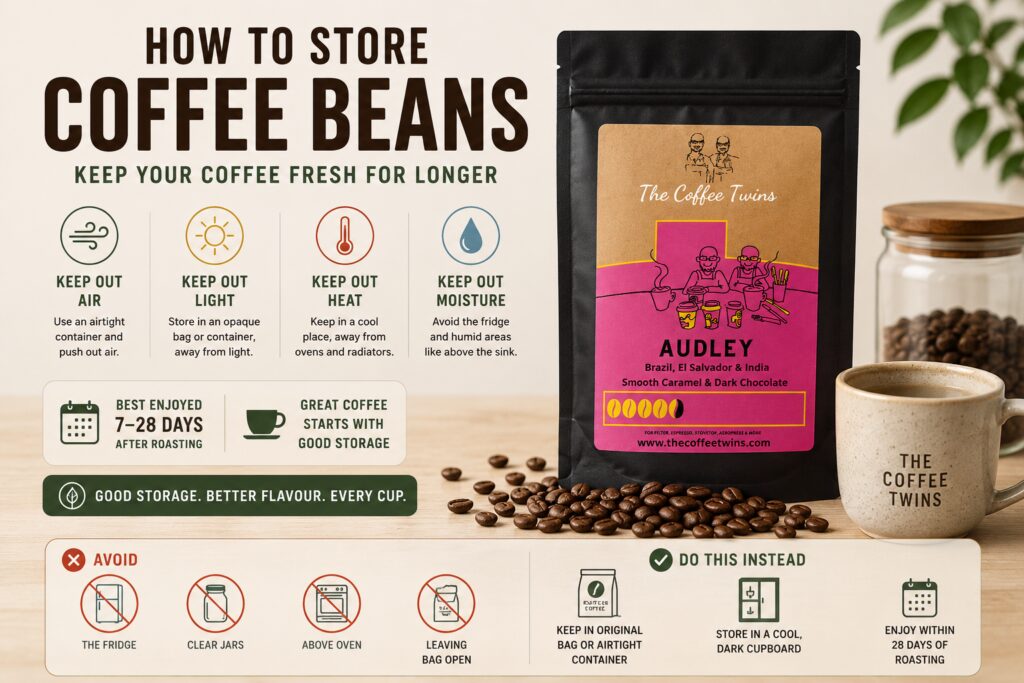
Quick answer: Store coffee beans in an airtight container, at room temperature, away from light, heat, air, and moisture. Specifically, the original resealable speciality coffee bag works perfectly — don’t transfer beans to glass jars unless they’re opaque. Furthermore, drink beans within 28 days of roasting for peak flavour. Don’t freeze unless you’re storing for over a month.
Want beans that are actually fresh? Our coffee is roasted in England and dispatched within 24 hours. Browse our range here →
Why trust this guide?

We’re Jeremiah and Raja — The Coffee Twins. We roast all our own coffee in England, and one of the most common customer questions we get is “how do I keep my beans fresh?” Specifically, this guide is the honest answer — based on coffee science, our barista training, and the way we actually store our own beans at home.
Table of contents
- Why coffee storage matters more than people realise
- The four enemies of fresh coffee
- How to actually store coffee beans (the right way)
- How long do coffee beans stay fresh?
- Should you freeze coffee beans?
- Storing ground coffee (the harder problem)
- 4 storage mistakes that ruin good coffee
- How to tell if your coffee has gone stale
- FAQ
Why Coffee Storage Matters More Than People Realise
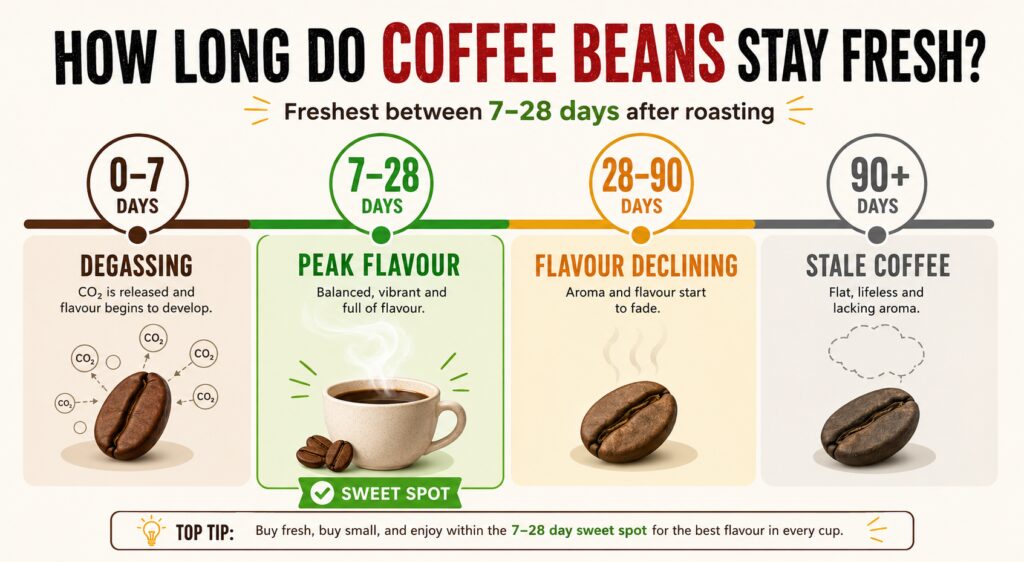
Coffee beans are at their best within 10–28 days of being roasted. After that, they start losing aromatic compounds — the things that make speciality coffee taste like anything other than “generic coffee.” As a result, even £30/kg single origins will taste flat if stored badly.
Specifically, here’s what happens to coffee over time:
- 0–7 days after roasting: The beans are “degassing” (releasing CO2). Furthermore, the flavour is at its peak from roughly day 7 onwards.
- 7–28 days: The sweet spot. As a result, this is when speciality coffee tastes best.
- 28–90 days: Flavour starts noticeably declining. Specifically, aromatics fade first, then sweetness, then body.
- 90+ days: The coffee becomes flat, woody, and one-dimensional. By the way, supermarket coffee is usually here when you buy it.
In other words, storage isn’t about keeping coffee “edible.” Specifically, it’s about preserving the freshness you paid for in the first place. Therefore, getting it right saves you from drinking £9.50 coffee that tastes like £3 coffee.
The Four Enemies of Fresh Coffee
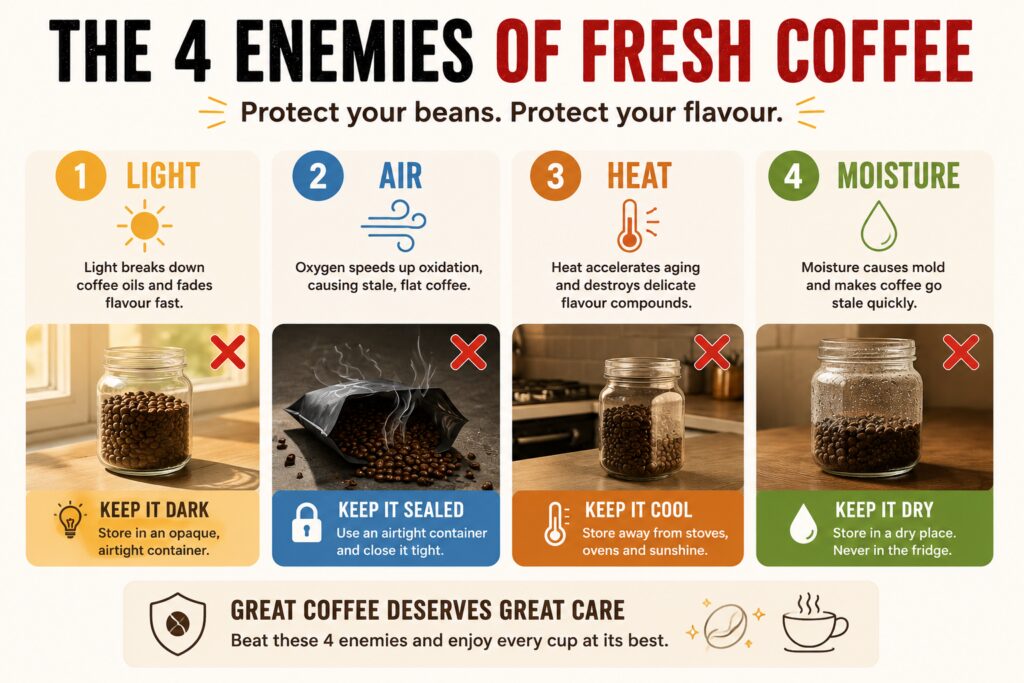
Coffee beans degrade because of four specific things. Specifically, getting storage right means protecting against all four.
1. Air (oxygen)
Oxygen oxidises the oils in coffee, which causes them to go stale and rancid. As a result, this is the biggest enemy — and the reason airtight containers matter so much.
2. Light
UV light breaks down chemical compounds in coffee, including the aromatic ones that give beans their character. Specifically, this is why our bags (and any speciality coffee bag) are opaque, not clear.
3. Heat
Higher temperatures accelerate every chemical reaction that causes staling. Therefore, beans stored next to your oven or radiator will go off faster than beans in a cool cupboard.
4. Moisture
Coffee beans are hygroscopic — they absorb moisture from the air. As a result, this dulls flavour and can encourage mould in extreme cases. Furthermore, this is why the fridge is a bad idea (more on that below).
How to Actually Store Coffee Beans (The Right Way)
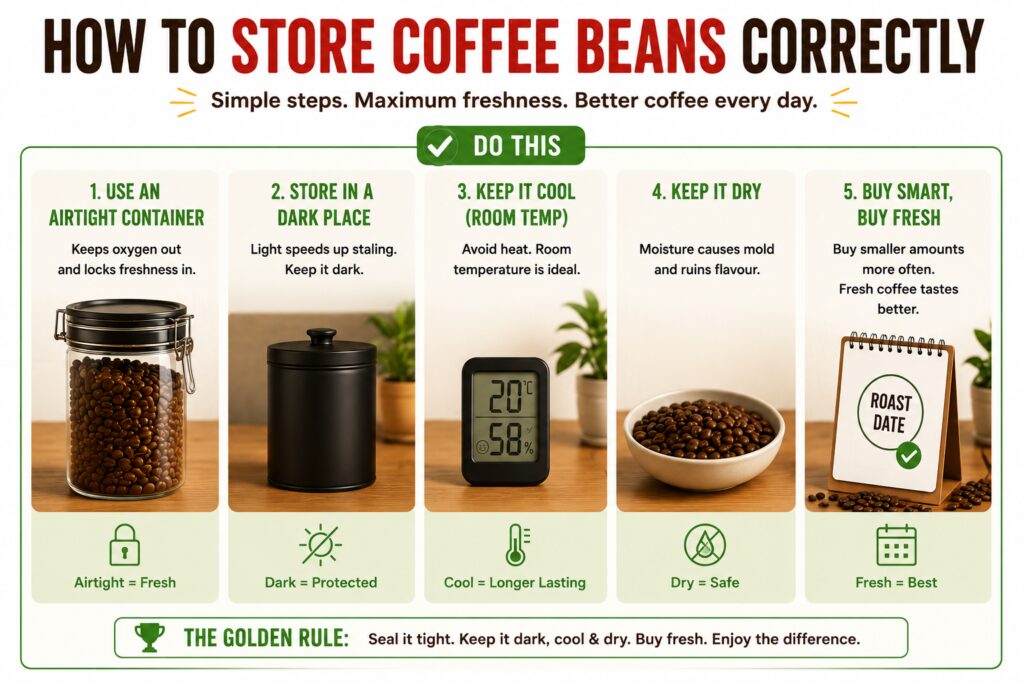
Here’s what we genuinely do at home — and what we recommend to every customer.
Step 1: Keep beans in the original bag
Most speciality coffee bags (including ours) are designed for storage. Specifically, they’re foil-lined, opaque, and have a resealable zip plus a one-way valve that lets CO2 escape without letting oxygen in. As a result, you genuinely can’t do better than the bag the coffee came in.
Step 2: Push out as much air as possible before resealing
Each time you open the bag, press the air out before sealing it again. Specifically, less air in the bag = less oxidation. Furthermore, this is the single most impactful habit.
Step 3: Store the bag in a cupboard at room temperature
Any kitchen cupboard works, provided it’s:
- Not above the oven (too hot)
- Not next to the radiator (too hot)
- Not next to the sink or kettle (humid)
- Closed (away from light)
Specifically, room temperature (18–22°C) is ideal. By the way, no need to refrigerate.
Step 4: If you must transfer, use an opaque airtight container
If your bag has split or you want a more decorative storage option, transfer beans into a ceramic or opaque steel container with a proper airtight seal. Specifically, brands like Airscape, Fellow Atmos, and Coffeevac are all good options. As a result, you can store up to a 250g bag of beans for the same length of time as in the original bag.
Above all, don’t use clear glass jars. Furthermore, beans in clear glass jars on a shelf are getting hit by light all day long.
How Long Do Coffee Beans Stay Fresh?
Quick reference:
• Peak flavour: 7–28 days after roasting
• Still excellent: Up to 6 weeks after roasting
• Acceptable: 6–12 weeks
• Past best: 12+ weeksGround coffee, properly stored:
• Peak flavour: Within 30 minutes of grinding
• Acceptable: 1–2 weeks
• Past best: 2+ weeks
Note that “still excellent” depends on storage. Specifically, well-stored beans can taste great at 6 weeks. By contrast, badly-stored beans can taste flat at 2 weeks.
This is why roast date matters so much. By the way, all our bags print the roast date — that’s how you know what you’re getting. Supermarket beans often have a “best before” date 2 years out but no roast date. As a result, they’ve usually been sitting in warehouses for 3–9 months before reaching you.
Should You Freeze Coffee Beans?
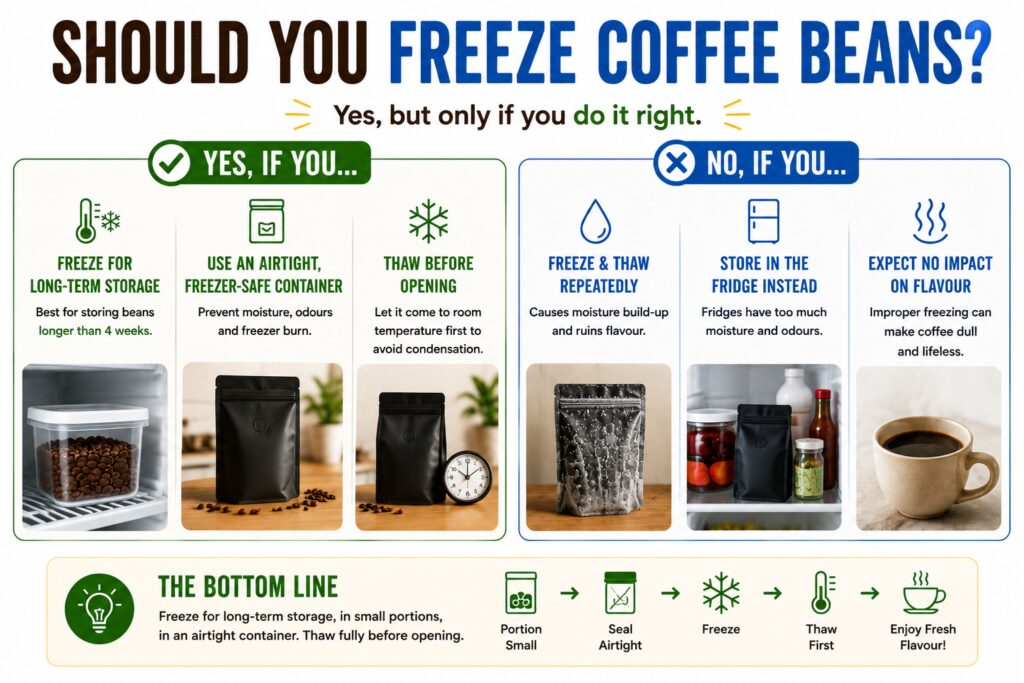
Possibly the most-debated question in home coffee. The honest answer: yes, for long-term storage. No, for daily use.
When freezing makes sense
- You bought a 1kg bag and want to keep half fresh for next month
- You’ve stocked up on a coffee you love and want to preserve it
- You’re storing rare or expensive beans for occasions
How to freeze coffee properly
- Divide into single-use portions. Specifically, ziplock freezer bags with 100–250g per bag.
- Push out all the air before sealing.
- Freeze immediately in the back of the freezer (most consistent temperature).
- When you want to use them, defrost the whole bag at room temperature for 2 hours before opening. Above all, don’t repeatedly freeze and defrost.
Why frozen beans can taste better
Freezing locks in the volatile aromatic compounds at the moment of freezing. As a result, beans frozen at peak freshness (day 14, say) can taste better than 60-day-old beans stored at room temperature.
Why most people shouldn’t freeze daily-use beans
Specifically, every time you open a frozen bag, condensation forms on the cold beans. Furthermore, that moisture is a problem (see Enemy #4 above). Therefore, freezing only makes sense if you can commit to opening the bag once and using it all up within 1–2 weeks of defrosting.
Storing Ground Coffee (The Harder Problem)
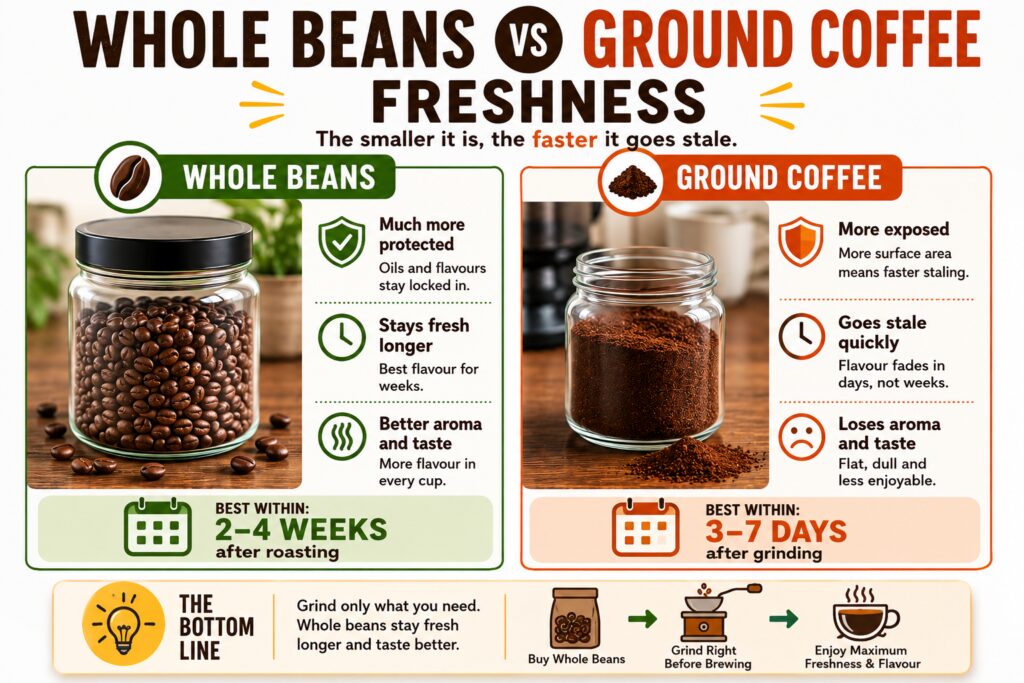
Ground coffee is dramatically harder to keep fresh. Specifically, grinding exposes far more surface area to oxygen, which means oxidation happens 20–30 times faster.
The practical implications:
- Grind fresh if you can. Specifically, a £100 burr grinder is the best £100 you’ll ever spend on home coffee.
- If you buy pre-ground, buy the right grind for your brewer. Furthermore, our bags ship pre-ground for Cafetière, Espresso, or Filter — order what matches your kit.
- Use ground coffee within 2 weeks of opening. By contrast, whole beans last 6 weeks.
- Same storage rules apply (airtight, dark, room temperature).
4 Storage Mistakes That Ruin Good Coffee
The four mistakes we see most often:
Mistake 1: Storing beans in the fridge
The fridge is the worst place for coffee. Specifically, three reasons:
- Humidity is too high (moisture damage)
- The temperature fluctuates every time you open the door
- Coffee beans absorb other food smells (your coffee will taste like leftover curry)
As a result, just don’t.
Mistake 2: Using a clear glass jar
Beautiful, Instagram-friendly, terrible for the coffee. Specifically, UV light breaks down aromatic compounds. Therefore, opaque storage only.
Mistake 3: Buying too much at once
It’s tempting to buy a 1kg bag for the savings, but if you’ll take 3 months to drink it, the last cup will taste flat. Specifically, buy what you’ll drink in 4–6 weeks. Furthermore, set up a subscription that delivers fresh beans on a schedule.
Mistake 4: Leaving the bag open
“I’ll seal it later” then forgetting. Specifically, every hour the bag is open is hours of oxygen exposure. Therefore, develop the habit of resealing immediately after dosing.
How to Tell if Your Coffee Has Gone Stale
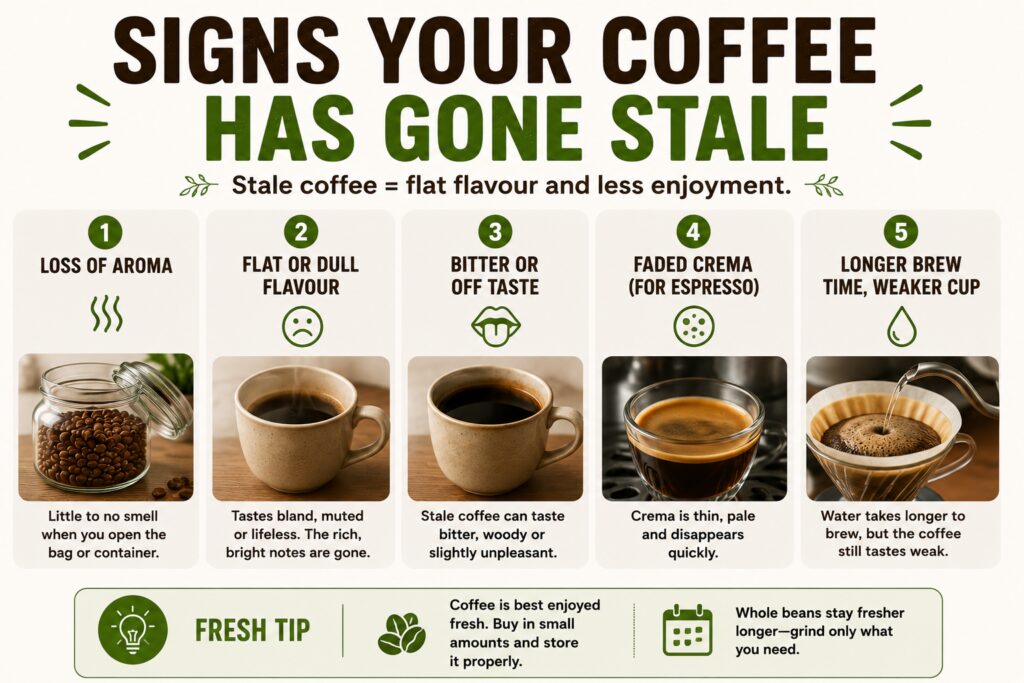
The four warning signs:
1. Weak aroma
Fresh beans smell unmistakably like coffee — sweet, aromatic, complex. Specifically, stale beans smell faint, woody, or like nothing much at all.
2. Flat taste
Stale coffee loses its distinctive tasting notes first. As a result, what you taste is “generic coffee” rather than the chocolate, fruit, nut or spice the bag promised.
3. Bitter or harsh finish
Stale coffee often tastes more bitter than fresh coffee. Specifically, the sweetness is gone but the bitterness remains.
4. No CO2 release when ground
Fresh beans release a noticeable CO2 “bloom” when wet (you’ll see it puff up on a V60). By contrast, stale beans bloom barely or not at all.
What to do with stale coffee
If you’ve got stale beans you don’t want to throw out:
- Brew strong (more coffee than usual)
- Use in milk drinks (the milk masks the flatness)
- Make cold brew (the long extraction can rescue mildly stale beans)
- Use as coffee scrubs or compost
Above all, the best fix is just buying fresh beans next time.

Frequently Asked Questions
How should I store coffee beans at home?
In their original resealable bag (or an opaque airtight container), at room temperature, in a cupboard away from light, heat, and moisture. Specifically, push out as much air as possible before sealing each time. Furthermore, drink within 28 days of roasting for peak flavour.
Should I keep coffee beans in the fridge?
No. Specifically, the fridge has too much humidity, fluctuating temperatures, and absorbs food smells. As a result, coffee beans store better in a kitchen cupboard at room temperature.
Can I freeze coffee beans?
Yes, for long-term storage (over a month). Specifically, divide into single-use portions in airtight freezer bags, push out all air, and defrost the whole bag at room temperature before opening. Furthermore, don’t refreeze.
How long do coffee beans stay fresh?
Peak flavour is 7–28 days after roasting. Specifically, properly stored beans remain excellent for up to 6 weeks, acceptable for 6–12 weeks, and past their best after 12+ weeks. Therefore, supermarket beans (typically 3–9 months old) are past their best by the time you buy them.
How long does ground coffee stay fresh?
Peak flavour is within 30 minutes of grinding. Specifically, ground coffee remains acceptable for 1–2 weeks if stored airtight, then becomes noticeably stale. Therefore, grind fresh if possible, or buy pre-ground for your specific brewer and use within 2 weeks.
Why do speciality coffee bags have a hole in them?
That’s a one-way valve. Specifically, it lets CO2 (released by fresh-roasted beans) escape, while preventing oxygen from getting in. As a result, the bag stays sealed against oxygen but doesn’t burst from internal pressure. Furthermore, it’s a sign of speciality-grade packaging.
Are clear glass jars bad for coffee storage?
Yes. Specifically, UV light breaks down aromatic compounds in coffee. Therefore, opaque ceramic, steel, or the original foil-lined bag is dramatically better than clear glass.
Where can I buy fresh, properly-packaged coffee beans in the UK?
The Coffee Twins — we roast all our coffee in England and dispatch within 24 hours. Specifically, our bags are foil-lined, opaque, with one-way valves and resealable zips. £9.50 / 250g. Furthermore, every bag prints the roast date so you know exactly how fresh it is. Free UK shipping over £30. Use NEW10 for 10% off your first order.
Summary
How to store coffee beans: keep them in an airtight container at room temperature, away from light, heat, air, and moisture. Specifically, the original speciality coffee bag works perfectly — push out air before resealing each time. Furthermore, drink within 28 days of roasting for peak flavour.
Above all, the four enemies of fresh coffee are air, light, heat, and moisture. As a result, the fridge is the worst place, clear glass jars are second-worst, and a closed kitchen cupboard is ideal. By the way, freezing only makes sense for long-term storage of over a month.
For genuinely fresh coffee, buy from a roaster who prints the roast date on the bag and dispatches within days. Specifically, our whole range ships within 24 hours of order, roasted in England. Free UK shipping over £30. Use NEW10 for 10% off your first order.

0 Comments