

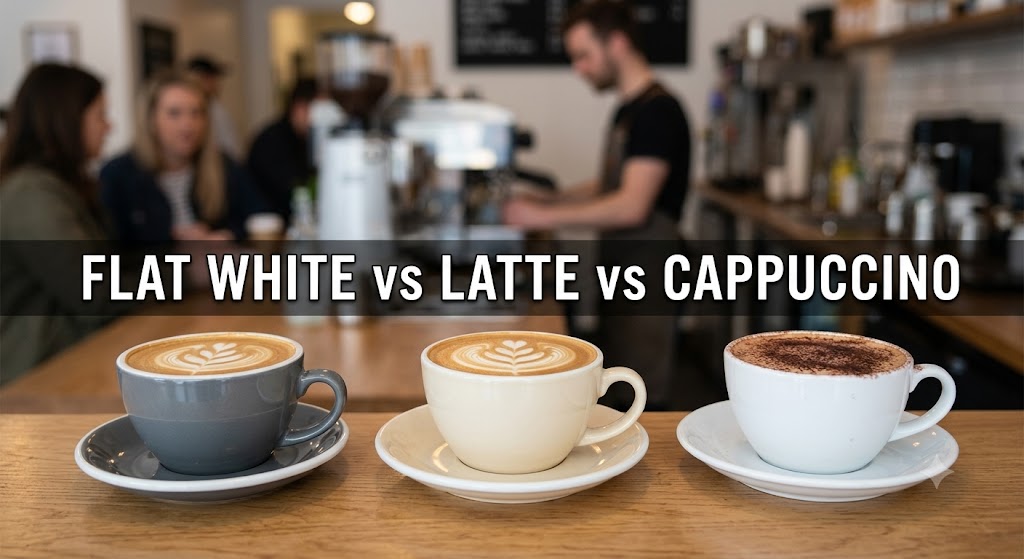
Quick answer: The difference between a latte, cappuccino, and flat white comes down to three things: cup size, milk volume, and foam thickness. Specifically, a flat white is the smallest and most coffee-forward (150–170ml, thin microfoam). A cappuccino is medium-sized with thick foam (180ml, equal espresso/milk/foam). A latte is the largest and milkiest (200ml+, mostly steamed milk with a thin foam layer).
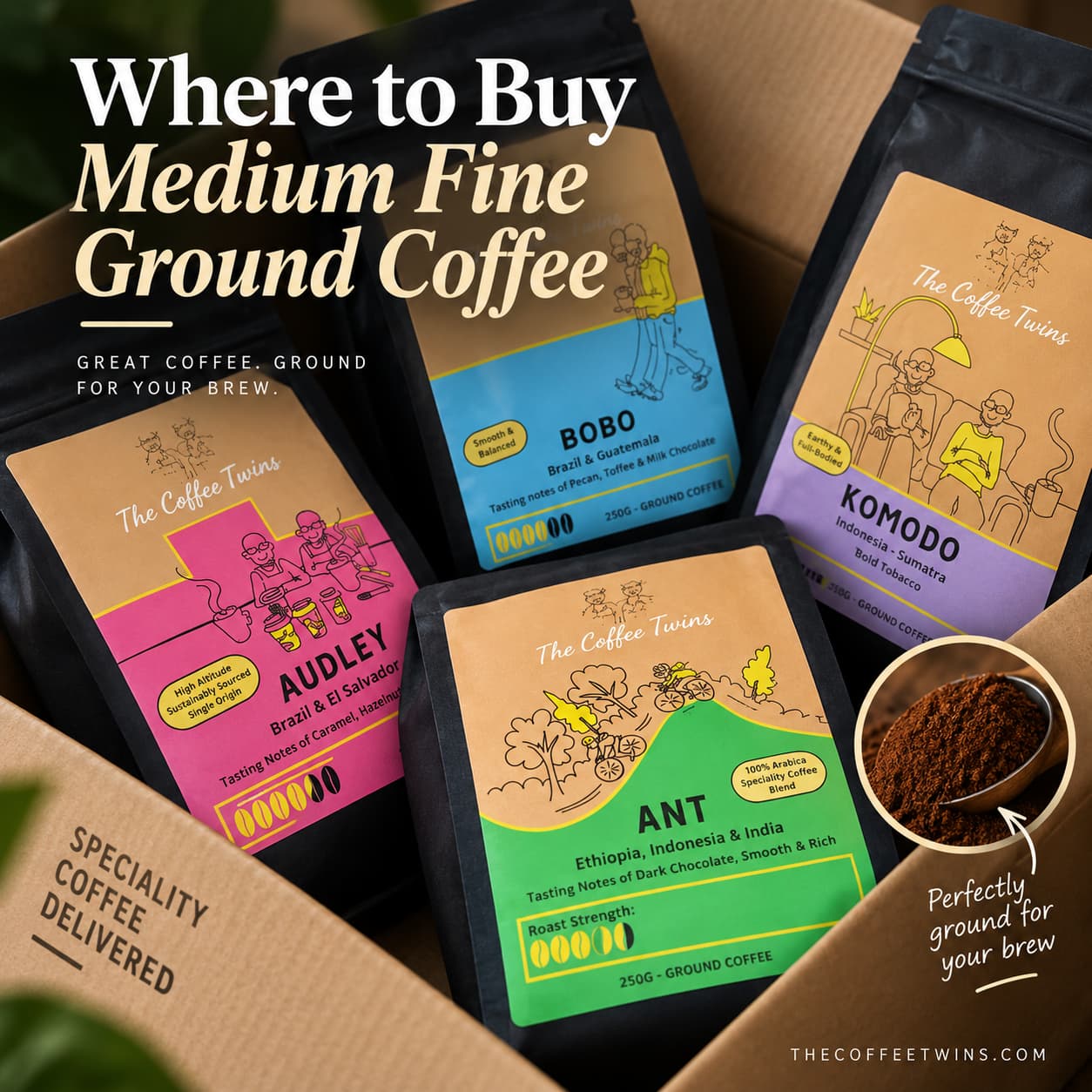
For all three, the right beans matter. Our Bobo (£9.50 / 250g) and Audley (£9.50 / 250g) are built for milk-based espresso drinks.
Why trust this guide?

We’re Jeremiah and Raja — The Coffee Twins. Before launching our UK speciality coffee brand, we trained in five-star hotel food and beverage and managed a coffee shop in Farringdon. Specifically, we pulled thousands of these drinks for thousands of London customers. As a result, this guide is what we’d teach a new barista on day one — translated for home brewers and curious coffee drinkers.
Table of contents
- The quick comparison (side-by-side)
- What is a flat white?
- What is a cappuccino?
- What is a latte?
- Which is the strongest?
- Caffeine content compared
- Calories and milk compared
- Which should you order?
- The best beans for each drink
- FAQ
The Quick Comparison

Specifically, here’s how the three drinks compare on the things that actually matter:
• Cup size: 150–170ml
• Espresso: Double shot (36g)
• Milk: ~120ml steamed
• Foam: 5–8mm of glossy microfoam
• Coffee-to-milk ratio: 1:2
• Taste: Most coffee-forward of the threeCappuccino
• Cup size: 180ml
• Espresso: Double shot (36g)
• Milk: ~60ml steamed
• Foam: Thick — equal third of the cup (15–20mm)
• Coffee-to-milk ratio: 1:1
• Taste: Balanced; the foam adds textureLatte
• Cup size: 200–300ml
• Espresso: Double shot (36g)
• Milk: 180–250ml steamed
• Foam: Thin layer (5–8mm)
• Coffee-to-milk ratio: 1:3 or higher
• Taste: Mildest and milkiest
In short, the espresso shot is identical in all three drinks. As a result, what changes is the amount and texture of milk added — which dramatically changes how the drink feels.
What Is a Flat White?
The flat white originated in Australia and New Zealand in the 1980s. Specifically, it became a UK staple after the rise of Antipodean cafés in London in the 2000s. By the way, you’ll find a flat white on almost every UK speciality coffee menu now.
What defines a flat white
- Small cup: Usually 150–170ml
- Double espresso base: 18g of grounds yielding 36g of espresso
- Microfoam milk: Steamed to glossy, paint-like texture with thin foam (5–8mm)
- 1:2 coffee-to-milk ratio
How a flat white actually tastes
Above all, the flat white is coffee-led. Specifically, you taste the espresso clearly through the milk — the chocolate, caramel, or nutty notes of your beans come through. Furthermore, the microfoam adds silky texture without diluting the coffee.
As a result, a good flat white feels small but satisfying. It’s the drink for people who want the espresso to lead, with just enough milk to round the edges.
What Is a Cappuccino?

The cappuccino is the Italian classic — named after the brown robes of Capuchin friars. Specifically, it’s been on Italian café menus for over a century and is the world’s most universally recognised milk-based coffee.
What defines a cappuccino
- Medium cup: Usually 180ml
- Double espresso base: 18g of grounds yielding 36g of espresso
- Three equal parts: 1/3 espresso, 1/3 steamed milk, 1/3 milk foam
- Thick foam: 15–20mm thick
- 1:1 coffee-to-milk ratio
How a cappuccino actually tastes
Specifically, the cappuccino balances espresso intensity with creamy milk texture. As a result, the thick foam acts as a “lid” that keeps the drink warm and adds airy mouthfeel. Furthermore, traditional Italian cappuccinos are dusted with cocoa powder or cinnamon.
In Italy, cappuccinos are only drunk before 11am — never after a meal. By contrast, in the UK we drink them any time. Either way, the cappuccino is the right pick when you want coffee + milk + that distinctive frothy texture.
What Is a Latte?
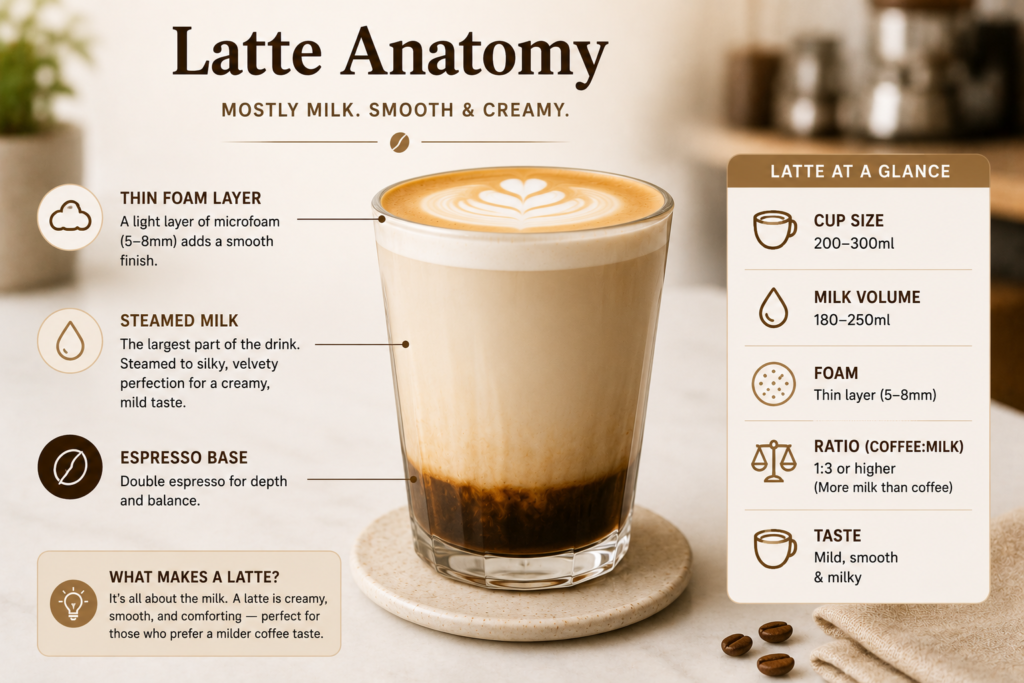
The latte is the milkiest of the three drinks. Specifically, the name comes from the Italian “caffè latte” — literally “coffee with milk.” However, in Italy, asking for “a latte” gets you a glass of plain milk. As a result, when ordering in Italy, ask for “caffè latte.”
What defines a latte
- Large cup: 200–300ml
- Double espresso base: 18g of grounds yielding 36g of espresso
- Mostly steamed milk: 180–250ml
- Thin foam layer: 5–8mm
- 1:3 or higher coffee-to-milk ratio
How a latte actually tastes
The latte is the gentlest and most milk-forward of the three drinks. Specifically, the espresso provides flavour but doesn’t dominate. As a result, the cup feels creamy, comforting, and easy to drink — which is why lattes are often a starting point for people new to speciality coffee.
Furthermore, lattes are the most popular drink for adding syrups (vanilla, caramel, hazelnut), since the larger milk volume balances the added sweetness well.
Which Is the Strongest?
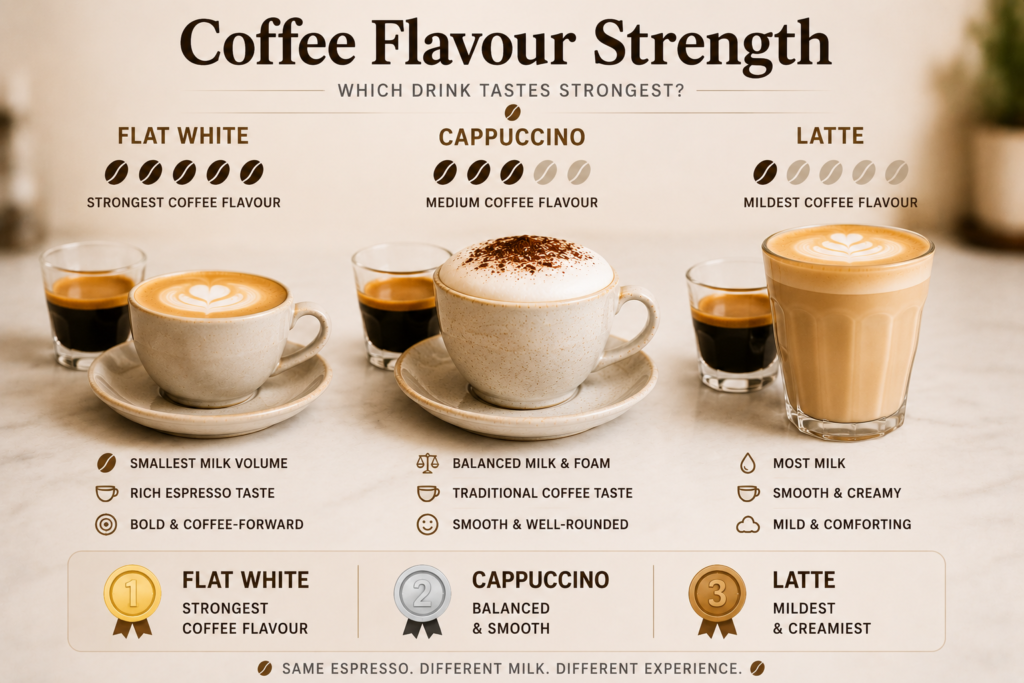
The flat white is the strongest-tasting of the three drinks. Specifically, here’s why:
All three contain the same espresso shot (a double, ~36g of espresso). However, the amount of milk varies dramatically:
- Flat white: 36g espresso + 120ml milk = coffee-forward
- Cappuccino: 36g espresso + 60ml milk + 60ml foam = balanced
- Latte: 36g espresso + 180–250ml milk = mildly coffee-flavoured
As a result, the flat white tastes the most like coffee because the milk doesn’t dilute the espresso as much. By contrast, a latte is the mildest — the espresso is still there, but the milk takes centre stage.
Important caveat
All three contain the same amount of caffeine. Furthermore, “strength” in this comparison refers to flavour intensity, not caffeine kick. By the way, see the next section for more on caffeine.
Caffeine Content Compared
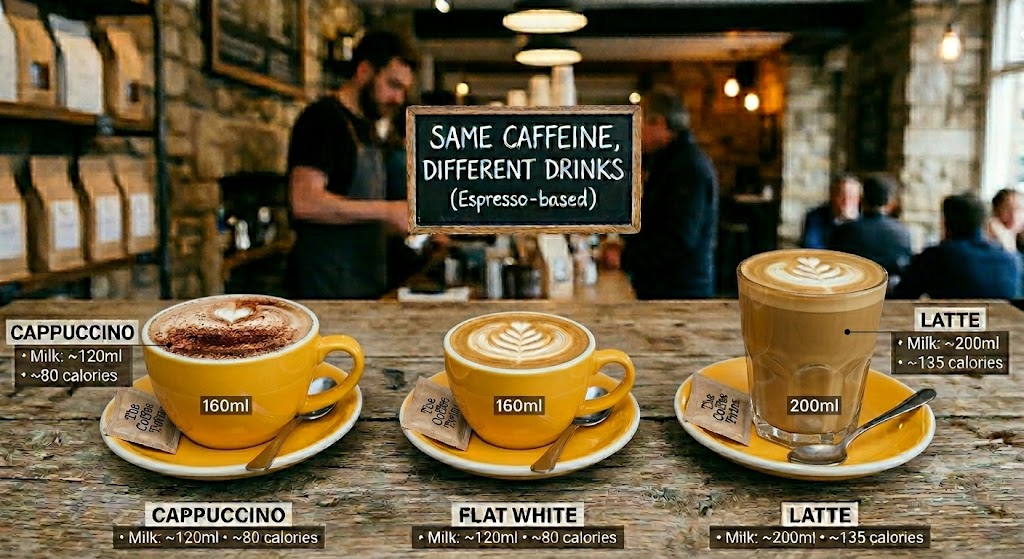
Here’s the surprising bit: a flat white, cappuccino, and latte all contain the same amount of caffeine. Specifically:
- Standard flat white (double shot): 120–160mg of caffeine
- Standard cappuccino (double shot): 120–160mg of caffeine
- Standard latte (double shot): 120–160mg of caffeine
As a result, switching from a latte to a flat white doesn’t change your caffeine intake — only the flavour intensity. By the way, the only way to genuinely cut caffeine is either to order a single-shot version or switch to a Swiss Water decaf like our Hufflelump.
For more detail, see our UK guide to caffeine in coffee.
Calories and Milk Compared
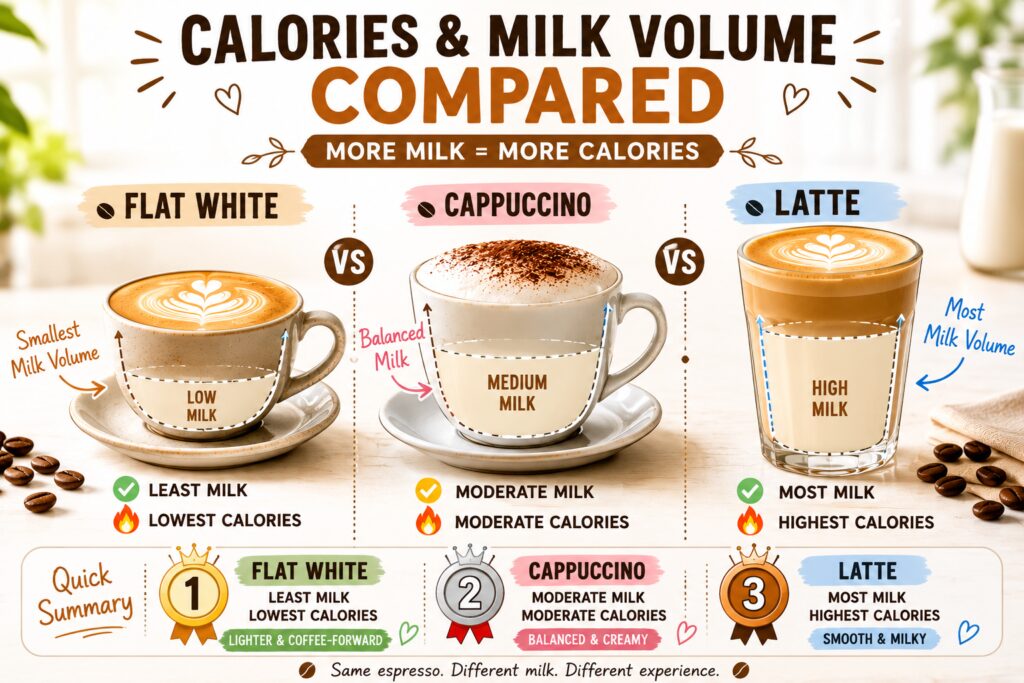
Specifically, the calorie difference comes entirely from the milk volume.
• Flat white (120ml milk): ~80 calories
• Cappuccino (120ml milk): ~80 calories
• Latte (200ml milk): ~135 calories
• Latte (250ml milk): ~165 caloriesSkimmed milk calories (approximate):
• Flat white: ~45 calories
• Cappuccino: ~45 calories
• Latte (200ml): ~75 caloriesBarista-edition oat milk calories (approximate):
• Flat white: ~65 calories
• Cappuccino: ~65 calories
• Latte (200ml): ~110 calories
In other words, the calorie hit comes from the milk. Therefore, if you’re watching calories but love milk-based coffee, the flat white is the lowest-calorie option of the three.
Which Should You Order?
Specifically, here’s our honest guide based on what kind of coffee experience you want:
Order a flat white if…
- You want to actually taste the coffee, not just the milk
- You like smaller, more intense drinks
- You’re watching calories
- You’re drinking it as a “proper coffee” rather than a hot milky treat
- You’re at a speciality café and want to assess the bean quality
Order a cappuccino if…
- You like the airy texture of milk foam
- You want a balanced drink — neither too coffee-led nor too milky
- You enjoy the visual ritual (chocolate dusting, latte art)
- You’re a traditionalist who’s been ordering them for years
Order a latte if…
- You want a milder, milkier drink
- You’re new to coffee and finding espresso a bit much
- You’re adding syrups (vanilla, hazelnut, caramel)
- You want a larger drink that lasts longer
- You’re drinking it in the afternoon as a “treat” rather than a morning coffee
The Best Beans for Each Drink
Above all, the beans matter as much as the technique. Specifically, here’s what works best for each drink from our range:
For flat whites
You want a coffee that holds up against milk without disappearing. As a result, Bobo (pecan, toffee, milk chocolate — body 4/5) is our top pick for everyday flat whites. Alternatively, Audley (caramel, dark chocolate — body 5/5) is the choice for stronger flat whites.
For cappuccinos
The thick foam dampens flavour, so you want a strong, full-bodied espresso underneath. Specifically, Audley (roast 4.5/5) or Ant (body 5/5, dark chocolate) cut through cappuccino foam beautifully.
For lattes
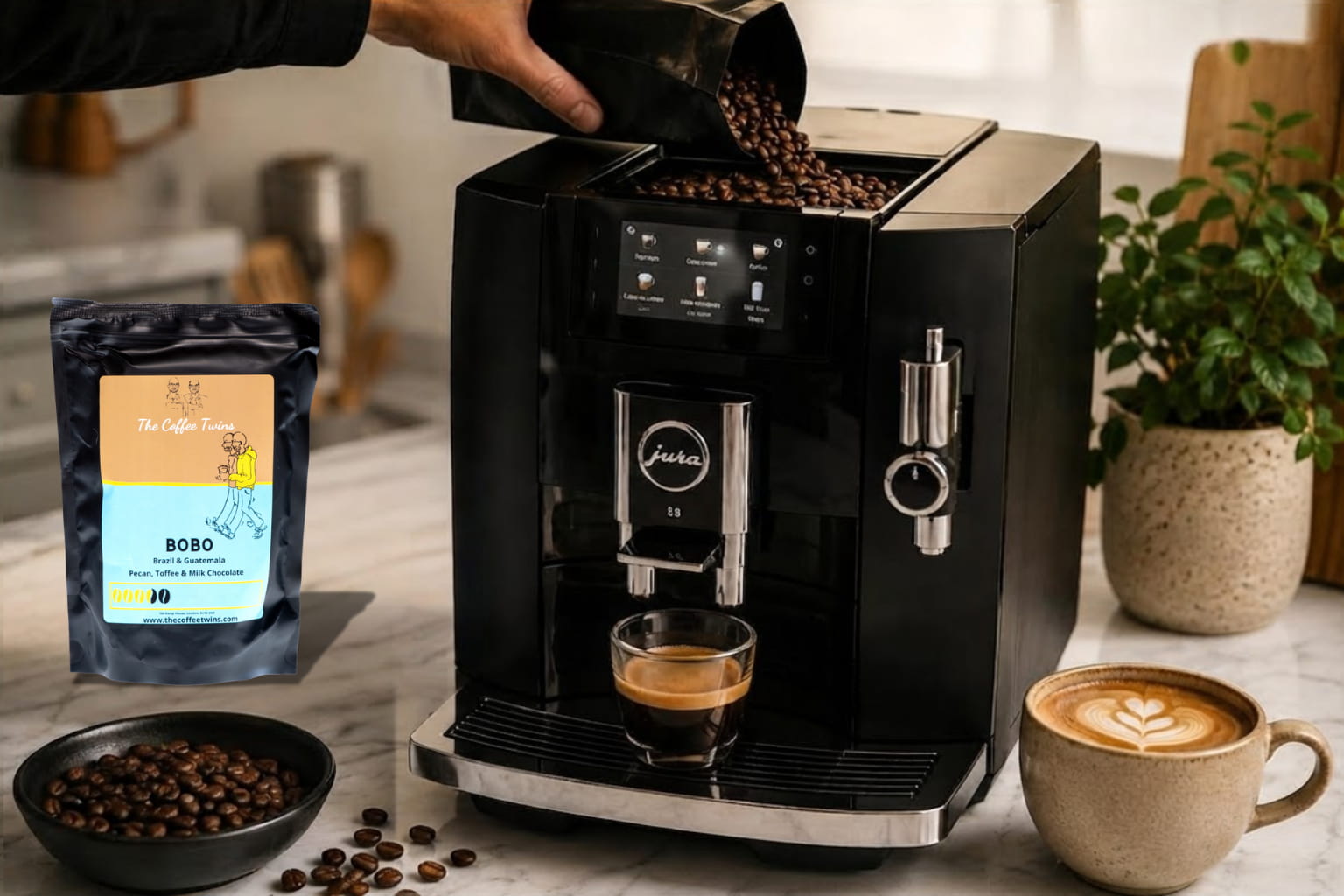
With so much milk, you need a coffee that can carry through dilution. As a result, our two strongest blends shine here: Audley for caramel and dark chocolate notes, or Ant for nougaty sweetness with baker’s chocolate. Furthermore, for oat milk lattes specifically, Bobo is the most milk-friendly option in our range.
For evening / decaf versions
All three drinks work brilliantly with our Hufflelump Swiss Water decaf — body 4/5, dark chocolate and nutty, 99.9% caffeine-free.
Frequently Asked Questions
What’s the main difference between a latte, cappuccino, and flat white?
All three contain the same double espresso shot. Specifically, the difference is in the milk: a latte uses the most milk (200ml+) with thin foam, a cappuccino uses equal espresso/milk/foam, and a flat white uses less milk (~120ml) with very thin microfoam. As a result, the flat white tastes most like coffee, the latte tastes most like milk, and the cappuccino is in between.
Which has more caffeine — a latte, cappuccino, or flat white?
All three contain the same amount of caffeine if made with a double shot — typically 120–160mg. Specifically, the milk volume doesn’t change the caffeine content, only the flavour intensity. Therefore, switching drinks doesn’t help you cut caffeine — switching to single-shot or decaf does.
Is a flat white stronger than a latte?
Yes, in flavour — but no, in caffeine. Specifically, a flat white has the same caffeine as a latte but tastes much stronger because it uses less milk. As a result, the espresso flavour is far more prominent in a flat white.
What’s the difference between a cappuccino and a flat white?
The cappuccino has equal parts espresso, steamed milk, and thick milk foam. By contrast, the flat white has more steamed milk and only a thin layer of glossy microfoam. As a result, the cappuccino feels airier and the flat white feels silkier.
Why does a flat white cost the same as a latte if it’s smaller?
Both use the same double espresso shot, which is the most expensive ingredient in a café drink. Specifically, the milk is the cheaper part. Therefore, café pricing reflects the espresso, not the milk volume. By the way, you’re not being overcharged for a flat white — you’re getting the same coffee in less milk.
Which is best for someone new to speciality coffee?
The latte is usually the gentlest introduction. Specifically, the milder, milkier profile is the easiest transition from supermarket coffee. Once you’re comfortable, work up to flat whites — that’s where you really start tasting the bean quality.
Can I make these drinks at home?
Absolutely. Specifically, you need an espresso source (espresso machine, moka pot, or strong AeroPress) and a way to texture milk (steam wand, milk frother, or jam jar shake). Furthermore, see our guides on making a flat white at home for the full method.
Where can I buy speciality coffee for milk-based drinks in the UK?
The Coffee Twins — we roast all our coffee in England. Specifically, our Bobo, Audley, Ant, and Hufflelump are all built for milk-based espresso drinks. £9.50–£10.50 / 250g. Furthermore, free UK shipping over £30. Use NEW10 for 10% off your first order.
Summary
Latte vs cappuccino vs flat white comes down to milk volume and foam thickness, not espresso strength. Specifically:
- Flat white: Smallest, most coffee-forward, glossy microfoam
- Cappuccino: Equal espresso/milk/foam, thick velvety foam, balanced
- Latte: Largest, milkiest, gentlest in flavour, thin foam
All three contain the same caffeine. Furthermore, the flat white is the strongest-tasting but lowest in calories. As a result, your choice depends on whether you want to taste the coffee (flat white), enjoy the foam texture (cappuccino), or have a milky, gentle drink (latte).
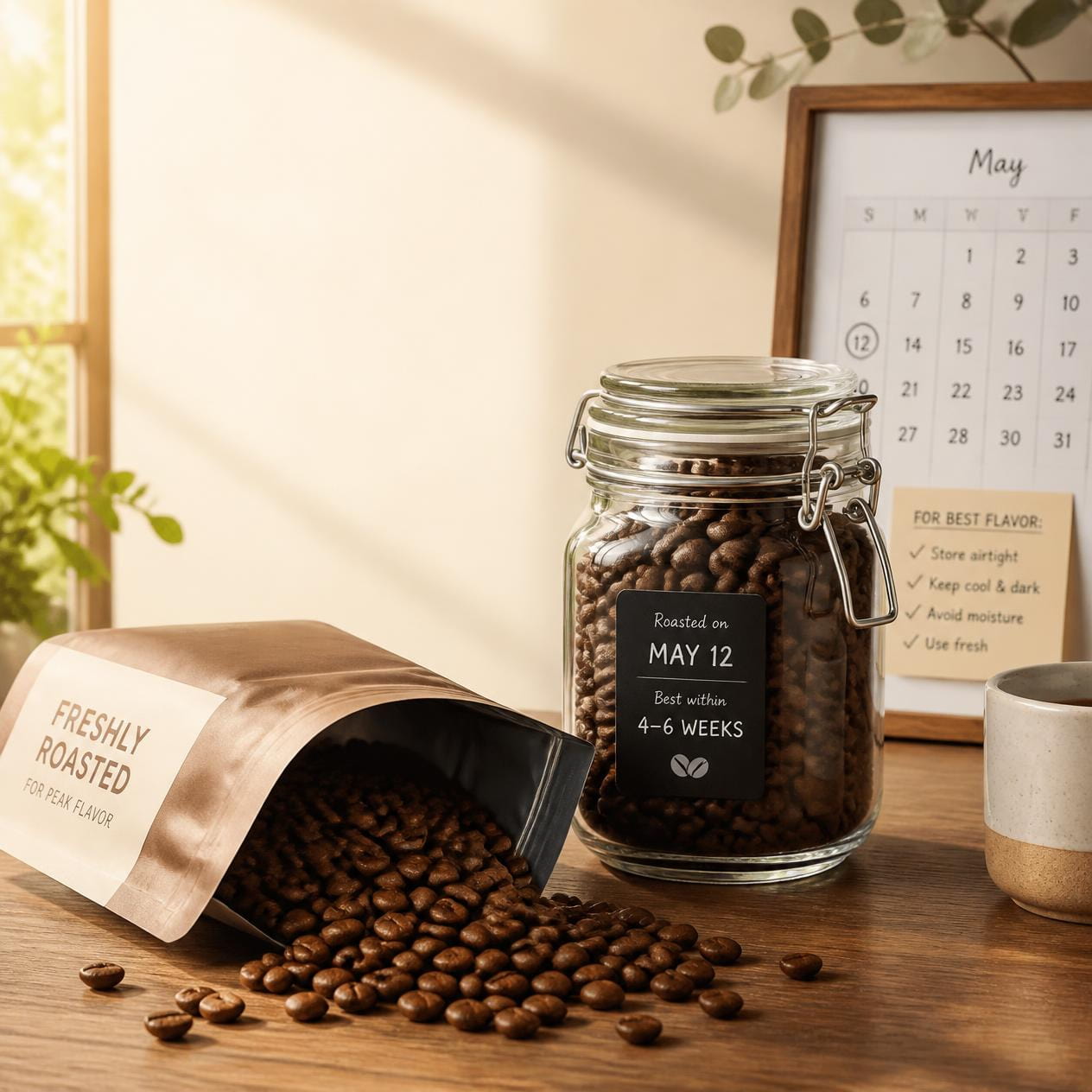
For all three, fresh speciality beans make a dramatic difference. Above all, our Bobo and Audley are built specifically for milk-based espresso. Free UK shipping over £30. Use NEW10 for 10% off your first order.
Shop Beans for Milk-Based Coffee →
0 Comments