Quick answer: Barista training in the UK sits in three tiers: free online courses like The Coffee Twins Academy (home barista fundamentals), in-person weekend courses from £150 to £450 (hands-on skills), and SCA-accredited programmes from £400 to £1,500+ (professional certification). The four skills every barista needs: espresso extraction, milk steaming, latte art, and tasting. You can learn the knowledge side at home in a few evenings; the physical skills take 30 to 90 days of real practice.
By Jeremiah and Raja, The Coffee Twins | Last reviewed 20 November 2026
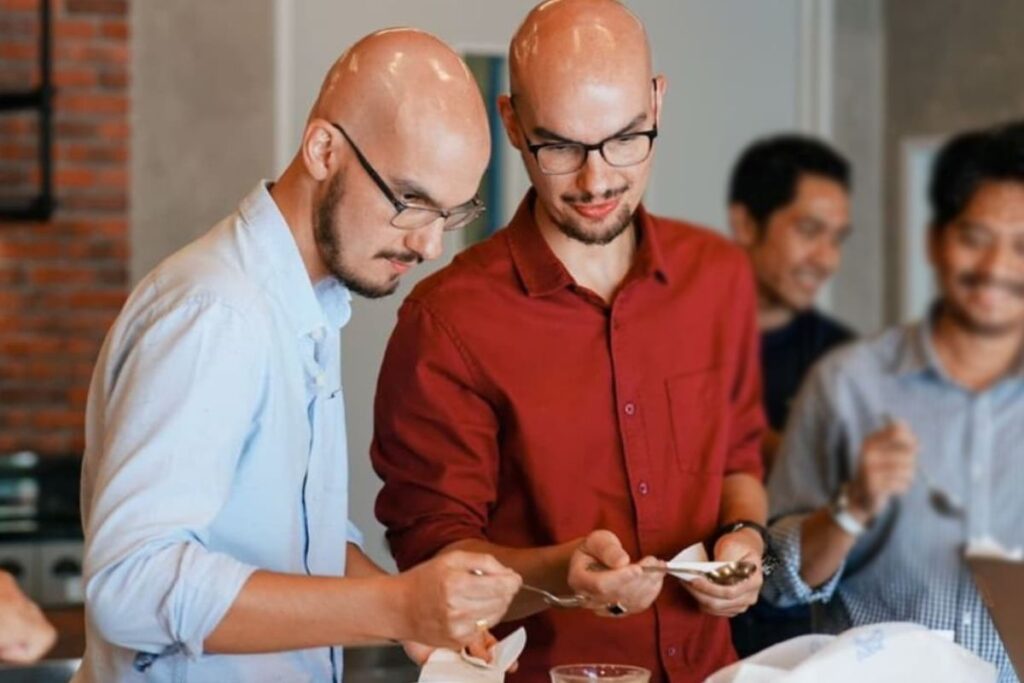
We came up through five-star hotel food and beverage, then ended up behind the bar at a specialty coffee shop in Farringdon, where people started calling us The Coffee Twins. Since then we’ve supplied coffee to Trafalgar St James and trained more hotel teams than we can count. Here’s the honest breakdown of what barista training actually teaches, where to learn in the UK, and what nobody tells you on the course page.
What skills does barista training actually teach?
Most people think “barista” means someone who makes coffee. In practice, the job is four separate skills working together.
Espresso extraction is the foundation. Everything else fails if the shot is wrong. A good shot uses an 18g to 20g dose of fresh coffee, pulls 36g to 40g of liquid espresso (a 1:2 ratio), and takes 25 to 30 seconds from the moment the pump starts. Faster than 25 seconds and the shot tastes sour; slower than 30 and it tastes bitter. You read the shot, adjust the grind, and pull again.
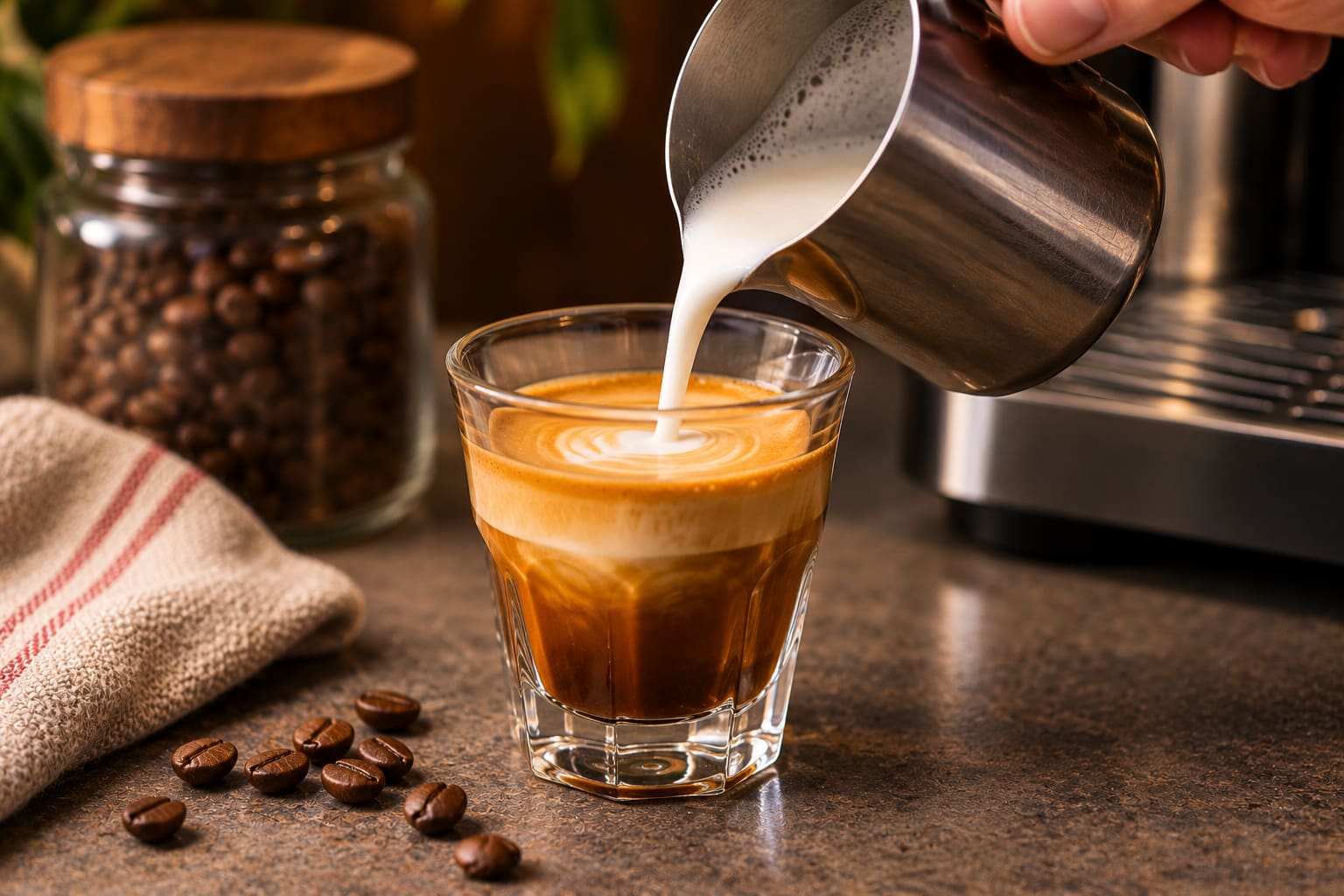
Milk steaming is where cafés separate from kitchens. The goal is microfoam: milk with thousands of tiny bubbles that look like wet paint, not the dry cappuccino foam from a 1990s Italian restaurant. You stretch the milk by holding the steam wand just below the surface for 3 seconds to incorporate air, then submerge it to spin the milk and heat it through to 55 to 65°C (130 to 150°F). Above 70°C (158°F) the milk tastes cooked and sweet notes disappear.
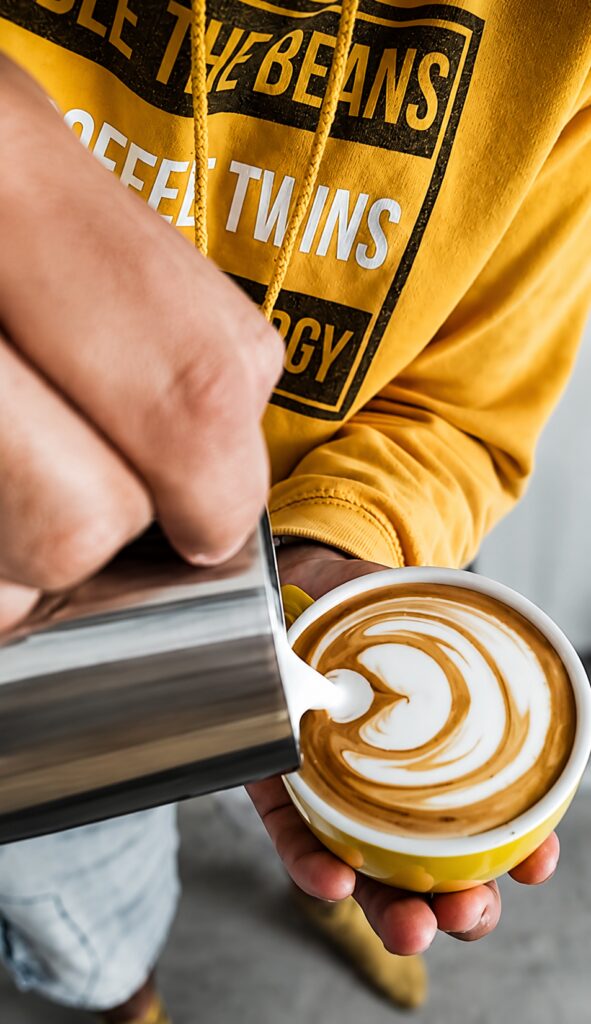
Latte art is the visible proof that your milk texture is right. If the pour makes shapes, your microfoam is good. Start high to break through the crema, then drop low for the last 30% of the pour to lay the pattern down. Hearts first, then rosettas, then tulips. The 30-day practice plan in The Coffee Twins Academy is built around this progression.
Tasting is the quiet skill that separates real baristas from lever-pullers. Using the SCA Flavour Wheel, baristas learn to identify origin notes (citrus from a washed Ethiopian, chocolate from a Brazilian natural), roast level by taste, and extraction faults like channelling or under-dosing. If you can’t taste the difference between a good and a bad shot, you can’t fix either.
How to train as a barista in the UK
There are three honest paths in the UK, and they suit different goals.
- Free online courses. Best for home baristas and anyone starting out. Build the knowledge and process side at your own pace. The Coffee Twins Academy covers the full home barista programme (10 courses, 20 modules, 201 lessons).
- In-person weekend courses. Best for hands-on skill building with a trainer watching. Short courses from £150 to £450. The feedback you get in person is where real technique gets built.
- SCA-accredited programmes. Best if you’re going professional or want qualifications employers recognise. The SCA Coffee Skills Programme covers Barista, Brewing, Green Coffee, Roasting, Sensory and Q Grader. Expect £400 to £1,500+ per module.
The smart order: start free, practise at home, then book an in-person course once your technique has a baseline. Trainers teach more per hour when you arrive already knowing what a correct extraction looks like.
How much does barista training cost?
UK barista training ranges from free to £1,500+ depending on format and certification.
- Free: The Coffee Twins Academy and Barista Hustle’s free content. Knowledge and process, self-paced.
- £150 to £250: Half-day and introductory one-day courses at London School of Coffee, Workshop and similar.
- £250 to £450: Full two-day or weekend barista courses with hands-on practice.
- £400 to £900: SCA Barista Skills Intermediate and Professional modules.
- £800 to £1,500+: Advanced SCA, Sensory, or Q Grader pathways for serious professionals.
If budget is tight, run the free courses first, practise on whatever machine you have, then pay for in-person feedback. A single afternoon with a good trainer, after a month of structured home practice, moves you further than a weekend course cold.
Can you train as a barista online?
Yes, for the knowledge and process side. No, if you think an online course alone will make you a working barista.
Online training is strongest for what we call the “why” of coffee: why does a shot taste sour at 20 seconds, why does milk taste cooked at 70°C, why does a light roast suit a V60 and not an espresso machine. That’s all learnable at home, free, through a structured programme.
What online training can’t replace is the physical side: the exact feel of tamping with 15kg of pressure, the wrist position for pouring a rosetta, the timing of a cappuccino against a flat white against an Americano in a 90-second service window. You build those by repeating them on a machine, with coffee, under some kind of pressure.
The practical approach: do the online knowledge first, then practise on your own equipment, then book in-person feedback before you start making coffee for other people’s money.
Is there a good coffee app for barista training?
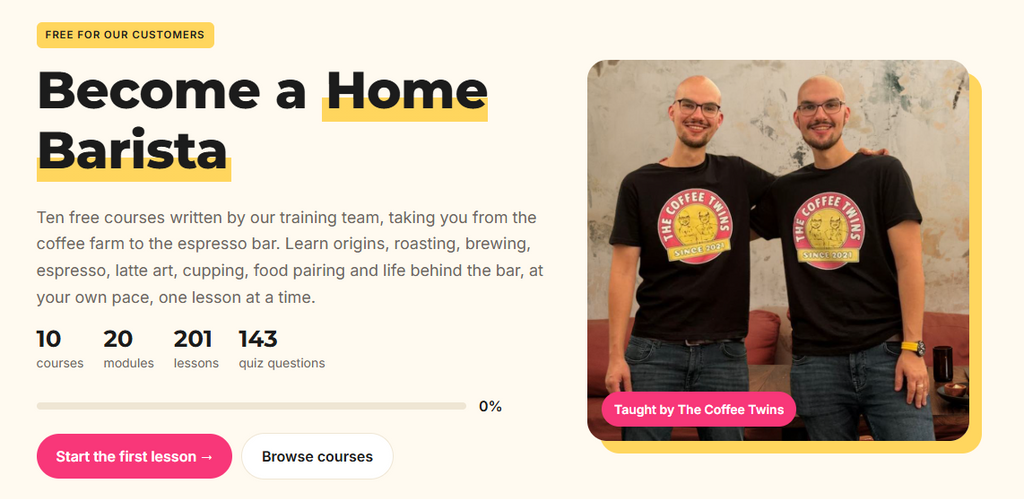
A few. Here’s the honest state of coffee apps in the UK right now.
- The Coffee Twins Academy is a progressive web app, so it works on any phone, tablet or laptop without App Store downloads. Free, structured, built for home baristas. Covers 10 courses from Coffee Origins through to The Professional Barista.
- Barista Hustle has a mobile app for its paid members. Deep, technical, built for people going pro.
- Brew Timer apps are useful for timing extractions and pour-overs but don’t teach anything structured.
- Coffee logbook apps like Filtru or Beanconqueror help you track recipes and bean notes.
If you’re looking for structured coffee training in app form, free, the Academy is the one we built to fill that gap. For dedicated professional progression, Barista Hustle is the paid gold standard.
How to practise barista skills at home
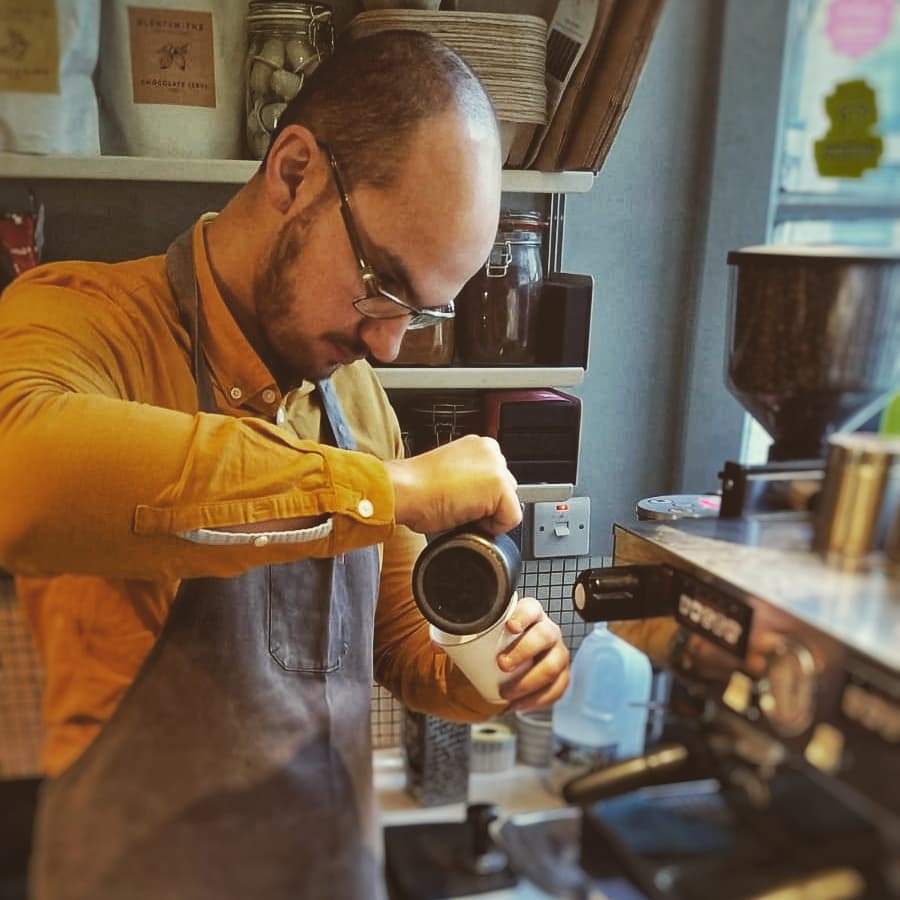
You need surprisingly little kit to practise properly. A grinder, an espresso machine (even an entry-level Sage Bambino, Gaggia Classic Pro or Rancilio Silvia), fresh beans within 4 weeks of roast date, and a milk jug. That’s it.
Set yourself a weekly practice rhythm:
- Monday: dial in a new bag of beans. Pull five shots. Record what changes when you grind finer or coarser.
- Wednesday: milk steaming only. No art yet. Just focus on getting the texture right.
- Friday: latte art. Pour 10 drinks (pour the milk out and reset if you need to). Aim for three solid hearts.
- Sunday: taste. Cup two different coffees black. Write down what you taste before reading the roaster’s notes.
The 30-day latte art practice plan inside Course 6 of the Academy is where most home baristas see the biggest jump. Nothing else moves the needle as fast as 30 consecutive days of pouring.
What makes a good UK barista course vs a bad one?
We’ve seen bad barista training cost £300 and leave people worse than when they started. Here’s what separates good from bad.
Good courses start with tasting. You cup coffee before you touch an espresso machine, because you need to know what you’re aiming for.
Good courses give you reps. You should pull at least 20 shots and steam at least 10 jugs of milk in a weekend course. Watching a trainer demo doesn’t teach your hands anything.
Good courses explain the why. If the trainer can’t tell you why the shot should be 25 to 30 seconds, they’ve memorised a recipe, not a skill.
Bad courses teach latte art first because it’s photogenic. Latte art without foundations is a rosetta on a bad shot.
Bad courses promise certification that no employer recognises. If you want a qualification on your CV, go SCA.
Frequently asked questions
How long does it take to become a barista?
The knowledge side takes 2 to 4 weeks of structured online study. Physical skills take 30 to 90 days of real daily practice. Working as a paid barista can start as early as a month in, though most cafés expect 2 to 3 weeks of on-the-job training before you serve customers unsupervised.
Do you need a qualification to be a barista in the UK?
No. UK baristas don’t need formal qualifications. However, SCA certification helps for specialty cafés, roasteries, and international hospitality roles. Most independent cafés hire on trial shift performance.
Is barista training worth it?
Yes, for anyone investing in home equipment (over £500) or working with coffee professionally. The fundamentals take 15 minutes to teach and transform every cup you make afterwards. Without training, most home baristas stop improving after month one.
Can you train as a barista online for free?
Yes. The Coffee Twins Academy covers the full home barista programme free. Barista Hustle offers free introductory content before its paid tiers. YouTube has useful individual videos but no structured progression.
What’s the best coffee app for barista training?
The Coffee Twins Academy for free structured training (web app on any device). Barista Hustle for paid professional progression. Brew timer apps for extraction timing only.
Do I need my own espresso machine to train?
Not for the knowledge side. Yes for the physical skills. Entry-level machines like the Sage Bambino or Gaggia Classic Pro are enough to practise home barista skills properly.
What’s the fastest way to improve as a barista?
Fix your grind first. 80% of bad home coffee is a grind that’s too coarse (shot runs too fast, tastes sour) or too fine (shot chokes, tastes bitter). Once the extraction is consistent, milk steaming is the next biggest win. Latte art is the last 10% of the skill, not the first.
Who runs The Coffee Twins Academy?
Jeremiah and Raja Wolstenholme, identical twins, co-founders of The Coffee Twins. Our background is five-star hotel food and beverage, then specialty coffee at a Farringdon shop. Since 2021 we’ve worked with a partner roastery in England, supplying hotels, cafés and home coffee drinkers across the UK.
Where to go next
If you want a free structured starting point, our Academy is online and takes two minutes to sign up for. If you want to brew along with the training, our Bobo is built for milk drinks and Audley is our morning espresso.
0 Comments