

Quick answer: The best coffee for a moka pot is a dark-roasted, full-bodied, low-acidity Arabica blend — built for the high-pressure stovetop extraction. Our pick is Ant — a rich Ethiopia, Indonesia and India espresso blend, body 5/5, with dark chocolate and smooth notes. £9.50 / 250g, free UK shipping over £30. Order as Espresso grind for moka pot brewing.
If you want to skip the guide: Buy Ant here →
Why trust this guide?

We’re Jeremiah and Raja — The Coffee Twins. We roast all our own coffee in England. Moka pots are how a lot of UK customers brew at home — they’re affordable, durable, and make properly strong coffee. This guide tells you which of our coffees we’d specifically reach for on the stove, and which we’d save for other brewers.
Table of contents
- What a moka pot actually does to coffee
- What to look for in moka pot coffee beans
- Top pick: Ant — built for moka pot brewing
- Runner-up 1: Audley (for classic Italian flavour)
- Runner-up 2: Komodo (for earthy, bold cups)
- Coffees we would NOT use in a moka pot
- The right grind size for a moka pot
- How to brew a perfect moka pot coffee
- FAQ
What a Moka Pot Actually Does to Coffee

The moka pot (also called a stovetop espresso maker or Bialetti) was invented in Italy in 1933 and has been a kitchen staple across Europe ever since. It works by forcing hot water under pressure through finely-ground coffee — somewhere between a French press and a proper espresso machine.
What this means for the cup:
- Strong, concentrated coffee — closer to espresso than filter coffee
- Full body and bold flavour — the pressure extracts heavily
- No paper filter — oils and fines come through, giving texture
- Punishes bright, acidic coffees — they taste sour and aggressive
- Rewards dark, full-bodied blends — they shine
The moka pot wasn’t designed for delicate light-roasted single origins. It was designed for Italian-style dark blends. Match the coffee to the brewer.
What to Look For in Moka Pot Coffee Beans

1. Roast level: medium to dark (3.5/5 or higher)
Darker roasts handle the moka pot’s pressure better. Light roasts tend to taste sour. Anything from roast 3.5/5 upward will work; 4/5 or higher is ideal.
2. Body: high (4/5 or 5/5)
The moka pot extracts heavily, so you want a coffee that has body to give. Thin coffees come out thin.
3. Acidity: low (2/5–3/5)
Pressure amplifies acidity. Coffees that taste bright in a V60 can taste sharp or sour through a moka pot. Stick to low-acidity coffees.
4. Tasting notes: chocolate, caramel, nut, spice
These notes hold up under pressure extraction. Fruit and floral notes get lost or distorted.
Top Pick: Ant — Built for Moka Pot Brewing

Origin: Ethiopia + Indonesia + India
Type: Three-origin espresso blend
Body: 5/5 (maximum) | Sweetness: 3/5 | Acidity: 3/5
Tasting notes: Dark chocolate, smooth, rich
Price: £9.50 / 250g
Order as: Espresso grind
Buy Ant →
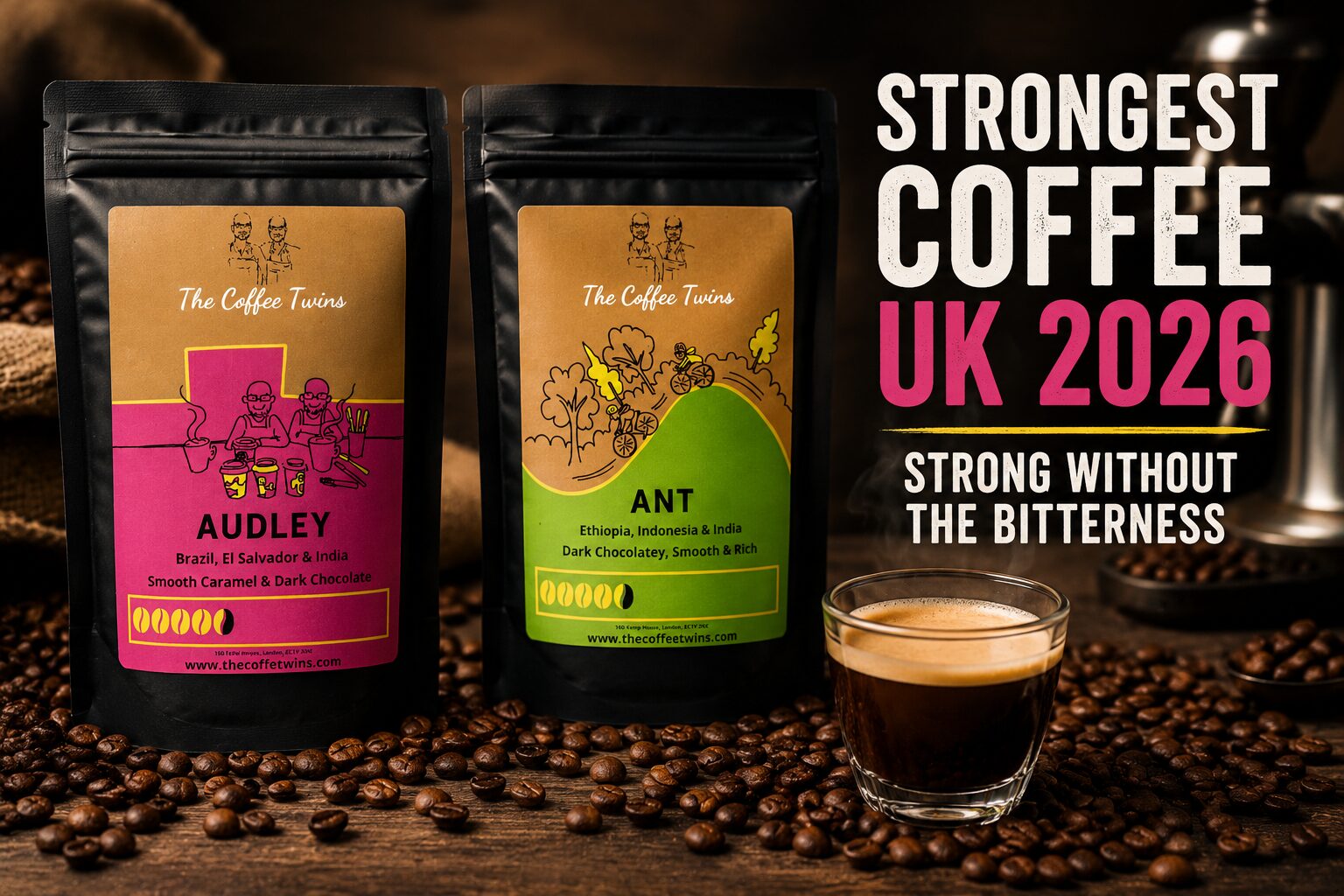
Ant is what we reach for when we make moka pot coffee at home. The bag describes it as “a rich espresso blend designed for those who prefer full bodied complex coffees, with bold flavours” — which is exactly the moka pot’s job description.
Through a moka pot, Ant delivers:
- Dark chocolate upfront — the Indonesian beans bring depth
- Smooth, rich middle — the Indian beans bring body
- A subtle lift in the finish — the Ethiopian beans keep it interesting
- A nougaty, baker’s chocolate quality when topped with milk
The combination of three origins gives Ant more complexity than a typical Italian dark blend, while still delivering the body and roast depth the moka pot needs.
Who Ant is for: Moka pot owners who want a properly strong cup that’s also interesting. Anyone making moka pot lattes or cappuccinos. People who find supermarket “espresso blends” bitter or one-dimensional.
Runner-Up 1: Audley — For Classic Italian Flavour
Origin: Brazil + El Salvador + India
Roast: 4.5/5 (our darkest) | Body: 5/5 | Acidity: 2/5
Tasting notes: Smooth, caramel, dark chocolate
Price: £9.50 / 250g
Buy Audley →
If you want a more classically Italian moka pot cup, Audley is the pick. Roast 4.5/5 — the darkest in our caffeinated range — with smooth caramel and dark chocolate notes. Acidity 2/5 keeps it gentle on the palate even under pressure extraction.
Where Ant is complex and three-dimensional, Audley is classically rich and roasty. Pick Audley if you want a moka pot cup that tastes like the one your Italian grandmother would have made.
Runner-Up 2: Komodo — For Earthy, Bold Cups
Origin: Indonesia, Sumatra (near Lake Toba)
Roast: 3.5/5 | Body: 5/5 | Acidity: 2/5
Tasting notes: Spicy, bold, tobacco
Price: £9.50 / 250g
Buy Komodo →
Komodo is our Sumatran single origin — Body 5/5, low acidity, with spicy, bold, tobacco notes. The traditional Giling Basah processing gives Komodo a thick, almost herbal character that comes through brilliantly under moka pot pressure.
This is the moka pot cup for cold winter mornings, drunk black. Earthy, intense, satisfying.

Coffees We Would NOT Use in a Moka Pot

The honesty section matters. Out of our eight coffees, three are not the right pick for a moka pot:
- Jojo (Ethiopian Limu, acidity 4/5) — beautiful on a V60, sour through a moka pot. The brightness that makes Jojo special gets harsh under pressure extraction.
- Parrot (Brazilian Cerrado single origin, roast 2.5/5) — light-roasted single origins generally don’t suit moka pots. Parrot is better in a cafetière, V60, or for cold brew.
- Little Robot (body 3/5) — too light-bodied for the moka pot’s pressure. The berry and vanilla notes get lost.
The pattern: light roasts, bright acidity, low body — all wrong for moka pots. If a coffee is sold as a “filter coffee” or “V60 coffee,” save it for those brewers.
The Right Grind Size for a Moka Pot
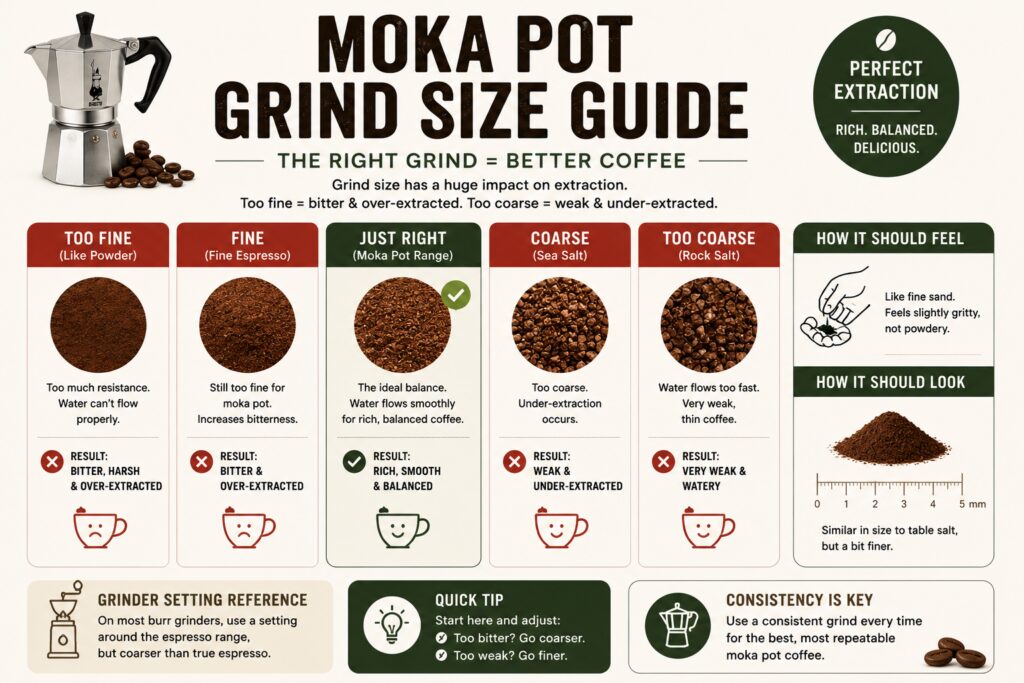
Fine grind — slightly coarser than true espresso, finer than filter coffee. Often called “moka pot grind” or “fine espresso grind.” If you order from us, select “Espresso” as the grind option and it’ll work perfectly.
Why it matters: too coarse and water rushes through, giving you weak coffee. Too fine and the moka pot can’t push water through at all, often causing the safety valve to release steam. Espresso grind is the sweet spot.
How to Brew a Perfect Moka Pot Coffee
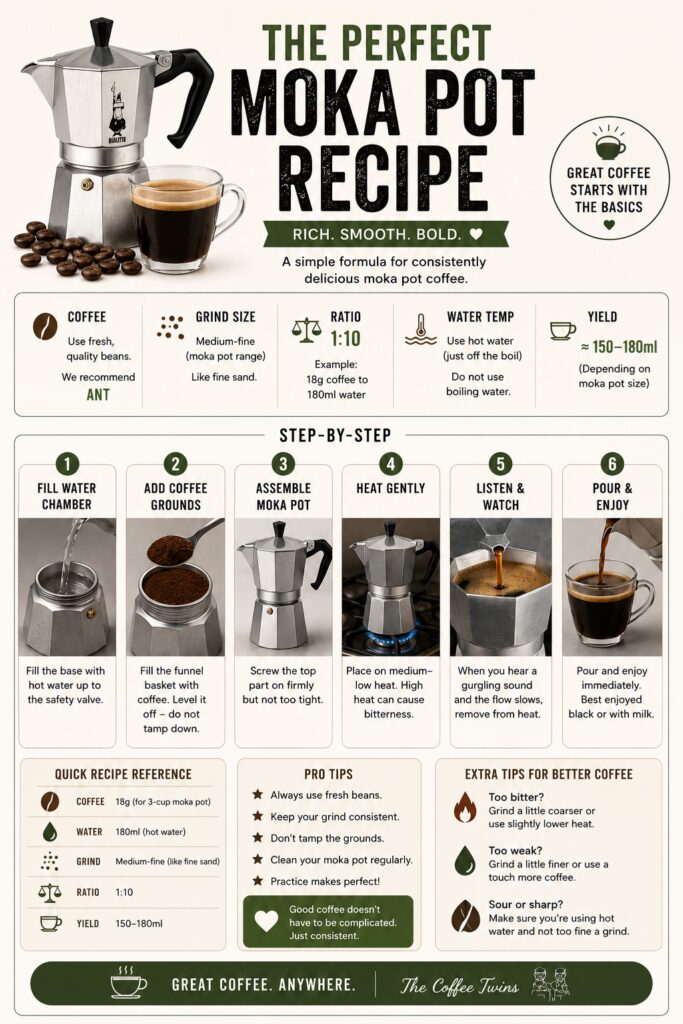
You’ll need:
- A moka pot (any size — common UK sizes are 3-cup and 6-cup)
- Ant coffee, ground for espresso
- Fresh, off-the-boil water
Method:
- Fill the bottom chamber with hot water up to the safety valve line. Using hot water (not cold) shortens the heating time and prevents the coffee from cooking on the stove.
- Add ground coffee to the basket. Fill it level — don’t tamp it down. Tamping causes excessive pressure.
- Screw the top on tightly. Use a tea towel or oven glove — the pot will be hot.
- Place on medium heat with the lid open. Watch the spout.
- When coffee starts gurgling out — wait until about 80% has come through, then take it off the heat and close the lid.
- Pour immediately. Don’t leave coffee sitting in a hot moka pot — it’ll over-extract and taste bitter.
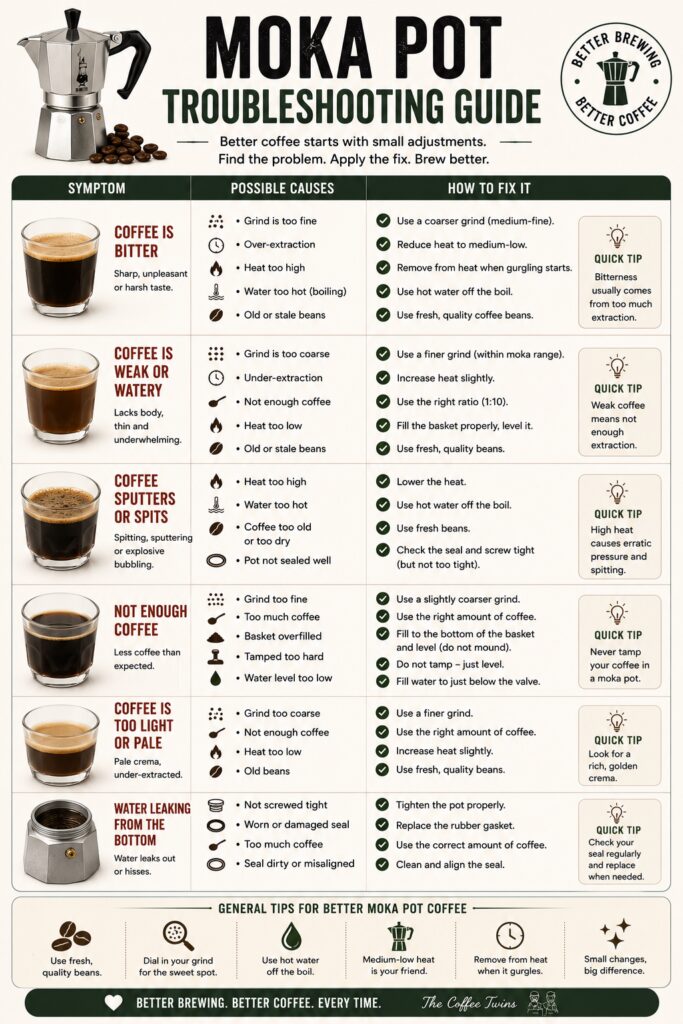
Troubleshooting:
- Coffee tastes bitter? Either the heat was too high (move to medium-low next time) or the coffee sat in the pot too long.
- Coffee tastes weak or watery? Grind finer, or use more coffee.
- Coffee won’t come through? Grind is too fine, or you tamped it. Loosen the bed.
- Steam coming from the safety valve? Take it off the heat immediately and check the grind — too fine is causing dangerous pressure buildup.
Frequently Asked Questions
What is the best coffee for a moka pot in the UK?
A dark-roasted, full-bodied, low-acidity Arabica blend. Our Ant blend (£9.50 / 250g) is body 5/5 with dark chocolate notes and is specifically built for espresso-style brewing including moka pots.
What grind do I need for a moka pot?
Fine — between espresso fineness and filter coffee. When ordering from us, select “Espresso” grind. If you have your own grinder, set it slightly coarser than your espresso setting.
Can I use espresso coffee in a moka pot?
Yes — espresso-roasted coffee at espresso grind is exactly what a moka pot is designed for. Most Italian moka pot users actually drink the same coffee they’d use in a proper espresso machine.
Is moka pot coffee espresso?
Not technically. True espresso is brewed at 9 bars of pressure; a moka pot generates around 1.5–2 bars. The result is somewhere between filter coffee and proper espresso — strong and concentrated, but not exactly the same thing.
Why does my moka pot coffee taste bitter?
Almost always one of three reasons: heat was too high (cook on medium, not full blast), coffee sat in the hot moka pot after brewing, or the grind was too fine. Lower the heat, pour immediately, and check your grind.
Can I make moka pot lattes?
Absolutely — moka pots are brilliant for milk drinks. Brew your moka pot, steam or froth milk separately, combine. Our Ant blend develops a “nougaty sweetness and baker’s chocolate” character in milk that’s particularly good in moka pot lattes.
What’s the best moka pot for UK home use?
The classic Bialetti Moka Express is the industry standard — durable, affordable (£20–£35 in UK retailers), and made in Italy since 1933. For induction hobs, the Bialetti Moka Induction or the Cuisinox Roma both work well.
Where can I buy moka pot coffee in the UK?
The Coffee Twins — we roast all our coffee in England, and our Ant blend is specifically built for moka pot and espresso brewing. £9.50 for 250g, order as “Espresso” grind. Free UK shipping over £30. Use NEW10 for 10% off your first order.
Summary
The best coffee for a moka pot in the UK is a dark-roasted, full-bodied, low-acidity Arabica blend. Our top pick is Ant (£9.50 / 250g) — body 5/5 with dark chocolate, smooth and rich. Runner-ups: Audley for classic Italian flavour, Komodo for earthy character.
Order as Espresso grind. Use hot water in the bottom chamber. Brew on medium heat. Pour immediately.
Avoid light-roasted single origins like Jojo or Parrot — save them for V60 or cafetière brewing.




0 Comments